
Society is what decides who’s sane and who isn’t. Loaded statement? Seems oddly accurate, all things considered. But if you’re ready to forget about the insane society in which we’re all presently attempting to survive and spend a couple of hours tucked away in the nice, sterile, padded safety of Nurse Ratched’s ward for the acute and chronic, self-proclaimed psycho-ceramics-the-crackpots-of-humanity, then Other Voices Theatre has just the show for you. One Flew Over the Cuckoo’s Nest, by Dale Wasserman (based on the novel by Ken Kessey) is live on their main stage both this weekend and next under the surefire direction of Tim Seltzer. Part humor, part darkness, and a great two-hours’ stage traffic, this production of One Flew Over The Cuckoo’s Nest is impressive and wholly engaging from start to finish.
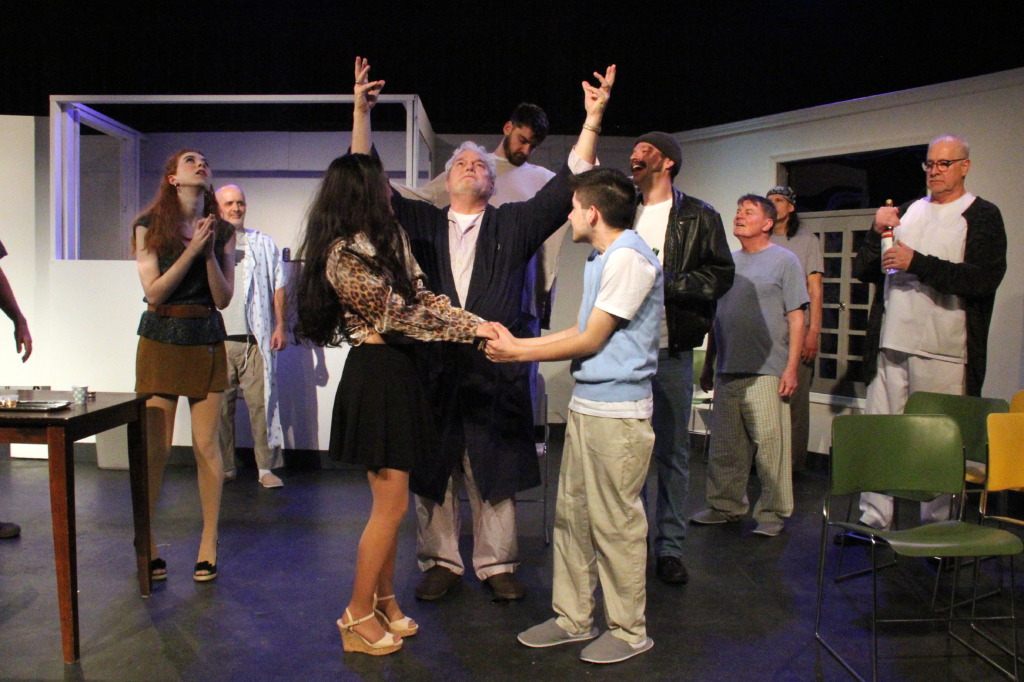
White walls, door to the supply closet, door to the dormitory, door to the shower, door to the nurse’s station with sliding glass, a locked door to the outside, and barred windows that are also locked. If that doesn’t scream ‘state-funded mental facility in October of 1970’, I don’t know what does. Cody James’ set design is deceptively simple and although James doesn’t make use of the second-tier built into OVT’s play space, there isn’t really a need for it. Despite the bright whiteness and overall sterility of the environment, James’ approach to the set helps to foster that claustrophobic essence that is an intrinsic part of the Cuckoo’s Nest experience.
Lighting and Sound Designers Stephen Knapp and Sean Stauffer collaborate with Director Tim Seltzer to bring the full experience of Cuckoo’s Nest to an almost immersive level. If you’ve only ever seen the movie, you’re in for somewhat of a surprise in the way certain characters are handled. At the top of the show and subsequently at most breaks between scenes— Chief Bromden, a character who is mute and deaf in the actual live-time performance, delivers his internal monologue as a soliloquy to the audience. Each time he’s bathed in a dim but tightly focused overhead spotlight whilst on the walls are projected a series of increasingly unsettling amorphous images. Could be waterfalls, could be electrostatic imagery, could be slides under a microscope. It’s very clear that Knapp and Seltzer’s intent is to ensure that you can’t tell what you’re looking at, which builds into the disquieting experience, augmented by Stauffer’s soundscape. Sometimes its off-kilter white noise, sometimes it sounds like water or out-of-joint electrostatic. Each occurrence increases in frequency, plunging the depths of unsettling, though it— like the direct parallel that it draws to Chief Bromden and McMurphy’s character growth— ebbs and flows after the third instance of its occurrence.
While this isn’t a “costume heavy” show, Lndsey Morris and Carter Kircher (of the two, Kircher is also responsible for the show’s properties design) desire a nod for their ‘sanitarium sartorial selection.’ Lots of basic white men’s undershorts. And those crisp, austere white nurses uniforms really give you that cloistered-in couture verve. They both get a well-deserved round of applause for McMurphy’s…surprise drawers…because those are just laughable and a delight to laugh at. Morris and Kircher also ensure that when Candy and Sandra show up to the asylum that they look like the groovy epitome of the outside ‘free-loving’ world and it creates a sharp, if not breathtaking, contrast to everything that is seen on the inside.
If there’s an issue to be had with the production from a technical standpoint it’s the overall projection of some of the actors on stage. This is mostly true for Dr. Spivey, occasionally Nurse Ratched. When they’re having heated moments or charged discussions you can hear them just fine, but there are moments, particularly when Ratched is attempting to show restraint, where her voice drops into that ‘televisual-severity-silence’ mode and it just doesn’t pick up on the drop mics. That aside, the show is well-paced, extremely emotionally balanced, and a really impressive attempt at taking a silver-screen icon and making it digestible for the stage.
Director Tim Seltzer does wonders with the pacing (and shoutout to Stage Manager Jeanne Lloyd), keeping moments moving from one to the next. He keeps the casting minimal. All too often in community theatre, particularly with a show like this, the temptation (whether the script allows for it or not) is to stuff the ensemble with ‘extra inmates.’ Seltzer avoids that, sticking with named characters only and the experience is more deeply enriching and fulfilling because of it. There’s something more raw about Seltzer’s approach to the production as well. For a lack of better wording and verbiage with which to explain it— all of the characters feel deeply exposed; as if the audience were seeing the best and the worst of them all at once. This makes for an unusual case, particularly with Ratched, as you get her with more human emotions than one might expect. He makes her almost vulnerable, though it’s still easy enough to loathe the way she treats the inmates on her ward. And in Seltzer’s attempt to find these raw humanized attributes, particularly in Ratched the audience is presented with a great moment of fascinating conundrum. In the fight scene (shout out to Intimacy & Fight Coordinator Miranda Troutman), the exchange between Ratched and McMurphy is jaw-dropping because of the way Seltzer directs it. And I’m not saying it’s the wrong choice— it actually works well for the breed of Ratched and overall approach he’s taken with the characters— but brings to mind the “Who shot first?” Star Wars debate, wherein the answer should always be Han. (Spoiler— that may not be the case here in Seltzer’s production.)

Seltzer does a sensational job of finding exciting, talented, eager individuals for each role in the production. “The Others” (literally listed that way in the program for the show), are Rebecca Apgar as Candy Starr and Caroline Watson as Sandra, are the living, breathing epitome of 70’s free-love. They have the patois and cadence of those ‘like whoa man’ hippies when they talk and they just ease their way into the ward like it’s their candy store. Apgar doubles up as Nurse Flinn, showcasing her versatility as a performer. For as free-wheeling as Apgar’s Candy Starr character is, is as buttoned-up and closed off as her Nurse Flinn character is. The look of abject unease and total terror when it comes to interacting with the patients when she’s playing Nurse Flinn is truly priceless.
Marcus Kersey Jr. and Richard Johnson, playing Aide Warren & Aide Williams, respectively, showcase some of the brutality that was unfortunately all too commonplace inside facilities like that ward for that time period. You see it best at the top of the show when the ‘action’ starts and they’re shoving Chief Bromden around. You’ve also got Ron Terbush playing the delightfully drunken Aide Turkle, whose gait is unsteady with the sway of alcoholism and whose reactions during the ‘party scene’ are really amusing to observe. And while Steve Lloyd’s Dr. Spivey may be difficult to hear at times, his overall jovial natura, particularly when it comes to cutting up and joking around with McMurphy are a warming, positive balance, to the otherwise negative and strict vibe that Ratched tries to keep in place on the ward.
The Patients are an impressive bunch as well. There’s something about the way they exist as a unit— as if they’ve taken Seltzer’s direction of “have fun with it, be free, play together,” to heart and really run off the cliff with it. Even Ruckley (Nate Apgar) who says very little…(three very inappropriate words!)…feels like an integral part of the band-of-merry-madmen. Watch Apgar, who spends most of his time being nailed to the wall or posing as the occasional basketball hoop, and you’ll find a fascinating case study in the mechanics of catatonic confusion. He’s got wildly animated eyes as he gets shuffled and shifted all around, which enhances the depth of his character. The same can be said for Martini (Bob Causer), though less so because of his animated eyes and more so because of the conviction with which he stares off at— well, things only the character can see. Cheswick (Tom Semmes) and Scanlon (Leon Gray III) are of a similar nature, invested in the quirks of their respective characters, whilst still falling in line with the group dynamic.
Kerr Lockhart’s Dale Harding is the self-proclaimed ‘chief looney’ or whatever particularly phraseology McMurphy throws at him upon arrival. Lockhart has a delicate balance of flamboyance and sensitivity in addition to gusto and a little hint of chutzpah in his portrayal. His interactions vary from person to person though watching the dynamic shift, and ultimately grow into a bond, with McMurphy is truly remarkable and feels authentic in a way that does not disrupt the script.
One of the most impressive performances in the production comes from Jayden Perez playing Billy Bibbit. The stutter is so natural, the internalization of the character’s mental distresses is so inherently physical— with the dedicated commitment to the hunched shoulders, the drooped head, the clutching, twitching fingers, it’s very satisfying to watch his portrayal of Billy because it feels so authentic. The moment when Perez’s Bibbit finds his spine and the stuttering stammer falls away and the confidence blossoms in him times ten is so breathtakingly beautiful, it’s that much harder to watch the instant that it’s crushed and he collapses— emotionally and physically— like the scared and tortured child that Billy Bibbit is. Perez is an excellent example of a dynamic, multi-dimensional character portrayal.

The other astonishing performance in this production comes from theatrical first-timer Joe Gaines (Choctaw and a traditional Indigenous drummer, singer, educator, and activist for social justice & human rights.) The way Gaines portrays Chief Bromden is gut-punching, heart-wrenching, and utterly extraordinary. The vast versatility in the way he commands a stage presence is nothing short of remarkable. The raw and unabashed fear and anger and resentment that Gaines channels into the character’s soliloquys is beautifully brutal and tragically beautiful; it makes you think, it makes you feel. Watching the interplay and relationship burgeon and blossom between him and McMurphy is its own brand of wonderful, particularly as the show winds down to its rather dramatic conclusion. You can feel those moments of struggle; Gaines gives the audience reasons in spades to empathize and sympathize with his character. And when he’s chanting in a native tongue at the very end of the show before a very intentional action, it’s simultaneously freeing and harrowing to behold.
McMurphy (Todd Mazzie) and Nurse Ratched (Lia Seltzer), it’s difficult to label them as protagonist and antagonist as— particularly in Tim Seltzer’s vision— they each serve as one to the other. (And honestly, the focal point of Seltzer’s production seems to almost be more slanted to Chief Bromden’s narrative and that’s a really beautiful and fascinating hot take on the show.) Mazzie is genuine. A genuine pain in Ratched’s ass. Seltzer is unrelenting. An unrelenting force for McMurphy to reckon with. Mazzie and Seltzer are each doing their own unique approach to the characters; it’s refreshing. You’re still getting the wild-eyed, defiant, wise-cracking jackass of a character from Mazzie when it comes to McMurphy but he’s more earnest somehow, more present, particularly in his interactions with Chief Bromden. And there are still notes and glacial tones of frosty detachment from Seltzer’s Ratched but she’s much more acutely aware of her human emotions, letting them surface in spurts and bouts like a leaky geyser, which makes for a compelling watch, particularly when she storms back into the ward after busting up the party with her shocking news. That scene is unbearable enough (even if you don’t know what’s coming) but the emotional burst with which she delivers it feels a little like being prepared for a blow only to have the whole building collapse on top of you. The pair square off perfectly, biting and sniping at one another with equal weighted blows, making the whole experience a rich one for all the theatergoers in the audience.
One flew east and one flew west…get your tickets to see One Flew Over The Cuckoo’s Nest at Other Voices Theatre before this production flies the coop, as it were.
Running Time: Approximately 2 hours and 30 minutes with one intermission
One Flew Over the Cuckoo’s Nest plays through March 9th 2025 with Other Voices Theatre Other Voices Theatre at The Performance Factory— 244-B South Jefferson Street in Frederick, MD. Tickets are available by calling the box office at (301) 662-3722 or by purchasing them in advance online.