author: Charles Boyington & Steven Kirkpatrick
What happens when the timeless music of Tchaikovsky meets the infectious energy of hip-hop? The answer is The Hip Hop Nutcracker, an imaginative and thoroughly entertaining reworking of a beloved holiday classic. While the production retains much of Tchaikovsky’s familiar score, virtually everything else has been reinvented. With contemporary choreography, vibrant storytelling, and a fresh visual aesthetic, this production introduces a new generation to a familiar musical masterpiece while inviting traditional ballet audiences to experience it in an entirely different way.
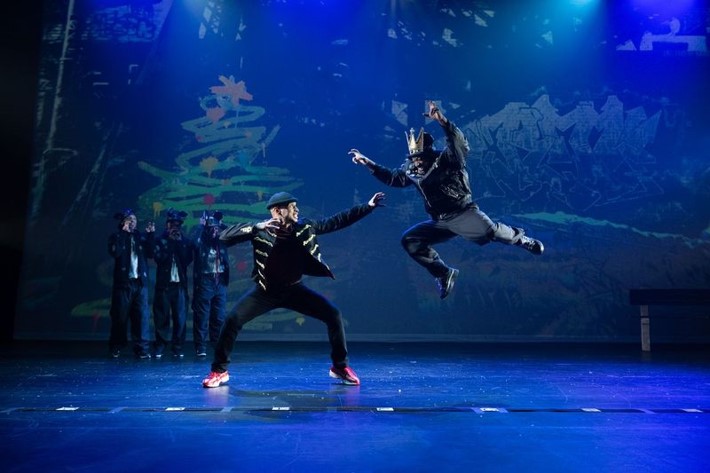
Set in modern-day New York City, the story follows a young woman, Maria-Clara, who finds herself caught between her bickering parents. Seeking an escape from their constant disagreements, she encounters a mysterious nut seller and embarks on an extraordinary adventure involving giant rats, dancing toys, and a journey through time. Directed and choreographed by Tony and Olivier Award-nominated Jennifer Weber, with a reimagined story by writer and co-creator Mike Fitelson, the production transforms the traditional Nutcracker narrative into something decidedly contemporary. Fitelson’s digital scenery adds another dimension to the storytelling, helping transport the audience between different worlds and eras.
The evening begins with an energetic opening set from the remarkable Shawntee Harris, better known as “Da Brat.” As the first female rapper to achieve platinum status, she brings considerable star power to the stage, warming up the audience with her original music and unmistakable style. Her appearance also serves an important purpose: introducing audiences who may be unfamiliar with hip-hop performance to the celebratory atmosphere that defines this production.
Following a final countdown, Tchaikovsky’s familiar music fills the theatre, accompanied by live mixing from Performance DJ Boo and live violin performances by the exceptionally talented Marissa Licata. Licata is one of the evening’s standout performers. Every time she appears onstage, she commands attention, adding a wonderful live musical element that bridges the classical and contemporary worlds at the heart of the production.
The visual design is equally effective. Sets, lighting, and costumes combine to create a monochromatic vision of New York’s streets. Although largely devoid of color, this world is anything but devoid of life or joy. Movement and dance are everywhere, establishing the production’s energetic atmosphere from the outset.
We meet Maria-Clara, played with considerable charm by Jazmyn Thomas, walking with her parents, portrayed by Akari Morimoto and Iron Bryan. Their personalities are immediately apparent. Her mother is eager to relax and enjoy herself, while her father is considerably more reserved and uptight. Their constant bickering leaves Maria-Clara thoroughly unimpressed, and she soon sets off in search of adventure on her own.
That adventure begins when she encounters a nut seller known as “The Nutcracker,” played by Douglas “Trunkz” Peña. He is charming and well-intentioned, although his dancing abilities leave something to be desired. Fortunately, a pair of magical red shoes mysteriously drops from a lamppost, transforming him instantly into a dancer. This proves particularly useful when he finds himself facing off against New York’s giant dancing rats.
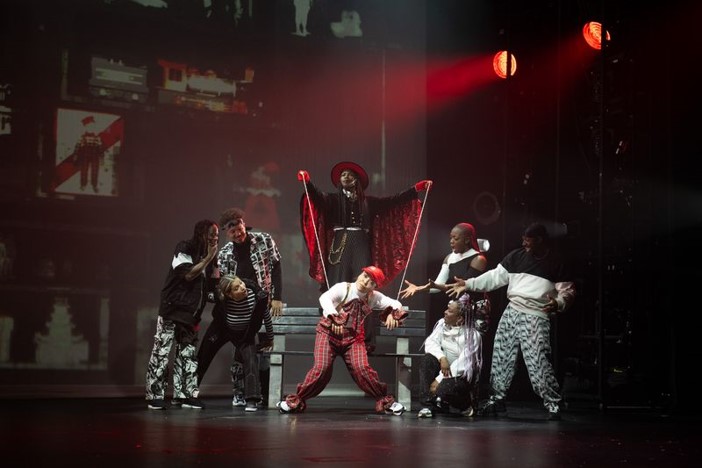
The adventure continues at a magical toy store run by Drosselmeyer, played by De’Leah Coleman. Sporting a distinctive red cape, Drosselmeyer clearly occupies a position of some importance! With an assortment of enchanted toys and a little theatrical magic, Drosselmeyer guides Maria-Clara and the Nutcracker on a journey that eventually takes them back to the 1990s via a New York subway ride.
Here, the production undergoes a striking transformation. The previously muted color palette gives way to a much more vibrant world, and the pair encounter a special candy store inspired by the era’s pop culture, including a nod to the familiar Urkel character. More importantly, they discover Maria-Clara’s parents as young people, just beginning their relationship. We learn that both shared a love of dancing, but what initially attracted her mother to her father was not his ability to show off on the dance floor. It was that he danced with her, making her the center of his attention.
Armed with this important discovery, Maria-Clara and the Nutcracker return to the present, where the world itself seems brighter and more colorful. Together, they set out to remind her parents of what brought them together in the first place.
The storyline may differ considerably from the traditional Nutcracker, but that is precisely the point. This is a story designed to connect with a contemporary audience, and it succeeds admirably. After all, the original Nutcracker was not a centuries-old tradition when it first appeared; it was a new work that spoke to the audiences of its own time. Reinvention is part of the creative process, and this production embraces that spirit wholeheartedly.
Perhaps its greatest achievement is its ability to bridge cultural and musical boundaries. Hip-hop enthusiasts may not necessarily be familiar with Tchaikovsky, just as traditional classical music audiences may have limited exposure to hip-hop. Here, however, the two traditions coexist remarkably well. Rather than competing, they complement one another, demonstrating that great music and dance can transcend genre, generation, and cultural expectations.
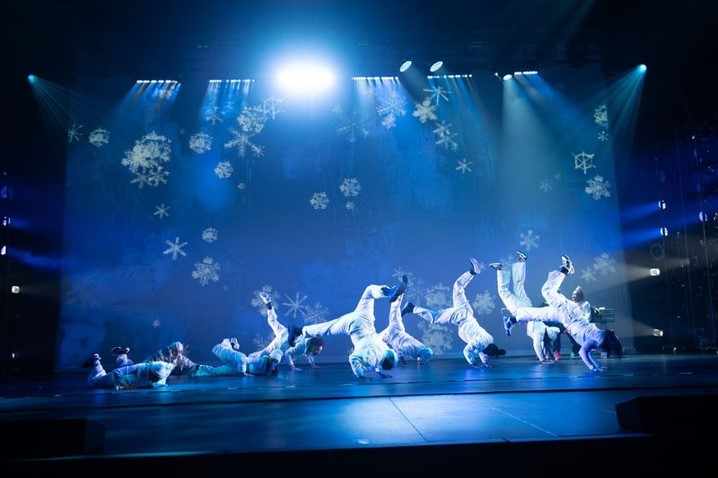
The performances are consistently engaging. Jazmyn Thomas brings warmth and an endearing sincerity to Maria-Clara, making her character’s emotions and motivations easy to understand. Douglas “Trunkz” Peña is an absolute delight as the Nutcracker, bringing infectious enthusiasm, an irresistible smile, and, once those magical shoes arrive, some impressive dancing. The chemistry between the two is particularly evident during their duets, which provide some of the evening’s most enjoyable moments.
Akari Morimoto and Iron Bryan are equally convincing as Maria-Clara’s parents, effortlessly portraying both their older and younger selves. Bryan, in particular, provides several of the production’s funniest moments, making excellent use of his character’s somewhat rigid personality.
The ensemble deserves considerable credit. It is evident that an enormous amount of work has gone into perfecting the choreography and making the demanding dance sequences appear effortless. More importantly, the performers seem to be having as much fun as the audience. Their enthusiasm is infectious, and the sheer joy radiating from the stage becomes one of the production’s most appealing qualities.
The Hip Hop Nutcracker is a lively, inventive, and welcome reinterpretation of a familiar classic. It may not be the Nutcracker that traditionalists expect, but it offers something equally worthwhile: a reminder that beloved stories and music need not remain frozen in time. Traditions can evolve, new audiences can discover old favorites, and sometimes all it takes is a fresh beat and a pair of magical red shoes.
If you have the opportunity to catch this limited engagement at the National Theatre, don’t miss it. It’s time to give your holiday traditions a hip-hop makeover!
Running Time: Approximately 2 hours with one intermission
The Hip Hop Nutcracker plays through November 22nd 2026 with Broadway at The National— 1321 Pennsylvania Ave NW, Washington, DC 20004. For tickets call the box office at (202) 628-6161 or purchase them online.