author: Chris Pence
The Sounds of Silence: Variations on Silence at Rapid Lemon Productions
“Hello darkness, my old friend / I’ve come to talk with you again / Because a vision softly creeping / Left its seeds while I was sleeping / And the vision that was planted in my brain / Still remains / Within the sound of silence.” Is silence truly just the absence of sound, or something more? What consequences can arise from silence? And which from a lack of silence? Rapid Lemon Productions, supported in part by the Maryland State Arts Council, delve into the meaning of silence in Variations on Silence, Baltimore’s 22nd annual ten-minute play festival. With theming determined by last year’s “Variations” audience, the festival showcases twelve ten-minute plays by local authors, all examining the depths of silence. Janis Hannon directs a superb cast of only six actors who embody almost fifty distinct roles with precision unrivaled in community theatre.
Entering the theatre, guests are welcomed with 70’s punk music, a deliberate illustration on a variation of silence, “the opposite of silence,” according to Rapid Lemon founder Max Garner. The production features a dark, sparse set, using flats, furniture, and props to transform the small space into various offices, living rooms, and other locations. Stage Manager Jackie Glenn conducts set changes expertly, bringing to life Steve Sawicki’s minimalistic and powerful set designs, making the space unique for each play. Each play is also accompanied with a stylized projection of title and author’s name, as well as sound cues of popular songs that address the concept of silence. Max Garner’s audio-visual design heightens emotions, as well as signals audiences when a play has ended, allowing audiences to appreciate each play on its own. While most of the plays don’t require much in the realm of costuming besides street clothing, Tim Clark’s costume design sees each actor in new clothes for every character. This trait, coupled with the actors’ incomparable proficiency, develops individual characterizations for each play, ensuring that each section stands on its own merits, and gives the audience twelve different experiences, as opposed to one experience of twelve different scenes.
At the top of the show, Colin Tillery’s The Void’s Had Enough of Your Noise opens on an office dedicated to scream therapy, run by the painfully cheery yet wholly uncaring MacKenzie (Cat Bustos). Jordan (Steven Forrester), an anxiety-ridden young man, enters to partake in MacKenzie’s services, an uproariously true portrait of nervousness. Following MacKenzie’s treatment allowing Jordan to scream into The Void, the personified entity of The Void enters. Dressed in black and white clown garb, Caleb Madison’s Void is very Grinchy, a sardonic being tired of hearing the many screams of MacKenzie’s clients. Despite The Void’s objections, MacKenzie refuses to halt the business, leading The Void to invite his sister, Abbie, to visit with MacKenzie’s patients. Abbie (ReginaGinaG), short for Abyss, introduces a darkness into the stage, swearing “stare into me, I stare back,” entrancing MacKenzie and her clients, as well as the audience. ReginaGinaG’s Abbie is the Heath Ledger to Madison’s Jack Nicholson, each a startling view of psychopathy that can hardly be compared.
Following Abbie’s spinetingling threats, the stage is reset, and so begins Things Unsaid, by Regan Marie Nelson. Ben (Steven Forrester) and Stephanie (Alexys Adams) wait impatiently in a hospital waiting room on news about their father’s emergency heart surgery following a heart attack. Forrester’s Ben talks nonstop, doing everything he can to avoid addressing his concerns about his father. Through painful reminiscence, the siblings share their regrets about not talking to their father, swearing to get closer should their father recover. All too real, the performance leaves the audience wondering about their own loved ones, and the many things left unsaid between families.
Next in the lineup is Can You Hear Me Now? by Wendy Matt, a post-apocalyptic story about two unlikely friends trying to find other survivors following a deadly virus. Jae Jones and Caleb Madison pair like peanut butter and jelly as Chris and Patrick, who are recording their story in the hopes that they may find others. Chris (Madison), the young “slacker,” struggles to come to terms with the loss of his friends, while Patrick (Jones), an older, wiser man, blames himself for the awkward silence left following the death and disappearance of the rest of humanity. When Chris leaves out of stress, Patrick is left completely alone to debate the “sound of one man speaking,” Jones delivering a stark reminder of how deafening silence truly can be.
Gabe Fremuth’s Voicemail is the next offering, finding Cat Bustos a spotlight performance amidst all the silence. Bustos takes the stage alone as Phyllis, a woman torn apart from her family due to political differences. Her brother Joe, voiced by Steven Forrester, calls to leave Phyllis a voicemail offering his forgiveness and understanding despite their differences, only to leave the phone recording as he debates with his wife, Sally (ReginaGinaG), whether Phyllis deserves mercy for her views. Bustos speaks volumes with few lines, relying primarily on body language to show Phyllis’ regret and longing for her family. Her startling performance gives the audience pause to wonder if political views are reason enough to cut family ties.
Appropriately enough, the next play in the lineup is one about family dynamics as well, Moving In by Allison Chen. The play peeks in on a close-knit family playing charades the night before their two children (Caleb Madison and Alexys Adams) are set to move into college, leaving Mom and Dad (Jae Jones, ReginaGinaG) as empty nesters. The family most come to terms with the college separation, never having experienced life so far away from each other before. While Adams’ character isn’t packed and ready to go, Madison’s character is, and taunts her with competence only a true sibling can provide. Their characters’ rivalry is as real as a hug accompanied by a wet willie. To the actors’ credit, they are all terrible at charades, or at least they act it well. This adds a sense of reality to the characters, as well as a closeness to the family that really nails the point home (or to college, I suppose).
Wrapping up the first act of the show is Taylor Leigh Lamb’s Body Language, a meet-cute that almost doesn’t happen because of apprehension. Out on the town at a silent disco, Ty (Steven Forrester) is overwhelmed by social anxiety, as well as all the typical woes of adult life. Alex (Cat Bustos) tries to calm him down by encouraging Ty to just have fun and ask someone to dance. As Ty spots a beautiful woman in the crowd, Jade (Alexys Adams), he tries to approach her, overcoming that universal fear of talking to the opposite sex. This piece sets a great tone leading into the intermission, ending on a high note, with the entire cast silently writing to the unheard beat. The musical imagery of the play is masterful, with Ty (and the audience) not hearing the music until he has the courage to speak to Jade, and taking a second to be sure that he and Jade are literally dancing to the same tune before he begins to open up to her.
Following a brief intermission, the audience is welcomed back with a brief but jarring reminder of the danger of silence with On Hold by Douglass E. Smith Jr. The play lasts for less than five minutes, but says more in that time than most plays say in three hours. The entire cast contributes their talents to the piece, which sees a man lose electricity due to poverty, a woman denied benefits despite her family’s desperate need, and a man arrested in the street for no reason other than his race and economic status. In each scenario, passersby just watch, offering no assistance at all. Said Dante, “The hottest places in hell are reserved for those who in times of great moral crisis maintain their neutrality.” Methinks Dante would have greatly appreciated this piece, and Rapid Lemon’s interpretation.
Fluttering into the space after On Hold is Save the Monarchs, by Tia Nellie. The piece follows the friendship of two women who bond over one’s caterpillar collection, as well as much more. When the caterpillars meet an unfortunate fate due to a third woman’s carelessness, the ladies realize that there’s much more transformation going on than just the butterflies. Alexys Adams and Cat Bustos lead the piece, doing their best to communicate without stepping on each other’s toes. A comment about the diversity of her Barbie dolls makes Bustos’ character seem a little too eager to please, making things even more awkward, though it’s clear how much She cares for Adams. The situation comes to a head with ReginaGinaG’s entrance as an unknown love interest (and grim reaper for the poor caterpillars). ReginaGinaG nearly steals the show with her desperate attempts to save the injured caterpillars, including offering them CPR, the audience guffawing. (NOTE: No caterpillars were hurt in the performance of this piece. And even if there were, ReginaGinaG would have it covered 😉 ).
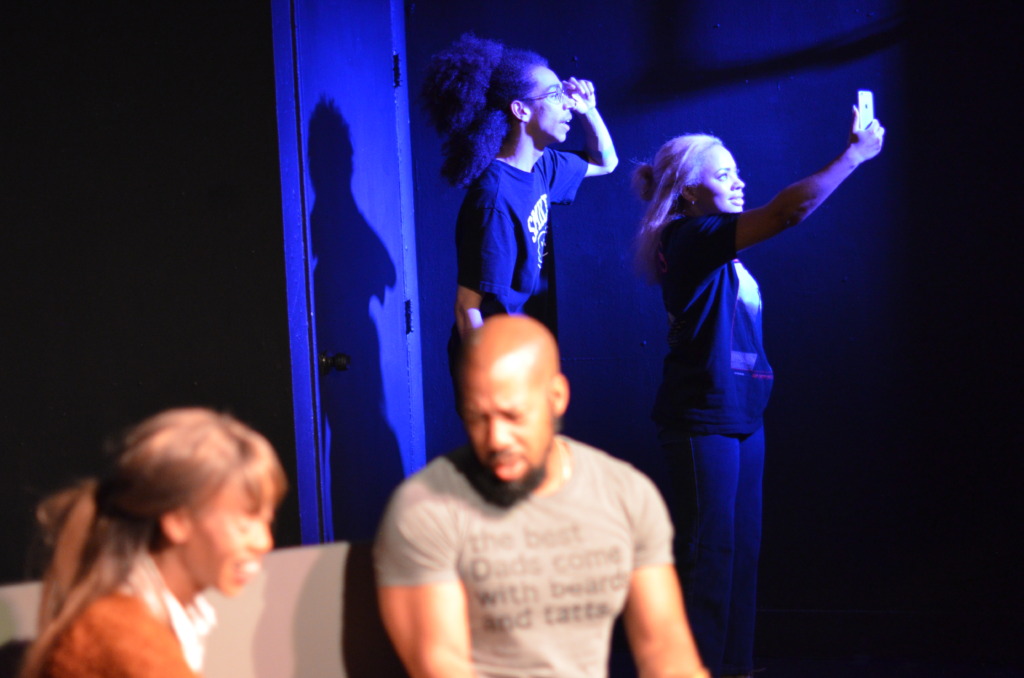
Yanking the spotlight back towards himself is Caleb Madison in Who Cares? by Alfonso Morales-Escobar. Madison’s Character is in no rush to say what needs to be said, a sassy, flamboyant representation of the audience’s conscience. No Jiminy Cricket, this conscience has had enough, taking a break to sip wine before accosting the audience for every decision they’ve left up to their conscience. Madison leaves the stage with a sashay, the audience feeling strangely guilty, as well as rather turned on.
With the theme of Silence, the cast must defer to the truest experts in the subject: Mimes! Dark Matter Department of Community Services by Deborah Carry-Amland sees two friends at restaurant, one talking incessantly (ReginaGinaG), the other listening silently (Cat Bustos). While ReginaGinaG has more lines than anyone in the scene (or probably in the entire production, for that matter), the true stars of this play are the servers, who present as mimes. Jae Jones and Steven Forrester, decked in the classic black and white shirts and white gloves, do their best to get the women’s attention, only to be ignored and talked over by ReginaGinaG. After some frustration, the servers find that they have an inhuman ability to halt sound with a simple gesture, and adjust speech and attitudes with their mute motions. Jones and Forrester have evidently done some tutoring with Marcel Marceau, because their actions certainly speak much louder than words, and tell the entire story without nary a sound. If their careers as actors with RLP don’t go as expected, they can take solace in knowing that there’s always an invisible box in which to get trapped somewhere in Paris.
Waiting for You by Mae Philippe-Auguste brings the audience back to reality with a thud that can be felt throughout the theatre. Alexys Adams and Cat Bustos star as a doomed couple debating their relationship as their line of communication frays to the point of breaking. Adams’ character wants just a few moments of quiet to come to terms with her thoughts, while Bustos sees the silence as an indication that something must be wrong. Adams and Bustos’ performance feels painfully accurate, reminding us that, while communication is key to any relationship, sometimes the lack of communication speaks just as loud.
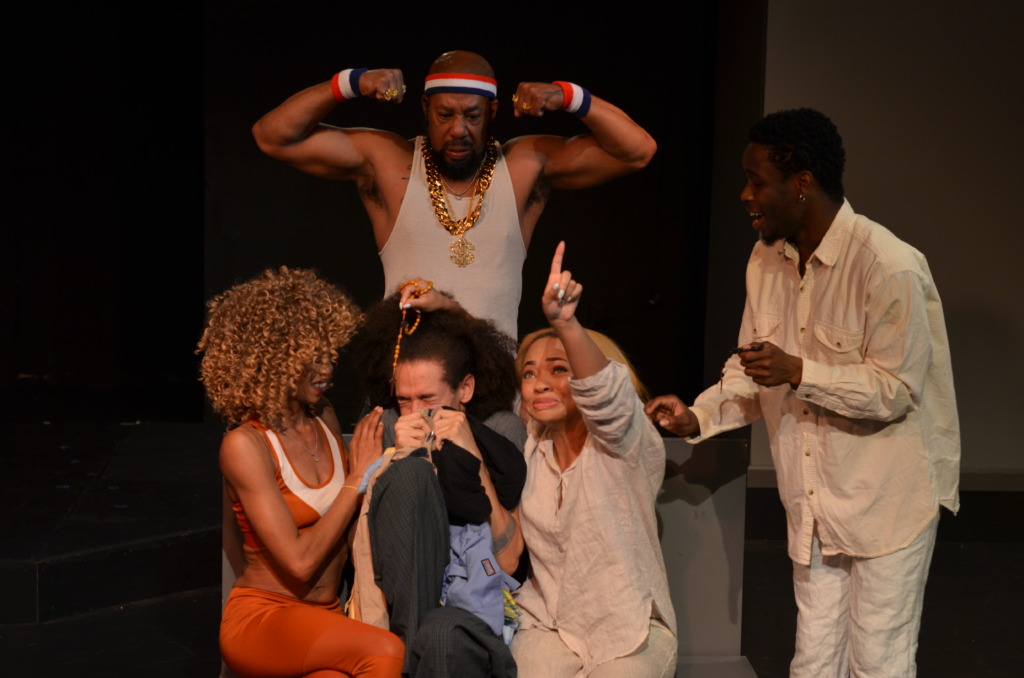
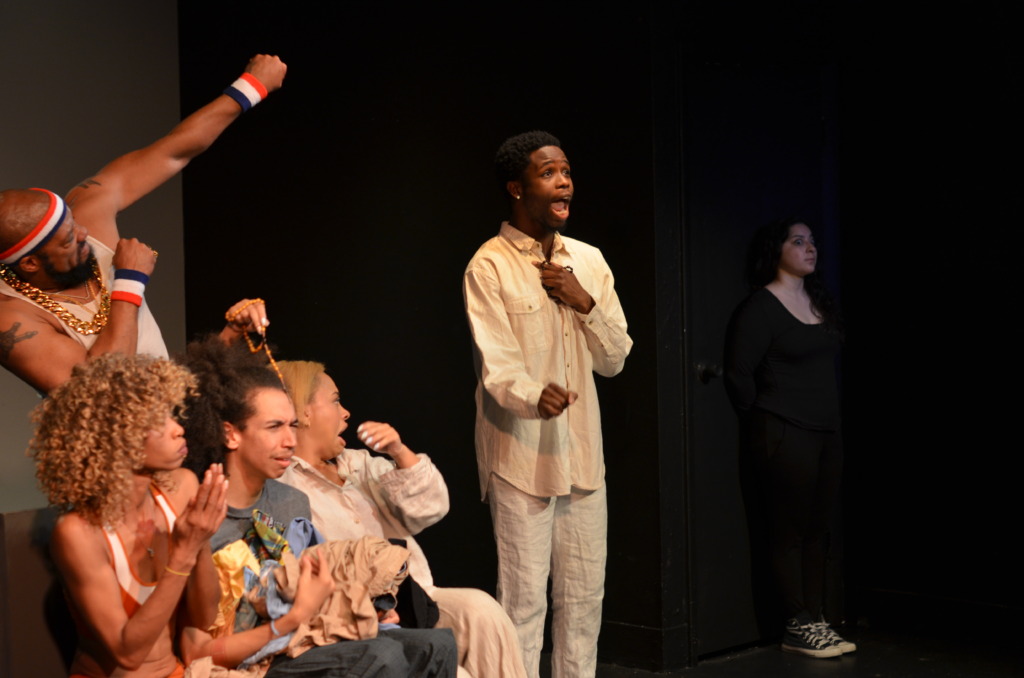
Rounding out the evening is Gus by Natasha Joyce & Martin Thompson, featuring the entire cast. Gus (Caleb Madison) is a young man who is still in the process of finding himself. While doing some chores, he starts searching the internet for advice, landing on three contrasting videos encouraging him to follow different paths. As members of an unnamed church, Steven Forrester and Alexys Adams encourage Gus to follow the path of religion, while Strongman Jae Jones belittles Gus’ lack of action, and naturalist ReginaGinaG suggests following Mother Earth to enlightenment. As their advice starts overlapping and assaulting Gus, he eventually cries out, unable to take their ceaseless harassment anymore. He resigns to find his path without these posers, asking Alexa (Cat Bustos) for the production’s outro music to finish the show. ReginaGinaG, Forrester, Adams, and Jones outdo themselves here, embracing laughable stereotypes to show the shallowness of much of the self-help world.
While each actor in this production deserves great praise, ReginaGinaG and Caleb Madison deserve special mention for their characterizations of their various roles. ReginaGinaG somehow manages to go from a demented clown to a loving, middle-aged mother, to a thirty-something lover, and everything in between. Her control of her wide range of roles is impressive, making her nearly unrecognizable and fresh in every scene. Madison exhibits much the same control, though from a completely different standpoint. Minus a few outliers, Madison’s roles all share many of the same traits, making it easy to slack off on their development. Madison does the exact opposite, taking time and care to develop each of his roles into distinct individuals, a feat that few actors can do effectively with one role, let alone seven!
Whether it’s shouted from the rooftops, or whispered into a friend’s ear, there’s not enough praise for Rapid Lemon Productions’ Variations on Silence; it’s everything that a short play festival should be, with excellent direction, impressive staging, and the perfect cast. Here’s wishing RLP great success with this production, and the Variations series, especially next year when they receive a certain reviewer’s submission for the next festival… 🙂 Be sure you speak up and get your tickets before this divine production becomes nothing more than a cherished whisper.
Running Time: 2 hours and 15 minutes with one intermission
Variations on Silence plays as a Rapid Lemon Productions’ show through July 26th 2026 at Strand Theater— 4526 Harford Road in the Lauraville-Hamilton neighborhood of Baltimore City, MD 21214. Tickets are available at the door or in advance online.