author: Erin Tarpley
“She has no ideas or wishes of her own at all: where you put her, there she stays”
I am remiss to admit, that before this weekend I had never heard of the brilliant Madame Germaine de Staël; but then, this was one of the objectives for the initiative “Expand the Cannon” as their {We Happy Few} mission “uncovers and uplifts classic plays by women & underrepresented genders – and is a call to action to produce them.”
Having experienced Parisian life both before and after the French Revolution, and then later exiled from Paris by the notorious Napoleon Bonaparte, Madame de Staël spent much of her mature adult life traveling Europe and expanding both her own philosophy and social reach from England, to Italy, Russia, and Germany. Written during her exile from France in 1811, The Mannequin centers on a classic comedic trope of examining marrying for love vs status with a sense of humor.

Our story’s patriarch, Monsieur Morlière (played by Andrew Quilpa), is a member of a French refugee family living in Berlin who is absolutely obsessed with all things French. Desperate to maintain a connection to his beloved ancestral homeland, he arranges a marriage for his bright, independent daughter Sophie (played by Gill Rydholm) to the French aristocrat, Count de Ville (Em German), who is less an idealistic lover and instead the walking epitome of vanity and mortification for any woman bound to him. Unsurprisingly, Sophie is repulsed by the prospect of marrying de Ville, and would much rather marry the sincere and modest, yet well-born, German painter Frederich (Esteban Marmolejo-Suarez). Recognizing that the Count is entirely incapable of listening to anyone but himself, Sophie hatches a delightfully absurd scheme: she intends to prove that her would-be-suitor would literally be unable to tell the difference between a living, breathing woman and a dressed-up mannequin. What follows is a ridiculous, sharp-tongued interrogation of marital autonomy, cultural snobbery, and the superficiality of high society.
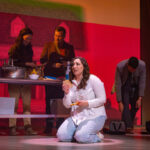
As the protagonistic bride-to-be, Gill Rydholm anchors the production with a light and agreeable demeanor as she also brilliantly enacts the role of “grand chess master” to the actions and reactions of the other characters on stage. While seemingly demure, Sophie masterfully operates several moves ahead of everyone else in the room as a way to control her own agency in a world that provides her sex little. Rydholm does well to play this seemingly innocent damsel who orchestrates the desires and ego of both her father and undesired groom.
Opposite Rydholm, Em German’s Count de Ville is an absolute caricature of comedic vanity. German embodies the character’s toxic self-absorption with a hilarious physical commitment—preening, posturing, and floating across the stage as if the entire universe were a mirror reflecting his own perfection.
Andrew Quilpa provides a highly energetic performance as Monsieur Morlière, capturing the desperate, tragi-comedic yearning of an exile clinging to a romanticized dream of France. Born in Germany, but raised on the stories of his Grandfather’s life in France, Quilpa wonderfully plays his accent balanced so as to display his focused desire to speak French fluently (although, do not worry, he is very much speaking English for this production!), while subtly sliding into a slight German accent when feeling too comfortable or too anxious. While subtle, this was a very deliberate character choice that conveyed the internal turmoil of Monsieur Morlière’s natural upbringing in Germany warring with his fantastical dreams to embody a homeland he has never visited.
Meanwhile, Esteban Marmolejo-Suarez brings a charming, grounded “boy next door” sincerity to Frederich. Though his contemporary warmth occasionally clashes with the rigid 1811 period setting, it provides a vital, endearing contrast to the Count’s cold demanor setting him up as the clear winner of Sophie’s affections.
Lastly, the mannequin (titular, but uncredited) does a “stand up” job at performing a charming character that could so easily be played as “stiff.” Even in those moments when she is meant to “fall apart,” she “holds herself together” and seems to “speak” a thousand words through her blank, yet “stationary” posture.
Directed by Kerry McGee, this production allows the text and the actors’ physicality to do the heavy lifting. Jon Reynolds’ scenic design is elegantly sparse through a clean, curtained cyclorama punctuated by a few select furniture pieces which allows the audience to feel more a part of an intimate salon more akin to Madame de Staël’s world. Wendy Snow Walker’s costume design does a lovely job of evoking the Regency era, dressing Sophie in a simple empire-waisted gown and her silent “double” in a fashionable bonnet and shoulder-length gloves, emphasizing the visual irony at the play’s core.
While the actors and production team have done a resplendent job in breathing this production to life, what distinguishes The Mannequin from many social satires is its compassion. Madame de Staël does not merely mock vanity or aristocratic superficiality; she understands the vulnerabilities that produce them. Her characters are not villains but casualties of systems that reward appearance over interior life. This nuance prevents the play from becoming didactic, and instead, unfolds as a study of people trapped within roles they no longer know how to escape.
In an age where it is all too easy to select a contemporary or more well-known piece, We Happy Few has selected to perform a piece lesser-known, but none-the-less humorous and well-deserved of more attention. Ultimately, The Mannequin is much more than a historical curiosity; it is a remarkably forward-thinking piece of feminist theater. Written in a time where her own daughter was of marrying age, Madame de Staël saw a future where women possessed true agency, and she used the canvas of farce to sketch it out. By rescuing this work from obscurity, We Happy Few has given audiences a production that balances genuine historical weight with outright silliness. It is a sharp and thoroughly entertaining reminder that wit has always been a radical act.
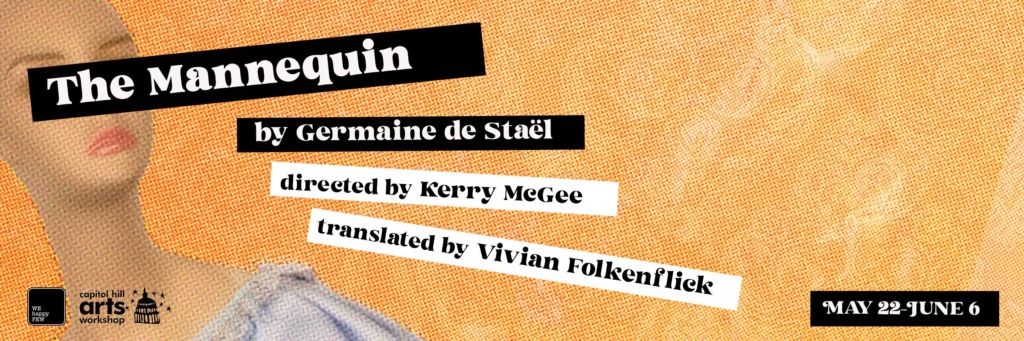
Playing now through June 6th at the Capitol Hill Arts Workshop (CHAW), do not sleep on this one! Seize this opportunity to expand your exposure to Nineteenth Century French rom-coms and be sure to catch The Mannequin before it is too late!
Running Time: Approximately 1 hour, with no intermission.
The Mannequin plays through June 6th 2026 with We Happy Few at the Capitol Hill Arts Workshop— 545 7th St SE, Washington, DC. For tickets call the box office at (202) 547-6839 or purchase them online.