
Some people build fences to keep people out. Other people build fences to keep people in. A powerful statement to be sure; an evocative thought that primes the mind for the emotional journey that is August Wilson’s Fences. Produced at Chesapeake Shakespeare Company as a part of the multi-year, city-wide Baltimore August Wilson Celebration, this striking production is a theatrical pleasure, inviting audiences into the intimate details of day-to-day life in the backyard of the Maxson home in Pittsburgh, Pennsylvania in 1957. Directed by Reginald L. Douglas, this gripping tale— the sixth in the August Wilson Century Cycle— explores the sorrows and the joys, delivering them in equal measure for the life experience of a black family in the late 50’s in east-coast America.
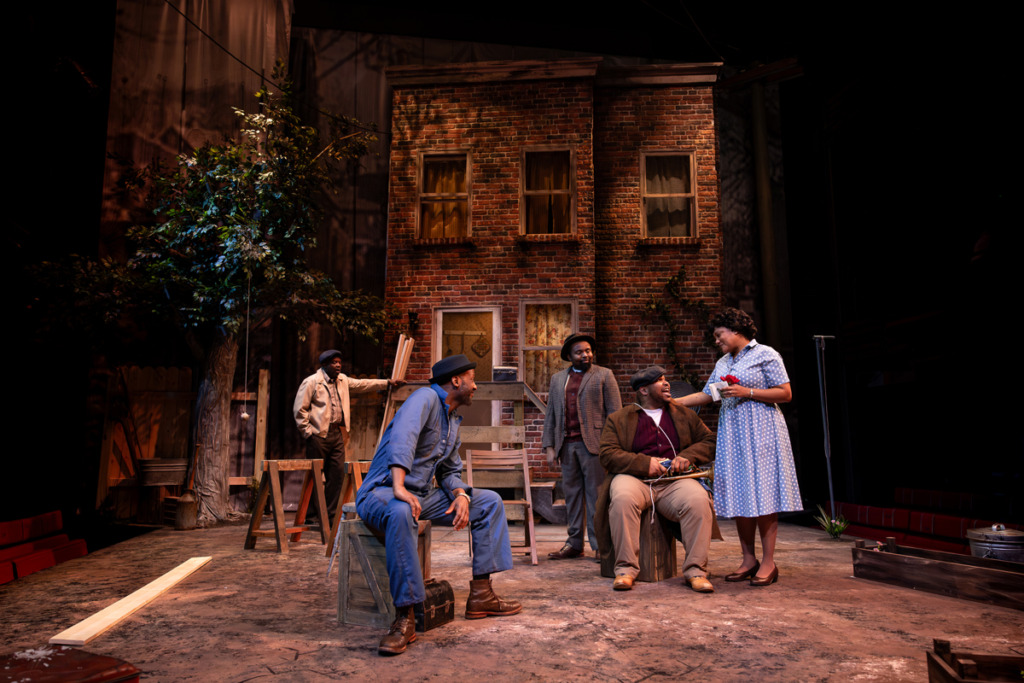
There’s a reason that Fences is often considered August Wilson’s finest play, if not his most prolifically produced; it’s story is extraordinary. And the production team at Chesapeake Shakespeare Company has outdone themselves with their rendition of it. Timothy Jones’ set design is breathtaking simplicity incarnate. There isn’t anything overly opulent or decadent about the backyard of brick house in a Pittsburgh neighborhood and yet Jones’ approach to the sweeping set gives you the grand sense of space. Devil’s in the details with the way the windows are built up to hide the structural balconies of the CSC stage (and yet effortlessly utilized, though not until the end of the performance) and the illusion that house goes inward and upward. It’s picturesque while still captivating the essence of economic circumstance and timestamps the period appropriately. Everything from the tree with the ‘rag-ball’ hanging from it right down to the meticulously line garden boxes creates this perfect scenery for the play’s action. And kudos are most definitely owed to Properties Artisan Isabel deCarvalho (or Technical Director Dan O’Brien) for the ‘fence boards.’ They saw apart brilliantly and the effect of seeing them in action is note and praiseworthy.
Tying together the show’s aesthetic is costume designer Cidney Forkpah. There is a delicate, appreciative beauty in the ordinary clothing seen on these characters. The trash-collector jumpsuits, whilst bearing the distressed marks of the trade, are still crisp and appear to be cared for with respect. You see these uniforms juxtaposed against the simple but tasteful and again, lovingly cared-for, house dresses featured on Rose and it just instills this sense of pride for these characters in what they own. Lyons’ suit is another piece— nothing too fancy but again something that sets his character’s path apart from the others that surround him. Forkpah has taken the ordinary, the basic, the mundane, and made it beautiful in a way that augments the existence of the characters in their story without overshadowing it or detracting from it.
Malory Hartman’s lighting and Chris Lane’s soundscape have a similar effect on the production. Hartman’s effects are most keenly felt as a scene draws to a close, lingering in that subdued darkness that reflects both a shift in time’s linearity and in the completion of a beat. It’s a rare thing to see lighting design exist both in the world of the play and in the world of reality so simultaneously, blending ‘end of moment’ with ‘end of scene’ in this sensual dance of time. Lane’s sound design functions accordingly, with little bits of transitional music heard between scenes, though you can also hear that unsettling, otherworldly soundtrack creep into the main action whenever Troy is facing down the devil or death; it’s beautifully haunting and really spikes the emotional thermometer in an intricately effusive fashion.
The show moves with brilliance and ease, with intention and perspective. Director Reginald L. Douglas embraces the narrative that August Wilson has set forth in Fences and allows each moment to breathe, celebrating the joys, accepting, embracing, and wholly articulating each heaviness as it comes, focusing on the minutia of every moment as it unfolds. Douglas and the primary cast of six (the character of Raynell, though integral to the story and tremendously talented for such a young performer, appears only briefly in the very final scene of the play) aren’t merely telling an important story which gives voice to the black life experience of Pittsburgh’s working class in 1957, they’re living the experience, exploring the dreams and defeats, cherishing, relishing, and reckoning each moment as it unfolds. August Wilson’s work may be lengthy in its existence, but Douglas’ direction and overall execution of his vision for the show keeps audiences rapturously engaged in the action, in the lives of the characters, and each evocative and visceral moment as it happens.
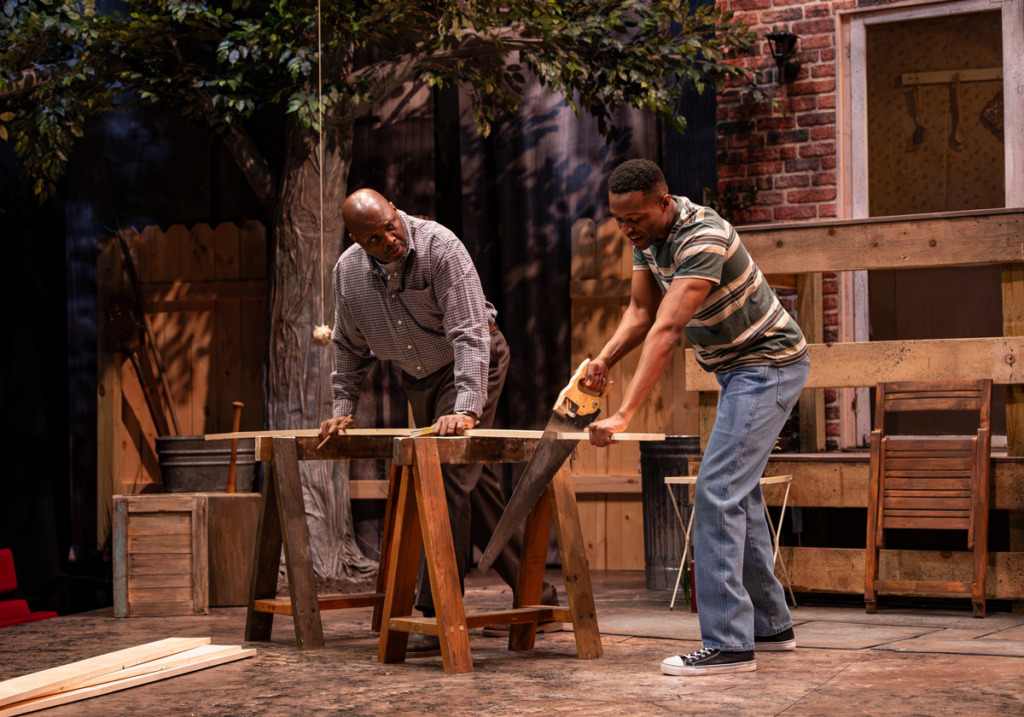
There’s also something to be said for the emotional dynamics that Douglas crafts between the characters. Fights and Intimacy Director Sierra Young aids Douglas and the cast in crafting these relationships into exquisite experiences, particularly when it comes to the playful and bantering nature between Rose and Troy in the earlier portions of the show and the palpably ferocious tension that builds between Troy and Cory as they come to blows in the latter part of the performance. Douglas’ work not only highlights the way each of the characters interact with one another within the confines of the narrative but it exalts the beauty of the ‘good’ moments with equal weight and merit in juxtaposition to the ‘bad’ moments; life isn’t one or the other, it’s always both— joy and sorrow, good and bad, dreams and nightmares, elation and being crushed— and Douglas infuses that notion immensely into every moment of the play from beginning to end.
While the character of Raynell (at this performance BelleGabrielle Willow Annibal) appears only briefly, her appearance has the audience screaming her praises for the few moments that she’s there. Annibal (under the supervision of Youth Coach Vanessa Strickland) is cheeky and charming with the perfect measure of sassy attitude that gingerly taps at the borderline of humorous and backtalk. She’s precocious without letting that character trait slide into obnoxious territory and when she sings with the Cory character, it’s a moment that resonates with a whole tempest of emotional expressions all around the audience. (Shout-out to Musical Director Tiffany Underwood Holmes who is instrumental in coaching several of the performers to alight at moments in song throughout the performance.)
One of the most evocative moments, certainly the one that brought the most tears to my eyes, is when Gabriel (Shakill Jamal) blows his horn in the final moments of the play. The entire execution of the Gabriel character is done masterfully in the hands of Jamal. The enthusiasm blending flawlessly into the character’s blissful simplicity is a tragically beautiful masterpiece to witness. Jamal creates a fathomless dynamism in a character that could otherwise be played at the surface level and he traverses the layers of humor and tragedy that are wrapped up within the character’s construction with deft fortitude. The sheer glee of finding a rose for Rose is an infectious type of joy that just exudes naturally from Jamal’s character right out into the audience and you can’t help but giggle and smile. This is also true when he’s making vividly expressive facial moves and fussing about Troy being mad at Gabriel. But it’s the versatility— Jamal’s superb capability— to flip from giddy and easy in one breath to paranoid and hearing and seeing things that nobody else can see in the next that makes his performance truly outstanding. It squeezes the heart intensely to watch Jamal portray a man going beserk over hellhounds and angels; it’s a stunning performance.
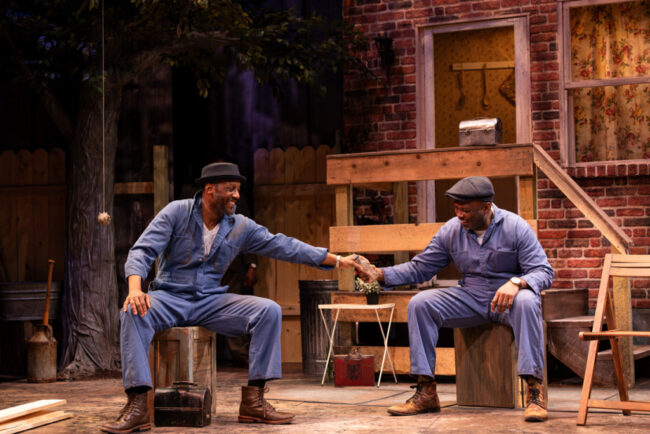
You get a similar, though more intellectually grounded, felicity in the Bono character, played by Aaron P. Watkins. He’s jovial and bouncing and his intrapersonal dynamic with Troy is that of true brotherly love, even thought they share no blood relation. Watkins is as physically expressive as his character is dynamically split and this makes for an engaging performance from the moment we meet him through to his final appearance in the last scene. While the jokes are humorous and perfectly timed, Watkins doesn’t shy away from the more serious side of his character’s existence, though few and far-between is it showcased in the story. When Watkins’ Bono has to be serious, you feel it; the way he addresses Troy in that ‘I love you, but…’ fashion is a raw truth that feels relatable and commendable.
Evan T. Carrington carries his portrayal of Lyons with a hint of pompous pride. There’s something indescribably zesty about his Lyons that just makes you grin, though subtly. It might be the bristly dynamic in every exchange he shares with Troy. Carrington differentiates his character’s pride from arrogance, setting his own path to his own tune and it makes for really juicy flare-ups in the father-son dynamic that is Troy and Lyons. The reverence with which Carrington addresses the Rose character and the respect with which he approaches Gabriel creates a sharp contrast to the edgier quips that he brings to the forefront when interacting with Troy. There’s a beautiful moment at the end of the play where Carrington’s character is standing with Rose and Cory, watching helplessly but reverently over Gabriel as he blows his horn and the expression of solemn acceptance and released peace on Carrington’s face is heartbreaking.
There is a level of difference between Cory (Isaiah C. Evans) and the other characters in the story’s orbit. There’s a hint of higher education, of unfettered dreaming, of determination that infiltrates Evans’ portrayal and guides his character down a different path. Evans’ character portrays reactionary fear as readily as he does indefatigable hope. And although many of his interactions with the other characters are brief, particularly in scenes with Rose, you get the sense that the character is deeply connected, as if those scenes exist in a realm outside of what we the audience are privy to; it’s extraordinary. The fight, starting verbal and transitioning into physical, between Evans’ Cory and the Troy character is riveting, not only because the dramatic tension that’s been building between the pair finally comes to a head but because Evans finds the pressure release valve on the character and rips it unapologetically open, blasting the entire play’s worth of emotional frustrations loose in that moment. It’s gorgeously unhinged. And that reckoning moment in the final scene of the play— absorbing and silently responding to Rose’s words, interacting with Raynell in song and being caught off-guard by the emotional tsunamic that crashes over him and gives him pause mid-song— a testament to Evans’ extraordinary emotional investment and overall acting skills.
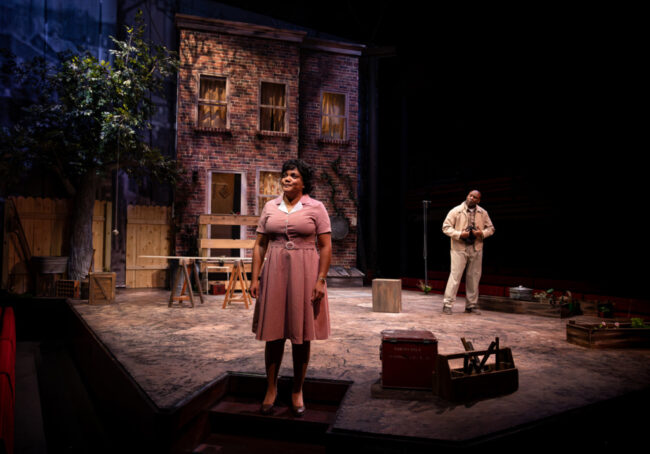
Rose (Lolita Marie) has a unique and pivotal role in the production as the narrative’s only female character (young Raynell notwithstanding and although Miss Pearl, Louise, and Bonnie are mentioned they are only brought-up in passing and briefly at that.) Lolita Marie is as pivotal in her performance as she is engaging, dynamic, and overall present with the emotions of the character, the connectivity between her character and the other characters, and with the way she commands a presence on stage. On one hand you have this ripe, grounded portrayal of a married woman who is very much in love with her husband, who lives fully and joyously in those silly moments, particularly whenever Troy is trying to spin her dizzy around the stage with his ardor and feelings for her. On the other hand there is a quiet storm building and brewing under the surface and when Marie releases it— it’s an emotional devastator beyond compare. She holds her own against Troy in the first half of the play. But that eviscerating moment when Marie’s Rose goes on the most extraordinarily charged monologue rant about choosing to stand with Troy— it is unrelenting gut-punch after gut-punch, blow after blow that is met, and rightfully so, with thunderous applause from the audience. The pristine precision with which Marie composes the character in that moment— still playing at the zenith of emotion but flawlessly articulate and deeply expressive of a myriad of eviscerating feelings without ever once collapsing or capitulating to the temptation of ‘giving in’— is the penultimate performance of the show, second only to the solo moment the Troy character has on stage alone with the bat. The dynamic that Marie’s Rose gives and receives with Troy is intense and carries the show from start to finish through a turbulent ocean of experiences that must be seen to be believed.

Wearing the protagonist’s crown, Dejeanette Horne gives exuberant life to Troy Maxson. Horne is firing on all cylinders in this role— physically as he drops to the floor super-spy-style to creep up on and surprise Rose, emotionally every time he shares dialogue with any of them, spiritually when he’s waxing nostalgic about leaving his father’s home and that harrowing experience, mentally as he’s trying to justify the actions of the character even when they’re indefensible— it’s a sensational performance, no question. Like everyone in this production of Fences, Horne’s ability to flip through expressions and stay dynamically present is remarkable. One minute he’s joking and bouncing around with Bono the next he’s rolling his eyes and cold-shouldering Lyons, the next he’s hugging and squeezing on Rose, and the next he’s demanding respect from Cory. It’s a journey, one that Horne conducts and delivers with rigorous intention, extravagant emotionally connectivity, and extraordinary mindfulness. In the confession scene with Rose, where she’s fiercely firing off that ‘day late, dollar short’ monologue, watching him absorb it, respond to it, and never falter is wild. The intensity that Horne brings to that solo moment on stage with the baseball bat, ranting at death and the heavens abound— is the most evocative moment in the play; it’s brutal, it’s beautiful, and lands with such tenacity in the capable hands of Dejeanette Horne. Fences is a true ensemble piece; Dejeanette Horne becomes the throbbing heart of that ensemble focus in this role.
The best of the celebration thus far, August Wilson’s Fences at Chesapeake Shakespeare Company is a must-see; they’ve extended the performance through the 8th of March 2026 but tickets are moving extremely quickly. It is a masterpiece of art, a work of beauty, a production of grace and celebration, not to be missed if one can help it.
Running Time: 2 hours and 35 minutes with one intermission
Fences plays through March 8th 2026 as a part of the Baltimore August Wilson Celebration at Chesapeake Shakespeare Company— 7 S. Calvert Street in Baltimore, MD. Tickets are available by calling the box office at 410-244-8570 or purchasing them in advance online.
*The primary cast of August Wilson’s Fences includes a total of seven performers, though