
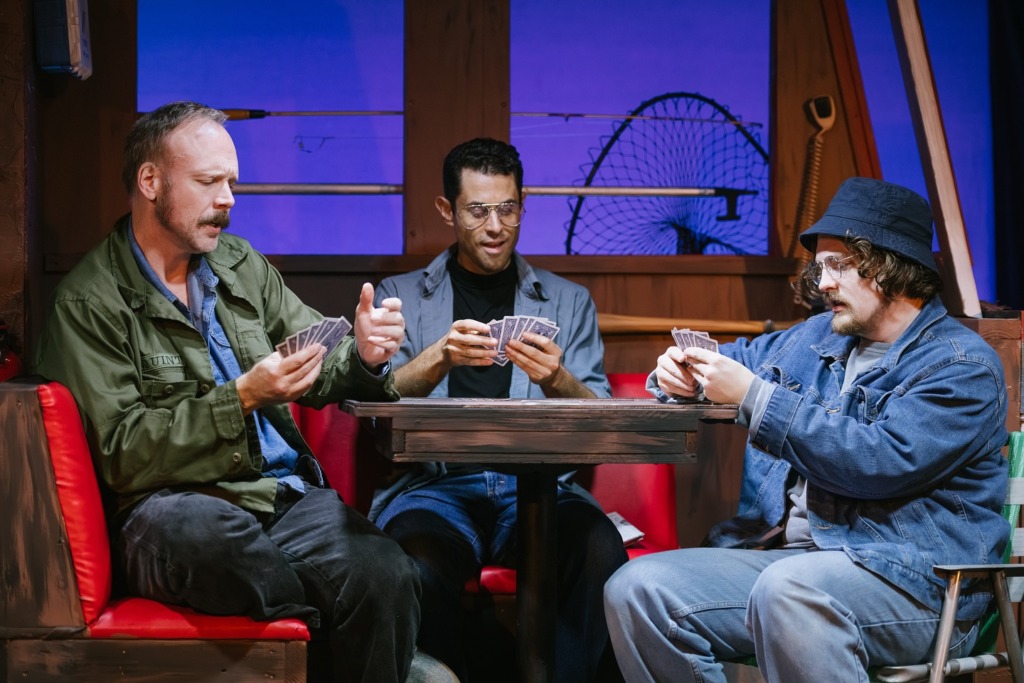
“You’re gonna need a bigger boat.” ~Chief Brody; Jaws 1975
Who knew that a line like that would still be titillating audiences literally 50 years later? I mean, “The human race won’t exist someday and here we are worrying about some stupid movie.” (Ian Shaw & Joseph Nixon; The Shark Is Broken.) As the Spielberg iconic film enters its actual 50th year of cinematic relevance, the Maryland Ensemble Theatre kicks off their 2025/2026 Main-Stage season with this wild new production The Shark Is Broken, written by Ian Shaw & Joseph Nixon) based around the real-life experience of Roy Scheider, Richard Dreyfuss, and Robert Shaw aboard the boat-set while filming Jaws. It’s remarkably funny, deeply explorative of so many things that even today tend to be taboo for topics of discussion (though they really shouldn’t be) and ultimately an excellent theatrical experience. Directed by Gené Fouché, this bumpy comedy is a tumultuously fun endeavor, that plumbs the depths of coping with one’s own existence whilst trying to differentiate the experiences of making art, and the by-product thereof: fame.
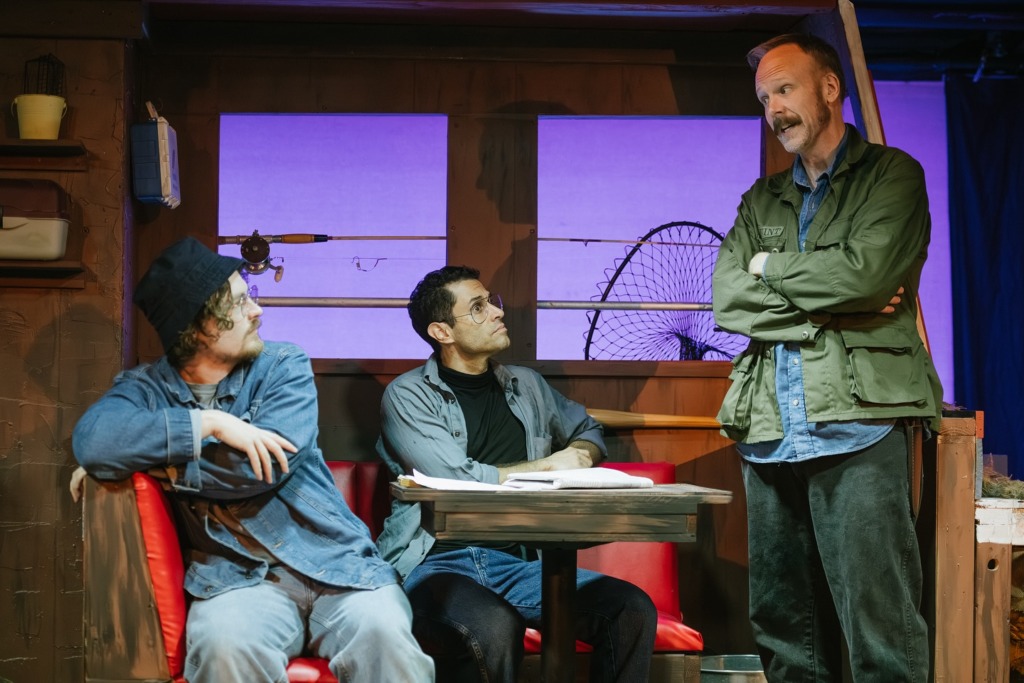
Known for its creativity and unique approaches to staging in the intimate main-stage space of the Maryland Ensemble Theatre, the production team does not disappoint on the delivery of The Shark is Broken. The devil’s in the details, as they say, and with Scenic Designer David DiFalco, Lighting Designer Shana Joslyn, Sound Designer Kevin Lloyd, and Props Designer Lori Boyd, you’re in for a titillating treat. (Jennifer Clark also deserves praises for the show’s costume design components; the three stayed outfits of the time, looking almost identical to what was seen in the film are brilliantly fitted to the three actors in their respective, iconic roles.) The boat DiFalco has fabricated is cramped, intentionally so, and beautifully laid out within its own confining structures. Every time the dinghy, motorboat, etc. (that remains wholly unseen from the ‘other/under side’ though is so realistically present that you feel a little sad you never actually see it because you simply know it’s actually there) bumps up against the ‘Orca’ the overhead cabin lantern sways and the thud echoes through the room. You get phenomenal storm effects from both Joslyn and Lloyd during that transitional scene of the storm onboard and ultimately you feel as if you’ve been submerged into the reality of being aboard the Orca with Brody, Quint, and Hooper. Even though you’re only ever really there with Scheider, Shaw, and Dreyfuss. DiFalco’s set is transportive; Joslyn deserves high marks for her dimming feature for that final scene— a verbatim recall to the film— that just sends shivers up the spine; Kevin Lloyd’s soundscape is superb and helps the moments in blackout, which ultimately shift the passage of time, feel like this surreal time-ballet. The whole of the production team has done wonders to craft this universe into which the audience is readily plummeting and it’s an impressive experience to behold.
The shocker to this production, which is far less of a complaint and more so of a ‘heed with caution’ is how lengthy the play actually is. This is only relevant as the show is performed without intermission. You never notice that you’re sat from a 7:30pm start time (evening performances only) through to a 9:20 bow at ‘curtain call.’ And again, the only reason that this bears mentioning at all is so that you can…visit the little orcas room prior to the start of the show and not miss a single moment of the comedy, the deep-dives, and the overall experience of The Shark is Broken.

The pacing of the show is sublime, (which is more than what I’m sure the real Dreyfuss, Scheider, and Shaw could have said for the lengthy time spent on the Spielberg set!) Director Gené Fouché (assisted by Production Manager Matt Harris, Technical Director Cody James, and Stage Manager Olivia Pietanza) has the scenes rolling as naturally as ocean waves, one on top of the other, even with those momentary blackouts for the actors to shift positions, exit, or re-enter the Orca. Fouché understands keenly the way the space works for the play and the way the play can work for the space. There is a sense of claustrophobia that occasionally permeates the set, it isn’t always present but it slinks in like a fog rolling up off the water, easing its way into the space and Fouché cultivates that by generating dramatic tensions superbly between her cast of three extraordinary actors and juxtaposing that against this indefatigable sense of camaraderie that penetrates even those bombastic moments where they find one another at each other’s throats. The scenes have a believability to them; you’re no longer watching actors portraying celebrities recounting their experience; Fouché has the audience so enmeshed in the narrative component of this theatrical endeavor that you find yourself wholly suspended in the disbelief that you’re watching Roy Scheider, Robert Shaw, and a young Richard Dreyfuss. (It doesn’t hurt that these actors have similar resemblances to the original actors and the costumes from Jennifer Clark just seal the deal!) It would be easy to succumb to the comic nature of this show but Fouché strikes an exacting balance, letting the comedy dominate, though there’s always an undercurrent of severity, emotional depth, and harrowing confessions waiting just beneath the surface.
The aforementioned perpetual camaraderie between the three actors (Willem Rogers as Richard Dreyfuss, Steven Todd Smith as Roy Scheider, Kevin Corbett as Robert Shaw) in this production is a bonafide example of outstanding ensemble work. The moment where the trio is discussing what they believe the play is actually about— and you get a beautiful answer and properly thought-out response from Rogers’ Dreyfuss and Smith’s Scheider, followed by the sarcastic ‘given-up-the-will-to-live’ response from Corbett’s Shaw— is just one of many such moments that readily displays their fraternal bond. You see their brightest moment together about halfway through the performance, when they burst into a rousing rendition of “Wild Rover” playing some nonsense-pub game called ‘shoot-the-ha’penny.’ It’s the zenith of their indestructible bond in that moment. The through-lines of the duos and how they relate to one another and to one another within the stricture of the trio is, in equal measure, fascinating, especially as they all exist, however briefly, as individuals living through this experience. Fight Director Tad Janes is owed a great many praises for making those more violent moments look and feel credible, whilst keeping the actors wholly in one piece.
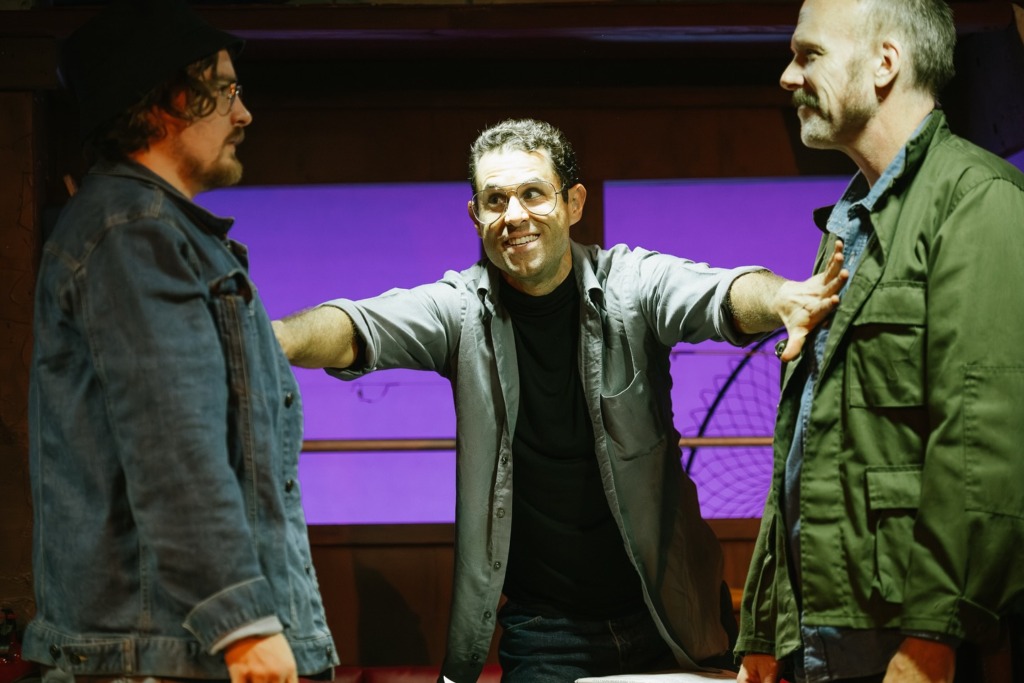
Not a bad performance from Willem Rogers as Richard Dreyfuss. (I don’t wish to inadvertently bruise egos; it was a solid performance but since that line gets slapped around in the show once or twice, I couldn’t resist!) There is this frenetic fidgeting present in Rogers’ Dreyfuss right from the start. He’s crawling up the scenery, constantly in motion, even when he’s trying to sit still. And the over-the-top expressions of his panic attack— completely upended into a comedic moment by Smith’s attempt to console him and then Corbett’s arrival and delightfully inappropriate misinterpretation of the scene— feel so authentic that its difficult to resist the urge to jump out of your seat and want to comfort him yourself. The incessant needling between Rogers’ Dreyfuss and Corbett’s Shaw drives a good few of the scenes, both into heavier moments and into comedic shenanigans and antics. And it exquisitely builds the natural born tension between the pair of them.
As the man-of-stage-come-screen Robert Shaw, Kevin Corbett gives a remarkable performance; the way he’s able to flip on a ha’penny from that languid British accent to whatever American-flavor Quint was meant to have in the ‘in-scene’ moments is beautiful to hear. Corbett’s character is responsible for more than one of the dramatic tonal shifts in the play. The ‘jovial-share-pride’ moment discussing how fathers came round to the notion of their sons being actors drops suddenly and heavily with Corbett’s brilliant delivery; he’s versatile. And his temper flares with precision in all of the right moments. Of course Corbett is as impressive as a serious actor with weighted material as he is exceptional at delivering the comedy of some of those lines, particularly when he starts complaining about the drivel of the film itself, how everyone will soon forget it, and how heaven-forbid there might be a sequel. The true chilling moment in the show— and anyone will recognize it if you’ve seen the film— is the final scene of the performance where Corbett’s Shaw is playing Quint and delivering that flawless monologue about the sharks in the water. And after spending nearly two hours’ stage traffic watching Corbett traverse the ups and downs of his character’s many flaws and anguishes and deep-seeded dysfunctions, it’s richly rewarding in a most indescribably fashion.
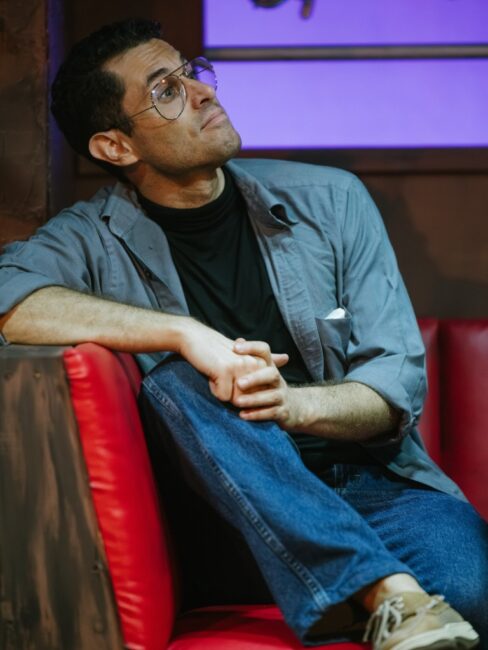
Winning the look-alike contest among the three, Steven Todd Smith tackles the role of Roy Scheider brilliantly. While he gets some beautiful lines of dialogue and quippy zingers throughout, it’s mostly his reactionary responses that showcase his versatility, dimension, and depth as a performer. When he slips up on the Orca while Rogers’ Dreyfuss is mock-roasting the other two to himself, watch Smith react; it’s hilariously unhinged. Smith’s character serves as the peace broker between the volatile Shaw and the agitating Dreyfuss and he manages to keep himself composed throughout most of it, but when he explodes between the pair of them, it’s visceral and bordering on a little frightening. But the scene of the show— truly stealing the performance in terms of undeniable comedic gold is the solo scene where Smith’s Scheider is told to take lunch. On the Orca. With cheeky confidence and a proper swagger, Smith gets wholly out of costume and sets himself up to sunbathe. And the antics that ensue— including that gut-bustingly laughable bit with the baseball bat and the radio will tickle your ribs so intensely, it’s high-hilarity at its finest.
The show hits deeper than one might expect; it’s more than just three actors being stuck on a boat because as the title implies…the shark is broken. There are some profoundly dark moments, heavy confessions, and deep discoveries, all balanced out by comedy and nonsense which makes this the perfect show to launch any season. It may not be safe to venture out into the waters of Amity Beach…but it’s perfectly safe to get tickets to the Maryland Ensemble Theatre’s area premiere of The Shark is Broken.
*Running Time: Approximately 1 hour and 50 minutes without an intermission
The Shark Is Broken plays through October 5th 2025 on the Main Stage of the Maryland Ensemble Theatre in the Historic FSK Hotel building— 31 W. Patrick street in downtown historic Frederick, MD. For tickets call the box office at (301) 694-4744 or purchase them online.
*Please note the 7:30pm start time for evening performances as there NO LATE SEATING WILL BE PERMITTED.