
Shakespeare is a thief. Theatres are haunted. Live theatre is best served with comedy. This year’s spring showcase for the Theatre Students of Brooklyn Park Middle School (Apex Arts program) has a bubbly mixed-bag of topics presented in two parts— the sixth graders performing Live Theatre and the seventh and eighth graders performing Shakespeare Bites, both written by CJ Crowe, a teaching artist working with theatre students as a part of the Apex Arts program. Crowe, who also directed the sixth grade performance, served as a Dionysus to these young performers, nurturing and engaging them in their craft (providing directorial guidance to the eighth graders, who directed Shakespeare Bites!) and it was a grand opportunity for the students to take a year of what they’ve learned and put it on display.
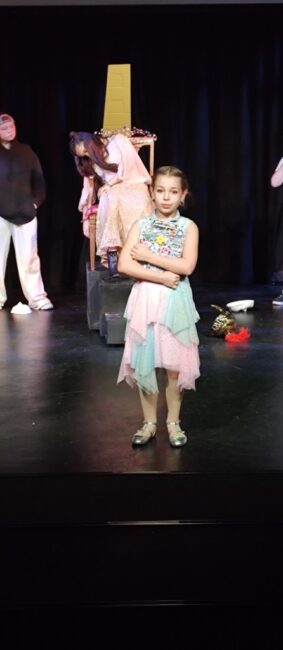
The first script— Live Theatre— is an innovative and cheeky look at how theatre students perceive theatre, particularly this current generation who thinks ‘ancient history’ is like Cats from the 1990s. (Cats, the sensational second-longest running Andrew Lloyd Webber musical made its Broadway debut in 1981.) It’s a theatre-history lesson presented to the students (and the audience) in an engaging fashion with dialogue that flows naturally and gives you the ‘bullet point’ of major foundations in the theatrical pantheon— the pyramid cornerstones if you will, and allows for the students to learn a little something while being on stage. The second script— Shakespeare Bites— is a deeper delve into arguably the greatest ‘historical playwright’ (fighting words, we know) that ever wrote for the stage. And while it doesn’t get too heady or too esoterically steeped in its own stew, you do get important factoids thrown at you— challenge style— about the comedies, the tragedies, and the histories. Oh, yeah, and the sonnets. It’s two really solid, educational and still entertaining scripts for these young performers to work with; think Miss Frizzle for the page and stage, if you will.
Across the board if there was a constructive criticism to be had it was that nearly all of the students could use a boost in ‘projection’ from a vocal/auditory standpoint. While there were a few who never had this issue (like Claire McDaniel of Live Theatre and Nathaniel Nicholls of Shakespeare Bites, they could consistently be heard loud and clear), for the most part this was a recurrent note across bot performances. But what they often lacked in volume they made up for in body language, facial expression, and overall placement and presence on the stage. The venue itself was intimate so even the whispers could be heard for the most part.
The opening bid— Live Theatre— was a clever take (with both shows written by CJ Crowe having that meta-component of ‘show-within-a-show’ to them) on kids trying to figure out which type of show to do for their final project. You’re introduced to Hannah (Callie Hynson) who serves as the group organizer of sorts. And as they bicker over what they’re going to do, you get to meet a bunch of ‘theatre kid archetypes’ though by far the most memorable were Piper (Natalia Blazonis), Lila (Magnolia Jones) and Jax (Ava Starbeck), where Blazonis was the kid who refuses to listen and touches all the props— like that squeaky chicken that definitely doesn’t belong to her, Jones was the scaredy-cat perpetually threatening to scream and making a full-on callback bit out of her personality quirk, and Starbeck was sort of serving as the sarcastic ‘doesn’t want to be here class clown’ type. The other Theatre Kids (Anders Johson as Sam, Ameenah Staggs as Bianca, Isabella Garcia as Cam, Lilianna Francisco as Maeve, Amelia Wacker as Elena, Miranda Mills as Iris, Quinten Colquhoun as Miles, Savanna Buchanan as Tessa, Zoe Crawford as Sunny, and Elliana Scribner as The Stage Manager) all take turns having little moments— particularly once the deities are introduced and they get to deciding exactly what type of show they’re going to do.
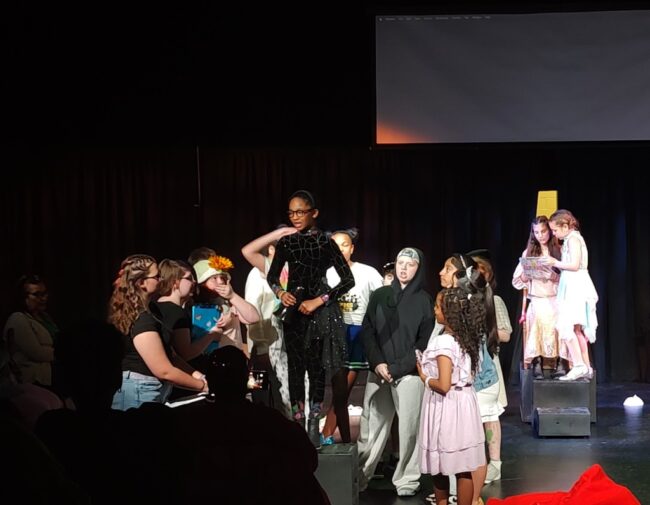
Enter: Miss Cue (Greyson Herbert) an Page (Claire McDaniel.) Herbert is bringing some delightful nervous energy to her character— the entity of stage lighting (and cleverly calling to the tech booth all the light cues…which just like in real live theatre, seem to have a mind of their own and fire and misfire at will!) McDaniel has exquisite comedic timing and a very mindful sense of stage presence. She’s reading stage directions and you’d believe she was a natural professional without hesitation, particularly when she’s told off by various characters. Presiding over it all, the repository of theatrical historical knowledge— Thea (Juliette Ladelma) the spirit or goddess of theatre. Possessed of temper and a fiery spirit, Ladelma tries to set the ‘Theatre Kids’ on a path of progression, helping to explain Greek Tragedy, Roman Spectacle, and the morality plays. There’s some hinting in the background (once Thea falls asleep as the spirit of theatre is wont to do) that “best of” these theatrical histories all come together in one canon— Shakespeare, which makes for the perfect segue into Shakespeare Bites, the play performed by the seventh and eighth graders.
Combining 30 seventh and eighth graders to represent the whole of the Bard is no small or easy task. Crowe’s script makes it easy to break down into battle-factions, pitting the comedies against the tragedies against the histories. And then there are three poetry-minded students who rail quite loudly about how you cannot do a comprehensive representation of Shakespeare without including the sonnets. (They’re not wrong! Everyone likes to discuss how he wrote 37 plays…but everyone seems to conveniently forget that the man also penned over 150— 154 to be exact— sonnets.) And you get a ‘battle to the death’ (without the death, obviously) for which group of Shakespeare’s four categories of work, is the hands-down best.
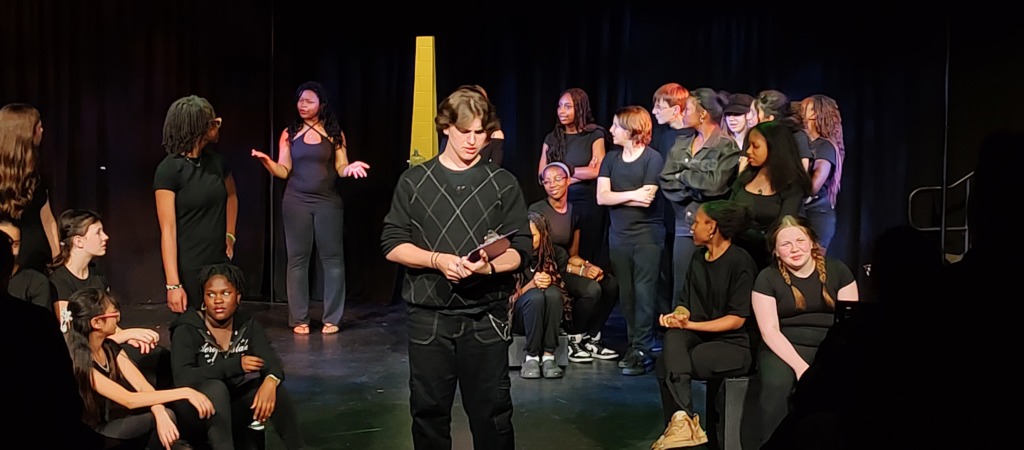
The precocious and charming ringleader of this band of merry-makers is Casey (Nathaniel Nicholls.) Whether he’s meant to be president of the drama club, class leader, project manager, student-director, etc., this kid is going places. With mindful stage presence, he’s able to address the audience and the characters on stage in equal measure and understands how to control both the crowd and his on-stage actors accordingly. Divvying up the students into the four categorized groups, Nicholls appears in every scene as a conduit to keep the pacing moving; he’s resourceful and a crowd-favorite.
You’ve got Alex (Violet Moul), Riley (Bianca Sikinyi), and Jordan (Isaiah Hammer) who get the roles of ‘director’ foisted upon them— each receiving comedy, tragedy, and history respectively. And then Morgan (Raven LeBrun) and Taylor (Riley David) who have an initial hissy-fit over being called turds…which is a miscommunication because Nicholls’ character tells them that they’re the DramaTURGS (just a little mishearing…Texas…taxes…could happen to anyone.) And while everyone is getting broken off into their trio of Shakespeare plays— Alexis (Aaleyah Pegus Fonrose), Rowe (Lily Seekford), and Elliot (Niyah Jean Pierre) show up to make some poetic noise. They represent— not the Lollipop Guild or the Lullaby League, no— they show up to rep SONNETS! Fonrose, Seekford, and Pierre are poetically passionate about the importance of the sonnets in Shakespeare’s cannon and make a point to inform both Nicholls’ character and the audience at large that sonnets are written in iambic pentameter. This trio of young performers do a great job of delivering sonnets in their own performative way, and in this humble reviewer’s opinion— they received the loudest cheers from the audience and should have won the “who wins” portion of the competition.
The comedy— Midsummer Night’s Dream— featured the play-within-a-play scene, one of the funnier moments in that particular comedy. With Maxaria Fleurimont as Quince, Anastasia Demetriades as Bottom, Samantha Hodges as Flute, Felix Anderson as Snug, Isa Espinoza as Snout, and Kennedy Watkins as Starveling, the audience was treated to that overly melodramatic moment and it was funny.
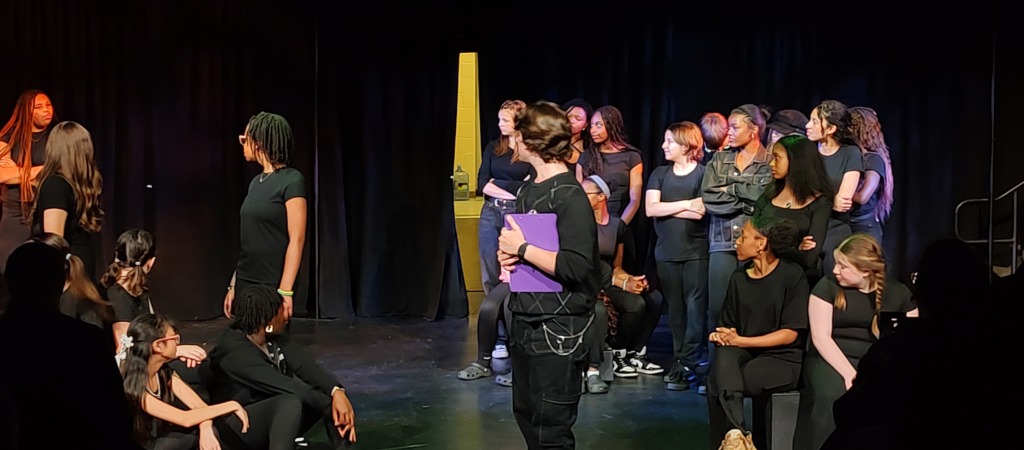
Harper (Camila Duarte) and Rowan (Amber Rhodes) lead the tragedy— and what better one to choose than the cursed one whose name you can’t say in a theatre? THAT SCOTTISH TRAGEDY!! Of course! (Also known as— and as long as you don’t read this review aloud in the theatre you’re probably not cursed for life— Macbeth!) Featuring Lillian Jackson as Macbeth, Natalie Houghtling as Banquo, Kyleen Neis as Witch1, Isabella Jones as Witch2, and Christian Robinson as Witch3, and Lilliana Neal as Ross— you get the infamous “Macbeth…Thane of Cauldor…Macbeth will be King…” scene and it’s got those dark and looming spooky components that sets the overall tone for that play.
My personal favorite— THE HISTORIES! (Blegh. Just kidding. Who actually likes the histories!?) Sydney (Mason Probst) and Charlie (Marley Henseon Coleman) gather up their players for Henry IV and they’re off to the races, which honestly even if the sonnets weren’t a part of it? The histories never stand a chance against the comedies and the tragedies…because they’re neither funny nor gory, except for Richard III, which is both and although it’s a history, belongs in a category all its own…but I digress. Featuring Andrea Regan as Price Hal, Kennedy Austin as Falstaff, Isabella Churchill as Poins, Jenesis Jenings as Bardolph, and Helen Vazquez as Mistress Quickly, you get a very quick and cheeky sampling of what place the histories hold in the canon for our beloved Bard.
Of course the whole thing culminates in a “cheer-off” with the audience where Nathaniel Nicholls (our narrative host of sorts) starts urging the audience to ‘vote’ for their favorite. (And he remembers the vote!) Clearly the audience was in favor of the Sonnets, but as both Nicholls and the eighth grade masses at large couldn’t seem to appreciate such a choice, he sends the Sonnets off and does a revote. And then eliminates yet another group and does a ‘sudden death’ showdown, resulting in The Histories as the winner.
Two different scripts, each running approximately a half an hour, each giving a different group of students the chance to showcase their learned acting skills in a practical fashion whilst simultaneously learning about theatre (and theatre history) and the importance of comedy on the stage; it’s a remarkable experience that Dionysus and Bacchus and the Bard have granted to these future actors of tomorrow.