What serves each of us best is what serves all of us best. Right? Radical idea, no? Tidewater Players is serving up a liberal dose of teenage angst and heartache with their current production of Spring Awakening (based on the play by Frank Wedekind with book & lyrics by Steven Sater and music by Duncan Sheik.) Exploring the topics of growing up and simply yearning to learn outside of what’s being forcibly presented as knowledge within the confines and strictures of the institutions of schools and churches, this theatrical voyage has stunning music with harrowing storylines woven intricately into the mix. Directed and Choreographed by Dickie Mahoney with Musical Direction by Jarrett Rettman, Tidewater Players’ production is inviting you to investigate your own moral compass with this show.
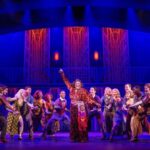
The intimacy of the Opera House’s black box theatre creates unique opportunities for scenery and setting. Scenic Designer William A. Price III makes choices, some which really enhance the show— like the not-yet-in-bloom twig-scrub-brush forest that flanks the house walls leading up to stage-lip stairwells— some of which generate questions and problems— like the pastel drapes strung about across the back of the stage. Price’s use of the draping almost creates this whimsical notion of exploration but because of the strange color scheme— pastel baby pink, pastel baby blue, and screaming easter-lime green— it ends up looking a bit more like a baby shower or gender reveal party went awry. Price, who also serves as the show’s lighting designer, is at war with himself in these design choices. There are moments when the drapery is backlit— like at the end of Act I in that striking purple, creating silhouette and shadow play on stage— and it’s a striking and rather stunning effect. But there are other moments when whatever lighting colors are coming in from behind and from the side just augment the garish mismatch and it doesn’t feel intentional. At least the furnishings, minimal though they are, appear on wheels, making for smooth scenic transitions. It’s baffling how Price can overdo and under-develop the play space at the same time, but the actors don’t let a little thing like confusing scenery stop them from giving their all to this production.
Microphones were well in balance at this performance, compliments of Dickson Teel (sound design.) The overall musical levels were a bit touch and go at the beginning of the show, but for the most part the accompaniment tracks stayed level and didn’t overpower the performers. If there’s one space where Teel’s work could be elevated from good to great it was in giving a boost to the boys when they sing their ensemble numbers. The female ensemble was powerful, no question, and the male ensemble sounded good but as there were double the amount of people in the female ensemble, mic levels could have been adjusted up to create that matching illusion of numbers if in nothing but aural playing space.
Musical Director Jarrett Rettman has brought exquisite harmonies to balance, blended vocals beautifully and worked magic with these canned tracks to inspire the performers to be edgy, and alive and in tune. (This is music where pitch control is not only a necessity but a staple and Rettman must have some magic wand tucked up his sleeve because all the sustains were clear and tonally balanced.) While the rogue edge of this rock-style musical is somewhat muted (tracks vs live orchestra but that can’t be helped) Rettman finds ways to get that feeling back into the musical numbers by way the cast and it feels good. “The Song of Purple Summer” is a powerful reckoning and the harmonies that roll through that finale number are sublime.
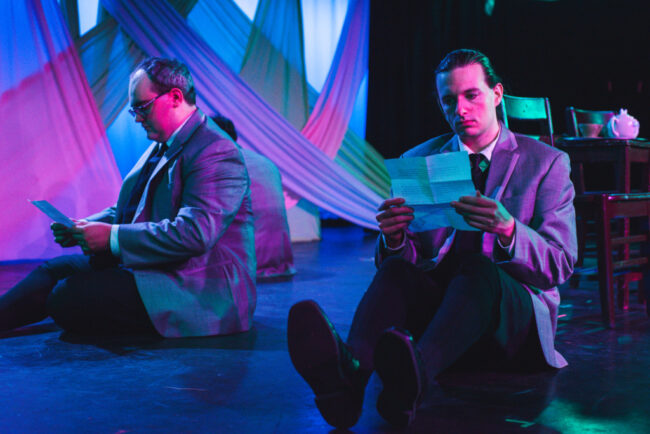
Costumer, Director, and Choreographer Dickie Mahoney set the time stamp on the show with the grey old-world uniforms for the boys and the full-sleeved, simple cotton gown and aprons for the girls. The choice to have Moritz and Wendla appear in cherubic whites at the end was a solid one. Mahoney’s attention to detail when it comes to blocking and staging showcases his knowledge of the space. The flash-fire blackout where a person is replaced with a specific piece of furnishing (spoilers) is exceptionally well executed and really nails the gravitas of that moment. There were also multiple moments throughout the performance where the ‘kids’ (all played by adults but these are meant to be young school-aged kids on the brink of their adolescent-adult discovery-line) rage or storm or flee wildly out into the house, bringing that immersive component of theatre right into the audiences’ laps. This works well in nearly every place in which its executed.
Spring Awakening isn’t a splashy, dance-heavy musical but what party-rager dance moves that do get incorporated read like organic chaos, matching the vibe of the music. Mahoney also gets mad praises for clever ways to hide various actors’ modern tattoos. All too often in intimate venues things like tattoos or piercings get overlooked in the run-up to opening only to be spotted by the audience; my personal favorite was the low-drop bouquet on Isla, which not only concealed one of her modern tattoos, but also gave her character this demure but coyly playful nature in that moment. It was an odd choice (though understandable, from the yen of wanting some of the ensemble players to have more featured moments/lines) to have the female ensemble play the rude-rogue boys at the reformatory; it sends a curious message that may or may not be intentional.
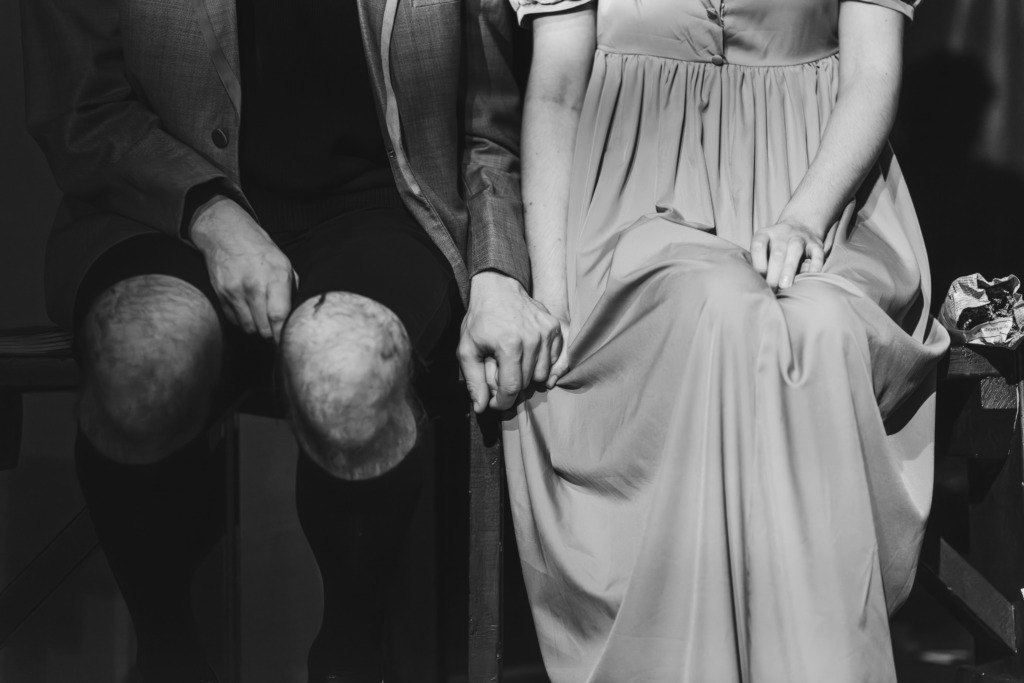
Kelly Carlson’s intimacy coordination and work should be praised thoroughly. It’s not often that you get more than half-a-dozen intense moments in any one show that require such coaching but Carlson’s work is sublime; everyone is reading as comfortable on stage even if some of those moments are particularly uncomfortable to watch from the audience (which is the point of this musical in certain regards.) Carlson builds different dynamics with each of her larger-scale intimacy moments. The meet-cute innocence of awkward hand-holding on the bench with Wendla and Melchior, which later transpires into a whole different animal when they reach the switch-smack scene and then the hayloft scene; the touch-and-coax between Hanschen and Ernst; the solo-flying moment with Hanschen— all of these moments are crafted with delicacy, purpose, and intention— even the more platonic embraces like with Melchior attempting to provide comfort to Mr. Stiefel— all feel as if they’re arising from a place of authenticity and realistic emotional gravity.
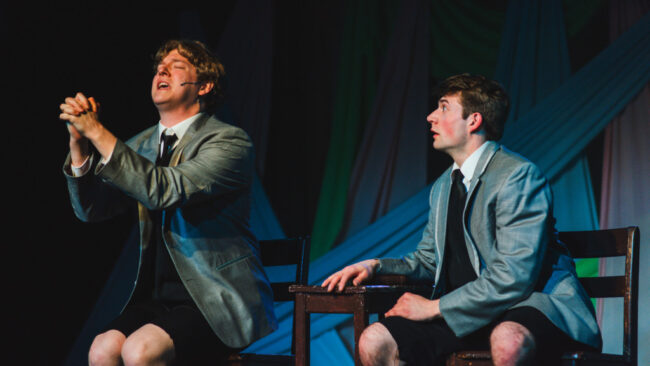
Energy was a little low/rough at this performance for some of the more intense numbers, chalk it up to final-dress jitters and tech week exhaustion but that talent is more than present, particularly when it comes to the resounding strength in the female ensemble. As a unit, these 20 performers come together to tell this tale and their most striking moment is the finale, “The Song of Purple Summer.” And there was somewhat of a mismatch in our adult character tracks with Eileen Keenan Aubele as Adult Female and Mark Briner as Adult Male. Aubele made distinctive, albeit subtle, character differentials to showcase that she was playing different women whereas Briner’s men were all the same. Though this could have been an intentional choice to attempt to showcase that ‘all adults are the same no matter who they are’ but if that was the case then both adult performers should have been on the same page with that. The pacing/comedic timing when Aubele and Briner when they are playing the heads of the school was a little off, pulling the dark and sinister humor out of those scenes.
Credited as the ensemble (though with inventive character names all the same) Rachel Bagley, Mia Coulbourne, Delaney Fairly, Sammi Flickinger, Thomas Knox, Jamie Morgereth, and Anna Odell add volume and intensity to numbers like “My Junk” and “Left Behind” and “Totally Fucked.” It’s these members of the ensemble that do the most ‘down-the-stairs’ flights out into the house and when they’re bouncing around during “Totally Fucked” you get the sense that they’re about to start a raging rebellion against society that you can’t help but want to get in on before it explodes.
The fellas— Myles Taylor as Otto, Daniel Michel as Georg, Grayson Mallon as Ernst, and Pyrrah Meadows as Hanschen— have a lot of really beautiful moments in their various on-stage existences. Michel’s Georg is bringing some spectacular vocals into play and quite frequently at that, when he gets these feature-line moments in numbers like “Touch Me” (particularly that heartfelt sound at the end of that number.) The emotional expression Michel creates with his vocals is sublime. And they dynamic between Mallon’s Ernst and Meadows’ Hanschen during “The Word of Your Body (Reprise 2)” is both striking and evocative. Meadows leads with this cunning, almost predatory approach— physically, vocally, and emotionally— and Mallon has these wild facial expressions which really amp that number right up, making it so fascinating an exquisite to watch and experience. Taylor’s voice, as Otto, gets that moment of recognition in “Totally Fucked” as well and its great.
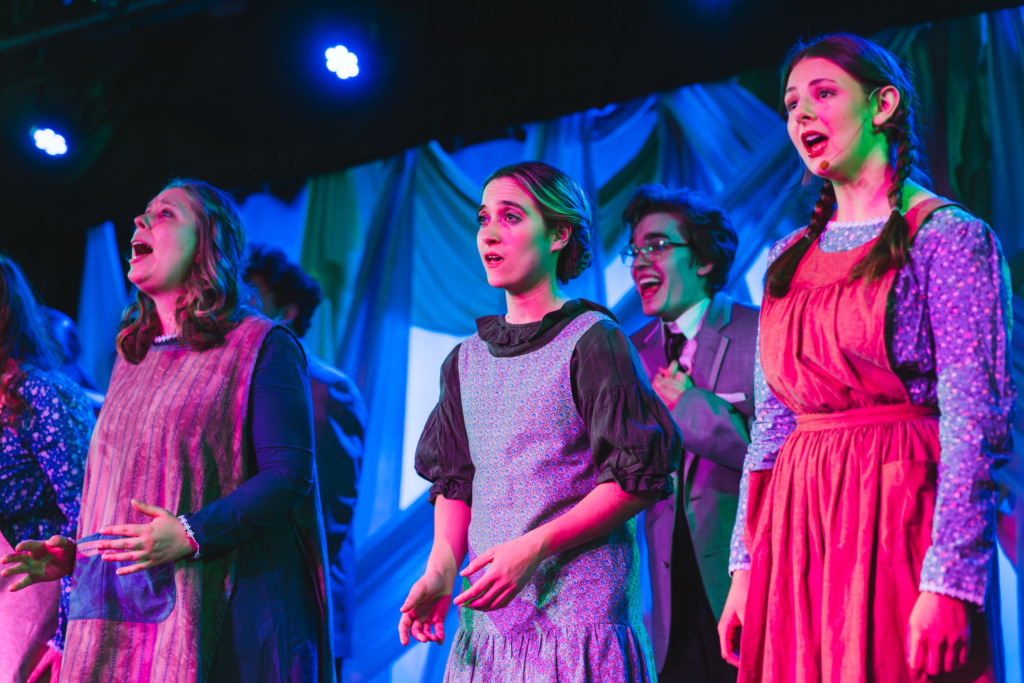
The named gals— Arianna Costantini as Anna, Abbey Edwards as Martha, and Sydney Phipps as Thea— add a gaggle of excitement to the giggly scenes often shared with Wendla and they make for some really lovely silly and whimsical moments with one another like when they’re singing through “My Junk” and melting down over the potential of Melchior Gabor. Abbey Edwards as Martha, gets to lead “The Dark I Know Well”, a duet shared with Isle (Jordan Burch.) Edwards brings the intensity and harrowing verve into this number, blending her subdued but accurately haunted vocals into line with Burch’s sound, letting this number really shake the audience. It’s also one of the few moments where Price’s lighting design works as intended with that eerie, unsettling magenta back-lighting creating that added sensation of disquiet to the ether.
Burch, as Isle, has this detached cloudiness about her; it’s an excellent choice to showcase her as the outsider, almost like she’s hovering on that line of being in real society but still trapped in the youthfully questioning phase like the other ‘children’ characters. It’s not aloof because it’s not cold or distant— but almost like this blank serenity; it’s difficult to describe but it works well with what she’s doing. Her delivery of what her life is like in the artist colony is delivered almost like this hazy dream and when you actually hear what she’s saying, coupled into her monotone delivery it’s really very powerful and disruptively striking; there’s no romanticizing her experience but she’s also not raging or fearful of it; it’s simply there, which is wild and really works well in this context. When Burch lends her vocals to “Don’t Do Sadness/Blue Wind”, the carousel duet between Isle and Moritz, it’s a lovely juxtaposition of sound, emotion, and harmony.
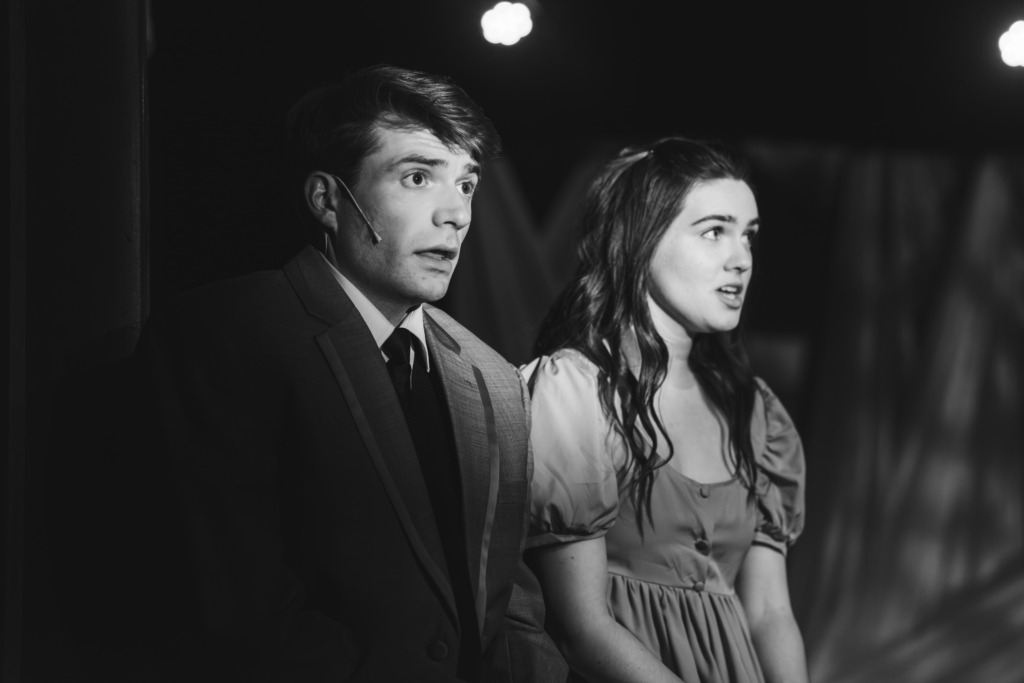
It’s Wendla (Olivia Aubele) and her story. Or is it Moritz (Stanley Evans) and his story. Or Melchior (Jesse Hutchinson) and his. The way this production is presented, it could be all three of their stories and none of their stories simultaneously. I’ve experienced other productions where the driving protagonistic force has been singled out to one of these three, but this performance feels equally weighted, like three threads of fate crisscrossing over one another (almost like the way William Price intended for his background draping to crisscross over itself.) And it’s fascinating approach to the show’s narrative. Aubele, Evans, and Hutchinson have this intrinsic bonded dynamic, which is wild as they never share the stage together as a trio until that final number, “Those You’ve Known” and the clutching grasp that occurs between the three of them is really a beautiful gut-punch.
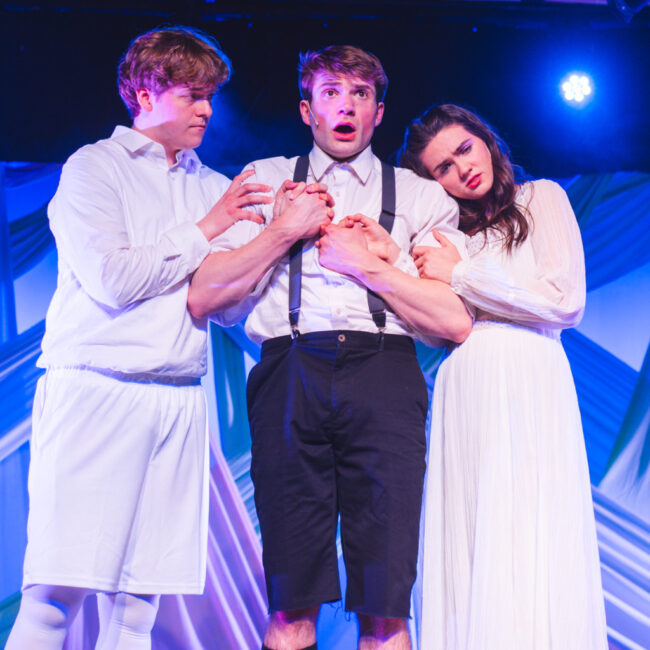
Hutchinson’s Melchior is the pivot point at the center. His actions or inactions or reactions, all three, have butterfly-effect ripples on the lives of the other two. And while most productions utilize Melchior as this bombastic, overzealous leader of youthful rebellion, Hutchinson takes a more subdued approach. He’s a philosophic poet and lover, not a revolutionary rioter and fighter. It’s wild. His voice is glorious and glassy with easy gloss in places, particularly when sailing up into those higher tenor sounds that border into falsetto territory. Jumping like jackrabbit lightning back and forth during “Totally Fucked” (the staging for that is really smart) Hutchinson gets a little incendiary spark going for the others to join him in this bombastic number. But hands down the way he expresses that emotional breakdown during “Those You’ve Known” is evocative and haunting, particularly his facial expressions as they melt down into his vocal delivery in that number. The chemistry he shares with Aubele’s Wendla is awkward and adorable, right up until it’s not (again, props to Kelly Carlson) and the gentle camaraderie he brings to Evans’ Moritz feels surefooted and firmly planted in a genuine fraternal-style bond.
You get to watch Aubele’s Wendla grow-up right before your eyes. From that simpering almost babyish innocence at the beginning, begging of her mother to tell her everything— that cheeky little way she plops her head down on her mother’s lap (a dynamic made delightful by the fact that Eileen Keenan Aubele is Oliva Aubele’s real-life mother!) and eagerly awaits ‘birds & the bees’ talk— to the way she hits stone cold maturity in that harsh moment when she finally realizes what has happened to her. There’s this solo singing moment for Aubele, after the initial doctor visit and it just hits— BAM— childhood erased, stone-cold maturity flooded all through her. It’s really visceral. Her vocals are the perfect set for the Wendla track and the burbling journey of becoming a woman for Wendla is deftly handled in Aubele’s capable hands.
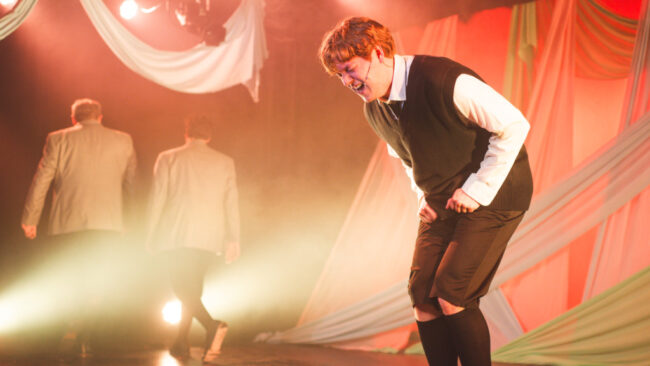
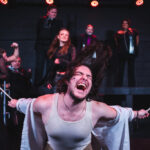
Stanely Evans’ Moritz is ripping your heart out, squeezing every last ounce of emotional blood from within and leaving you a shivering shaking shell once he’s finished with you. The angst, the agony, and the utter unsalvageable despair that Evans is bringing to this role is unhinged. He’s got young Adam-Pascal vocals working for him as well, which only enhances the experience. It’s the twitching physicality and painful-to-watch facial expressions as his eyes and mouth contort to fully exercise these demons from within him that really make his performance unbearably beautiful in that tragically terrific way. “And Then There Were None” gives us a taste of his vocal intensity and “Don’t Do Sadness” primes the audience for the eviscerating inevitable. Evans’ dynamic with Hutchinson’s Melchior feels earnest; the way he twitches and recoils from Burch’s Isle makes you want to squeeze him until he’s whole again, and when he takes the slap from Briner’s Mr. Steifel, Evans’ response makes you desperate to get up and slap that adult right back. There’s a level of evocative expressionism— physically and vocally— that Evans is bringing to the table that really draws you into his plight in a wholly unapologetically tragically beautiful fashion.
It’s a hard-working bunch, solid performances, and really striking moments with glorious music. Catch Spring Awakening as it hopefully awakens and invites the spring season to roll into the state of Maryland and stay here a good, long while.
Running Time: 2 hours with one intermission
Spring Awakening plays through March 8th 2026 with Tidewater Players in residence at the Cultural Center at The Havre de Grace Opera House— 121 N. Union Street in historic downtown Havre de Grace, MD. For tickets call the box office at 667-225-8433 or purchase them online.