
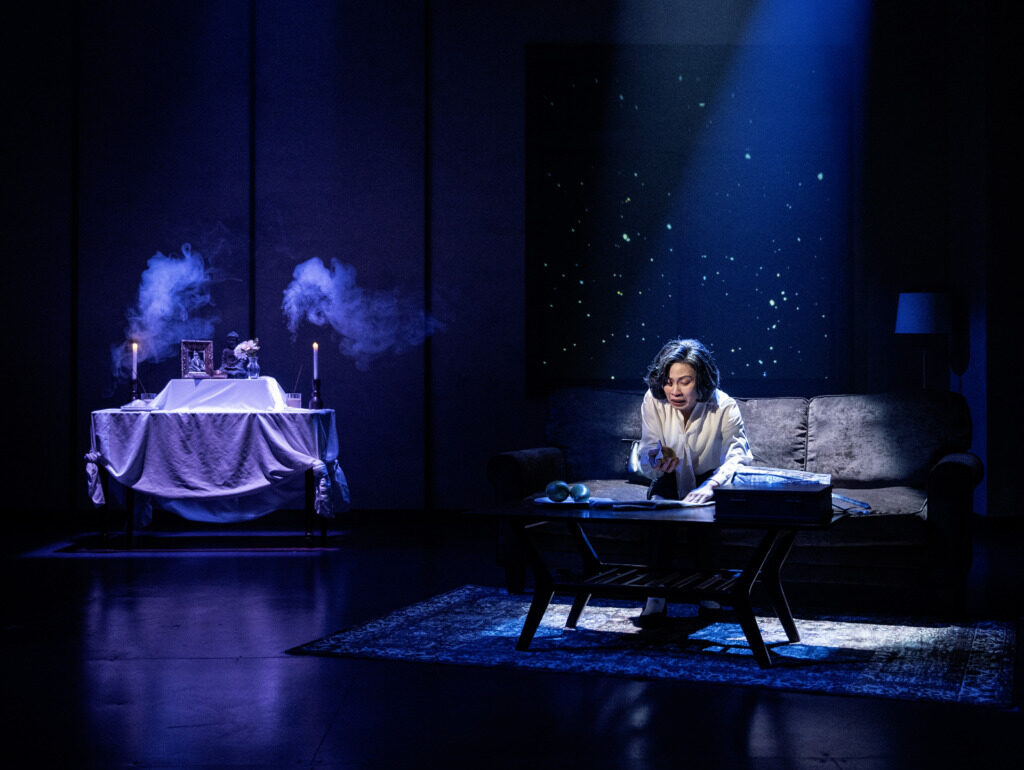
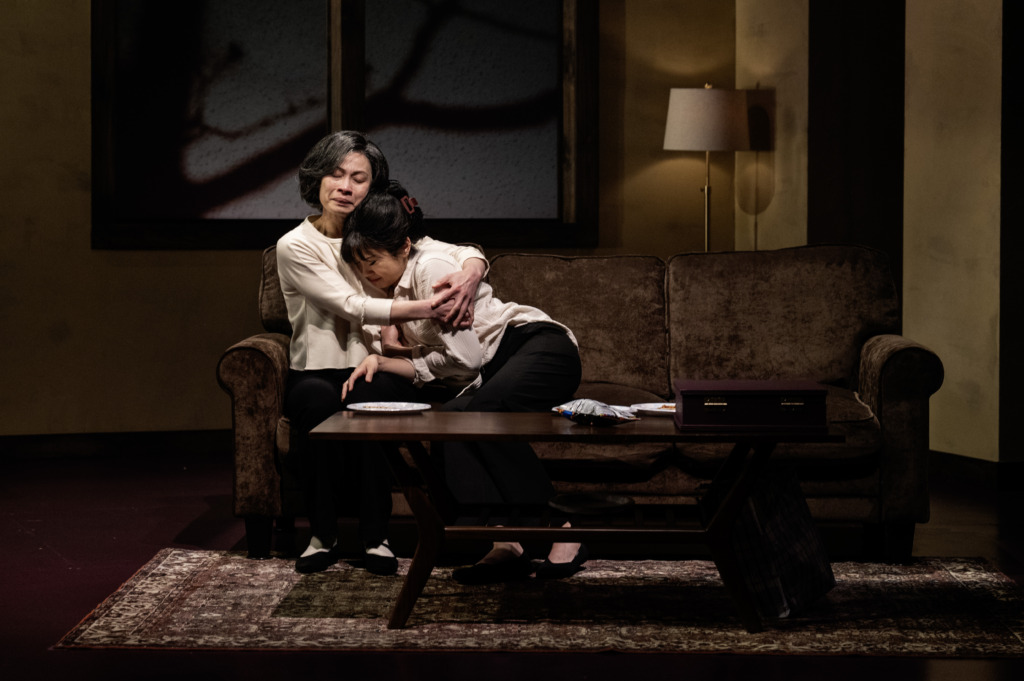
“No one understands their mother!” That was the line that got the most relief-laden laugh during the 82-minute run time of Dawn, a new play by Tuyết Thị Phạm, currently making its world premiere at Everyman Theatre. And while the sentiment may indeed be very true, its placement and timing were the exact break of levity that was required in the heaviness of the work as a whole. Directed by Seonjae Jim, this evocative and viscerally gripping, very personal story, explores the dynamic of generational disconnect when it comes to culture, trauma, and spirituality.
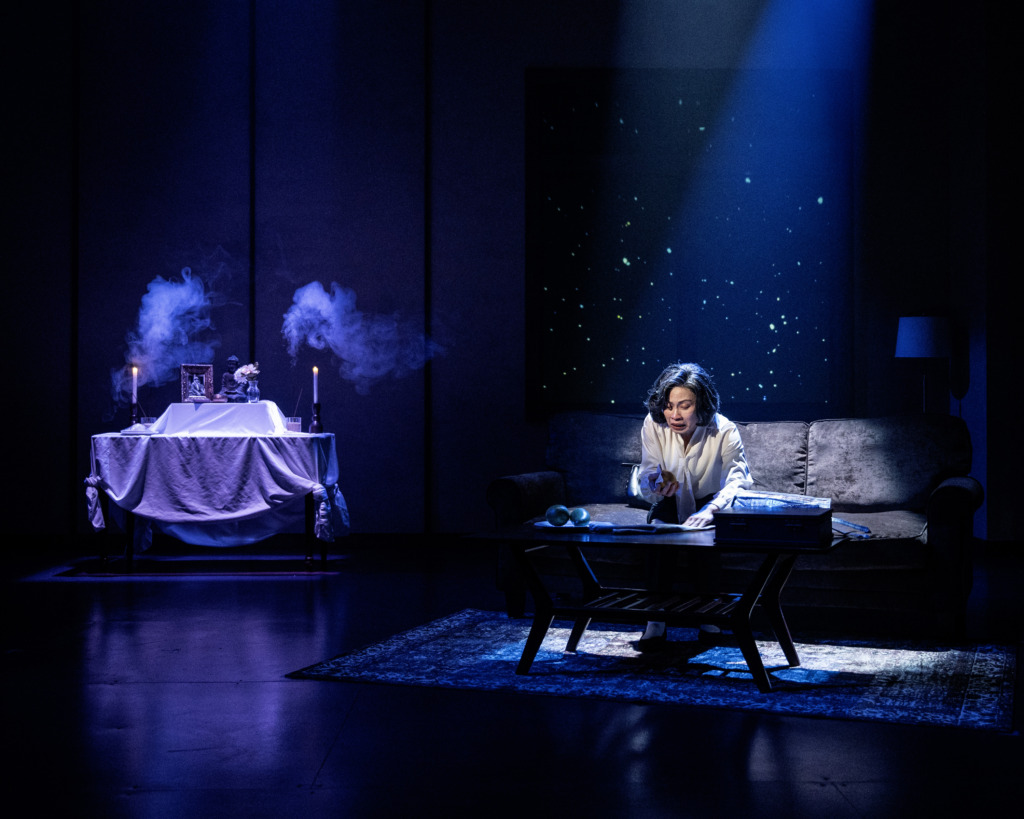
From a visual standpoint, the show is quite striking. Scenic Designer Paige Hathaway, working in tandem with Lighting Designer Juan M. Juarez and Projection Designer Chris Carcione, take an ordinary scenic shell— walls and windows constructed to be everything and nothing all at the same time— and transform them, predominantly through the use of Carcione’s projections, into the varying locational shifts of the play’s setting as well as the time hops. The projections that tell the audience specifically when and where the play has shifted to are appreciated but don’t seem necessary as the play’s ‘time-hops’ feel clear-cut enough to stand on their own. The truly striking imagery comes from the way Carcione projects stars onto the walls, for one glimmering moment allowing you to forget that you’re inside a theatre, watching a play.
Sound Designer Adam Mendelson does an exquisite job of moving the scenes from one to the other with an appropriate soundscape, keeping the sound effects mostly out of the active scenes, except in moments when they’re highly effective— mostly when ‘signs’ are being heard. Costume Designer David Burdick’s work is par with the expected timestamp of the production, nothing spectacular but certainly worthy of a mention for servicing the play’s aesthetic in its consistency.
Intimacy Director Sierra Young helps to fabricate the brutal reality between the Commune Director and Young Mother in a scene that occurs approximately two-thirds of the way through the performance. It’s Young’s work that allows this scene to read with such a visceral and raw reality, her direction, combined with the general stage direction and blocking of Director Seonjae Kim sends a powerful message in that scene, particularly the symbolism of how the scene concludes with those two actors blocked apart and the Young Mother character moving to re-attire herself in the way that she does.
The play itself is clearly a cathartic expression for playwright Tuyết Thị Phạm, though having her play the principal character does beg the question of what the play could have looked like had it been explored by another actor. Phạm’s writing, while beautifully expressive and deeply wound up in the harrowing reality of surviving such traumas— the play takes place, in part, in a makeshift hospital in Kampuchea during the era of Cambodian Genocide— and nightmares, falls somewhat short of feeling like a fully expressed work of theatre.
The character of Mary, the daughter to Mother, feels one-dimensional, existing only to lament about her perceived piss-poor upbringing because of her mother’s lack of presence in her life. There’s more to that and the family dynamic of loss, but I don’t want to give too much away as there’s a double-grief component that encapsulates the whole of the work (but you learn about both of these losses pretty early on.) Mary is presented as perpetually bitchy with few redeeming qualities, making it difficult for the audience to like her, let alone sympathize or empathize with her. Then there’s the unexpected belief-shift that the Mary character experiences ‘overnight’ at the end of the production. She spends most of the play railing against all sets, interlaced with her hatred and resentment of her Mother only to suddenly have a switch flipped after the ‘trauma reveal’ when she learns about what happened to her Mother. This feels both disconnected and unrealistic. It appears to be a step too far to ask the audience to suspend their disbelief in that vein, even with the reveal of the Mother’s experience to Mary.
The Sam (Taylor Witt) character also feels like surplus to requirement and begs the question if the same dynamic or purpose behind exposing this story and its meaning could be achieved without him. Witt felt a little flat in the performance, but this feels largely in part to his character not having much to work with other than the stereotype-framework that was used to construct his character.
The beauty of the script’s non-linearity is one of its finer points, though this does create a muddle of sorts when it comes to identifying the narrative burden because the protagonist isn’t readily identified. While this isn’t necessarily an issue as a story can have more than one protagonist, Mother and Mary don’t seem to share the weight of storytelling equally.
Some of the scenes, while really emotionally charged and pretty to observe just feel out of place. You have the rooftop scene (again beautifully crafted from a scenic standpoint) that gives the Sam character more to do (but again in a static, one-dimensional fashion) and the Mary character rants on and on and on, showcasing a plateaued, albeit heightened, level of bitterness, bitchiness, and overall resentment for her Mother, which both earlier and later gets repeated in the apartment both with and without Sam and the Mother. This particular scene also attempts to explore more of the relationship dynamic between Sam and Mary (which isn’t ever wholly established- lovers? married? dating? friends with benefits? it could be all of the above, none of the above, or something in-between) but falls short of doing so in a manner that benefits the play. It feels like an attempt to purge Mary’s pathos or expose her character flaws, which are already pretty well established. There is, however, this incendiary quote that really hits home for anyone who’s ever been in a difficult relationship- “…promise me that when I f*ck up, you’ll talk to me about it, and you won’t shut me out.” (it’s quotes like that all throughout the script that are truly awe-inspiring.) There’s also the ‘reveal’ that Mary shares with Mother (or Mother calls her out on, however you wish to perceive it) at the very end of the production which feels contrived to force that ‘spiritual-belief-shift’ and could have been left out, or played up more fully from go, rather than existing as a plot-device to draw the narrative to an open-ended close.
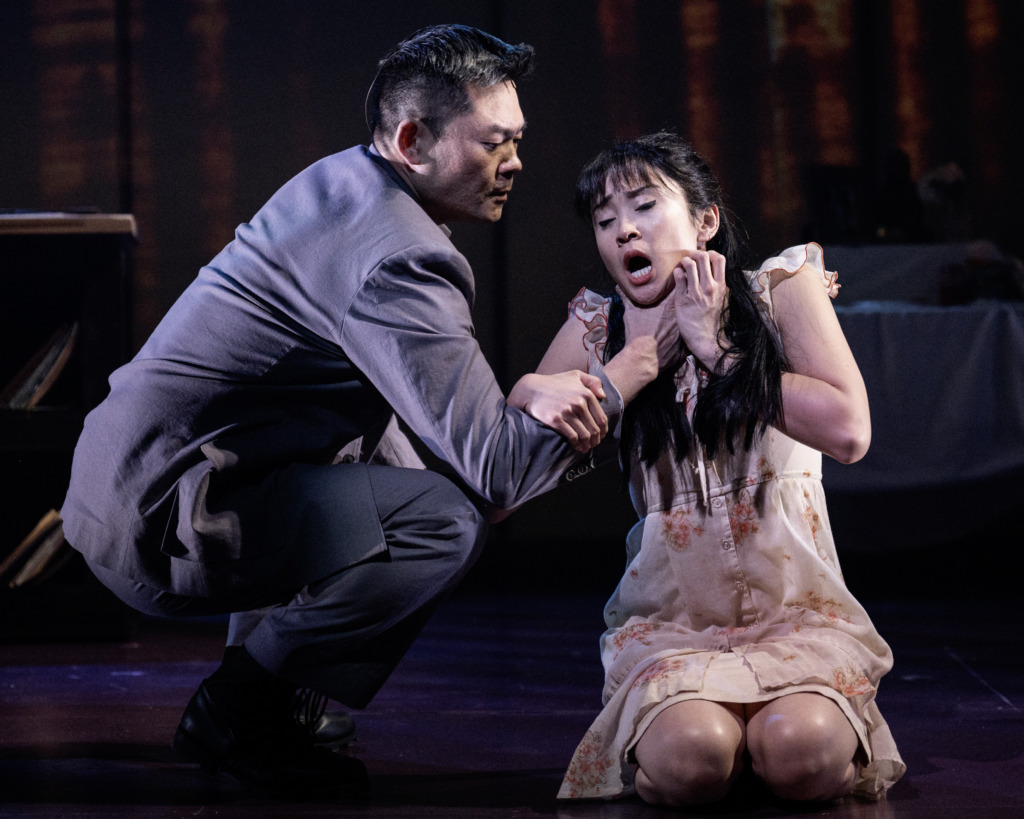
Where Phạm’s work is extraordinary is in the way it transitions through time— hop-jumping between memory and present. The choice to write the character of Mary and Young Mother to be played by the same actor is powerful and well executed in this production under the direction of Seonjae Kim. The actor, Ashley D. Nguyễn, delivers a striking performance as Young Mother, both in the opening scene at the hospital and in the later scene (parsed exquisitely as a living nightmare while Mother sleeps on the couch in the present setting of 2018) opposite Commune Director (Tony K. Nam.) Their scene as a whole is deeply unsettling, arguably the most evocative in the performance, though the moment that Mother (Phạm) has alone when she’s eating the mango and the altar is smoking of its own accord is a very close second, though it is disquieting in a very different fashion. Phạm’s most powerful moment on stage is when she is alone, eating the mango. The range of expressive emotions that she exhibits in that brief sweep of time is stellar and really reaches out to tug at the heartstrings; anyone who has ever suffered loss can find a point of relatability to the character in this moment.
The play is spiritually expressive, not without merit, and certainly not without important messages. There were half a dozen one-liners that caught the ear hard and fast in Phạm’s work that felt intensely moving, harrowingly meaningful, and intentionally loaded with questions that really gets the mind moving in how one can personally relate to this story. It’s a story worth exploring, despite feeling unfinished, or part of another experience, another existence. And the performances— particularly from Nam as the Commune Director, though he’s featured but briefly, and certainly from Nguyễn as Young Mother in the ‘past’ scenes— are intensely engaging, drawing you into the story.
New works should be celebrated and while this one may raise questions, may feel unfinished, and hopefully will grow to have legs on stages beyond Everyman Theatre, it’s worth investigating for the limited-engagement run in which it plays.
Running Time: Approximately 80 minutes with no intermission
Dawn, a play by Tuyết Thị Phạm is making its world-premiere through March 1st 2026 at Everyman Theatre— 315 W. Fayette Street in the Bromo Arts District of Baltimore, MD. For tickets call the box office at (410) 752-2208 or purchase them online.