
A lady’s imagination is very rapid, and while this lady’s imagination is not jumping from admiration to love to matrimony the way some of the Bennet daughters do in Jane Austen’s Pride & Prejudice, it is certainly jumping from point to point trying to extrapolate the thoughts and opinions formulated upon viewing Compass Rose Theater’s current production, as adapted by Emma Whipday under the direction of Madeline Austin (of no relation to the playwright.) I am only resolved to write in that manner, which will, in my own opinion, constitute my impressions thereof, take what you will from these musings and venture to formulate your own opinions on the viewing, accordingly.

Scenically, the show is quaint. Working within the confines afforded to Compass Rose Theatre by Maryland Hall, Set Designer August Henney and Lighting Designer Marianne Meadows craft a modest attempt at Regency era England and to some success, might I add. While there isn’t much depth to be had (of course, The Bennet household being one of meager means needn’t have such extravagance) Henney creates the illusion thereof with that little recessed exit-alcove upstage center. (And shoutout either to Henney or to Properties Designer Kristi Machemer for that delectable painting of Darcy when they arrive at Pemberly!) Ilana Mongilio’s costumes (assisted by Ali Saffell) are where the Regency era opulence come into play, particularly when it comes to the dresses that the Bennet daughters wear to the ball scenes. Meadows’ lighting, which for the most part is unobtrusive and otherwise unremarkable, literally shines in the moment where Lizzy is reading Darcy’s letter. The whole scene is quite heartfelt and dramatic, with Lizzy seated, the lights dimming and golden-ambering just so, (complete with a soft swell of emotionally charged instrumental music to underscore the moment, compliments of Sound Designer Jack Benedict) and Darcy standing behind her, reading in his own voice.
Where the show struggles is in its overall adaptation and in its generalized direction and pacing. Stage Manager Kaela A.C. Wilson keeps the scenic shifts moving swiftly but the overall pacing of dialogue exchanges in the scenes is more of a dreary soodle, even in places where snappy tempers and quick exchanges ought to prevail. Director Madeline Austin needs to drive a tighter tempo when it comes to much of this scene work, particularly as the text is all but calling out for it in certain scenes, most notably being the initial fiery shut-down exchanges between Darcy and Lizzy. In-scene pacing aside, perhaps the struggle comes more from what Emma Whipday (the show’s adaptor) has done, or rather— in places— failed to do. Whipday has taken the source and attempted to push it into farce-territory, only it feels as if she didn’t go far enough (or perhaps she did but director Madeline Austin didn’t take it there fully enough, six of one, half-dozen the other.) It feels as if Whipday’s approach is attempting to pay homage, mimic, or mirror a Kate Hamil (successful farce-adaptor of Pride & Prejudice amongst others) and the play cries out for more of that high-end comedic intensity. It’s there— in little nuggets and sprinkles, particularly with the character of Mrs. Bennet, though when she’s the only character living so wholly over-the-top it creates a noticeable disparity and generalized sense of unevenness amongst the others. It’s not to say that the show in places isn’t amusing or enjoyable, but the overall experience feels long, occasionally tedious, and clearly is begging for more comedy, more of a tempo push, and an overall zest that is just lacking— both from the adaptation and the overall direction.
Accents across the board were also somewhat uneven, with some actors maintaining more consistency than others, and no one is credited with the role of ‘dialect coach’ in the program (something that is oft expected from small, professional companies.) It wasn’t wholly off-putting and those who were consistent did so impressively, but for a professional company, the standard of expectation is higher. There were also other minor issues— like the lack of differentiating indicators for the actor playing Mary/Mrs. Gardiner; there simply wasn’t enough done to distinguish when she had shifted from being the sister to the aunt and on opening night it caused some inter-audience confusion (several audience members could be heard ‘whispering’ about why was the sister there and/or ‘who is that woman supposed to be?’) Again whether this is a muddle with the playwright or directorial decision seems unclear but this problem did not present itself when the actor playing Mrs. Bennet/Lady Catherine had to double up (nor was it an issue for the actor playing Kitty/Charlotte, so much so that it called for a double-take to see that that actor was in fact just one actor in two roles.)
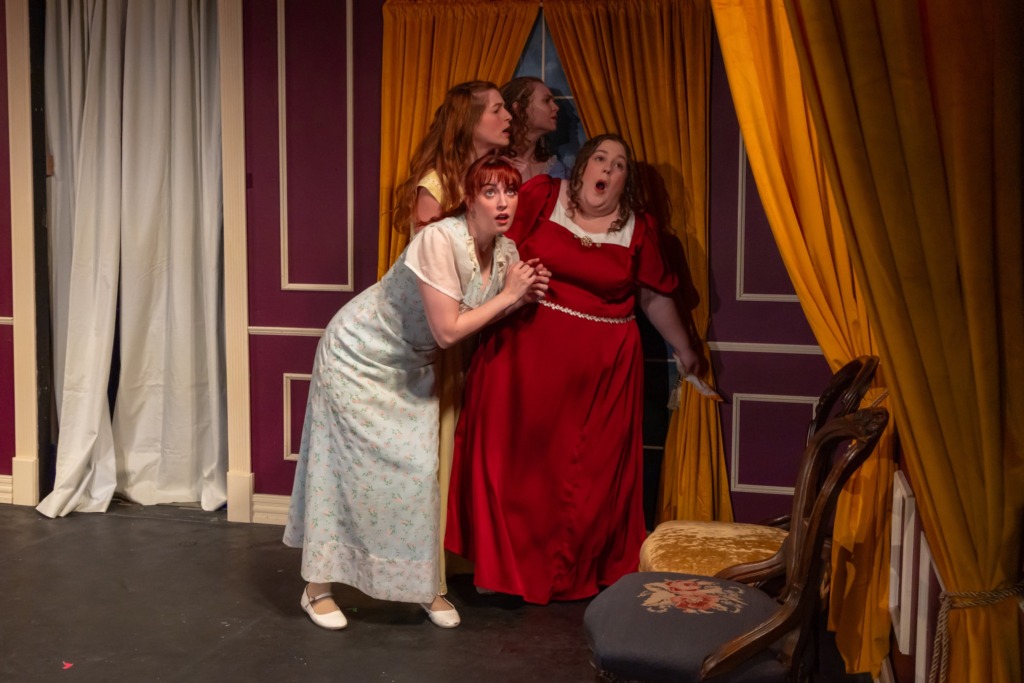
Arguably the most hilarious performance in the production was given by Katie Rey Bogdan as the indefatigably over-the-top Mrs. Bennet (and all the more so when she hip-saunters into the room as Lady Catherine, trying to make it as painstakingly obvious as possible that she has become another character.) Her heightened sense of theatrics, particularly her ‘turns-on-a-dime’ opinions regarding the various men in the room, is nothing short of an uproarious hilarity that has the audience giggling madly. When she starts fussing at Mr. Bennet (Matthew Crawford) you can’t help but feel for the poor fellow, it’s bad enough he’s already been saddled with being poor and having five daughters! Crawford has an excellent handle on his sardonic and almost flippant responses to his nagging wife, and gives consistent, intentional performances throughout the production (if there’s a singular note, from an aesthetic standpoint, they’ve done such a nice job with graying the top of his hair to give him a more ‘aged’ look but then left his ponytail and beard a perfectly youthful vibrant ginger…it makes the ‘gray aging’ look fake and very noticeable. Either leave it off entirely or go gray entirely, half and half isn’t working in this intimate venue and honestly, the beard makes him appear older than the daughters so the gray coloring feels unnecessary.)
Elvis Karageya, as Mr. Collins, creates a striking presence on stage, his towering stature looms over ever scene he enters. (Though is character is the one whose existence is most crying out for more humor, more over-the-top antics, etc.) His little asides, when he appears in ‘letter-delivery’ are quite cheeky, though. Compared to the smitten-kitten Bingley (Joshua Ikotun) and the brooding Darcy (Gaven Heglar) and the enigmatic Wickham (Matthew Beagan) he seems to be the most eligible of the bachelors (and that is certainly not what Jane Austen intended.) Ikotun, as the dashingly excitable Bingley is just charming and his little meet-cutes with Jane Bennet (Molly Marsh) and sincerely saccharine and delightfully sweet. Heglar’s Darcy is as close to a textbook approach to the character as one can hope to see on stage, particularly when having the initial rub-wrongs with Lizzy Bennet (Caleigh Riordan Davis.) Again, some of these lack that intensely sparked ire, though that feels to fall mostly on the shoulders of Madeline Austin and Emma Whipdash and far less so on Davis and Heglar.
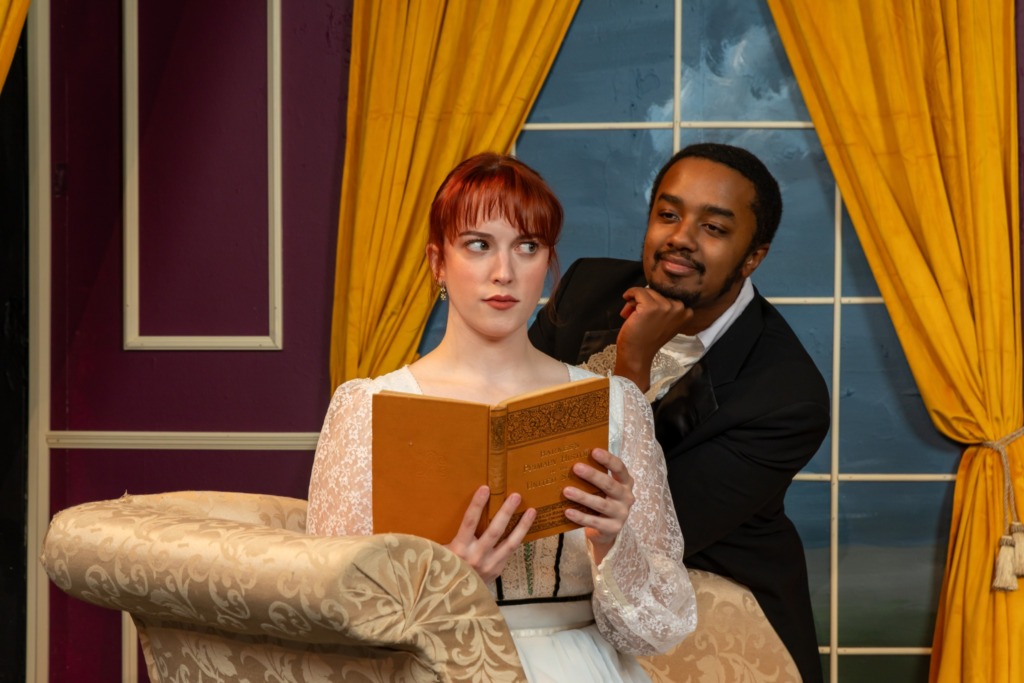
There’s a brilliant sororal bond between Davis’ Lizzy and Marsh’s Jane; they are the closest of sisters and the best of friends and it shows radiantly and with resplendence every time they interact with one another, even if it’s during the ‘letter delivery’ scenes. Emma Magner, as Kitty Bennet, and Leah Senseney, as Lydia Bennet, have that silly playful ‘youngest of the sisters’ mentality that is just bright and gay and lets you enjoy their youthful exuberance, though Senseney’s petulance comes into play as the soldiers come round and when she lands herself in Wickham’s (Matthew Beagan’s) court, you get to see a bit more of her impish behaviors in their fullness. Peri Walker, as the coughing, somewhat disturbing Mary Bennet, delivers this caricature role with great edgy resistance (she sings a song as well, necessitating the show’s musical director, Jack Benedict, and while it’s clearly meant to be off-putting as one of her ‘not-so-great-talents’, Walker has a lovely voice and puts the sound out there just fine.) The whole Bennet family is delightful to watch, Magner in particular when she’s playing Charlotte Lucas, first as confidant to some of the sisters and later as true relations for circumstantial reasons.
Lilly Burchfield, in a category all her own, drives a great deal of the show’s haughtiness when playing Caroline Bingley, the snooty, affluently-influenced sister of Bingley. Her jabs and barbs spar stingingly at both Jane and Lizzy and while she’s not truly a primary character, what’s she’s doing in her role is so very fascinating, you almost wish someone would adapt Caroline Bingley’s tale and spin the narrative from her viewpoint.
It’s a solid approach to Jane Austen, if not a lengthy one, though not without its little treasurable moments of laughter and if you’re looking for a way to celebrate Jane Austen’s 250th anniversary, this is an option that’s open and on the table.
Running Time: Approximately 2 hours and 35 minutes with one intermission
Pride & Prejudice plays through December 14th 2025 with Compass Rose Theater in residence at Maryland Hall for the Creative Arts— 801 Chase Street (third floor) in Annapolis, MD. Tickets are available for purchase by calling the box office at 410-980-6662 or in advance online.
While it does bring me joy to know the grey in my hair doesn’t fit with the rest of my vibrant ginger hair/beard… alas, I must report that it is my natural hair color. Polling the audience now, should I dye the bits of grey to match what’s left of my fading youth?
Oh dear!!! Your glorious youthful face and beard looked so vibrant it surely looked like a choice to make you old enough to be the father of the various and sundry Bennet daughters!