
Sometimes the right dress makes all the difference. I’d be hard-pressed to find a more relatable statement, particularly when it comes to going out to the theatre. In the industry for nearly 15 years a reviewer, with the reputation of ‘that one who dresses up to the theme of the show’ the right dress can make all the difference. Knowing nothing about Red Hill Theatre Group (a true shame as they’ve been around since January of 2020— getting one solid production under their belt before that pesky little problem of the global pandemic halted all theatre in person) and producing mostly in the Frederick area, I skimmed the press release for anything that might clue me in on what to wear. I honed in on ‘lavender martinis’ and went with a lavender dress; it felt fitting. And it made all the difference. Dressing Amelia, a work by Chloë Whitehorn, features a series of dresses all throughout this one-act production that helps to define pinnacle moments in the titular character’s life. A curious play told somewhat in reflective memory, this show, directed by Jacob Reese, does pose a lot of good topical conversation-starters and has some solid actors in its midst.
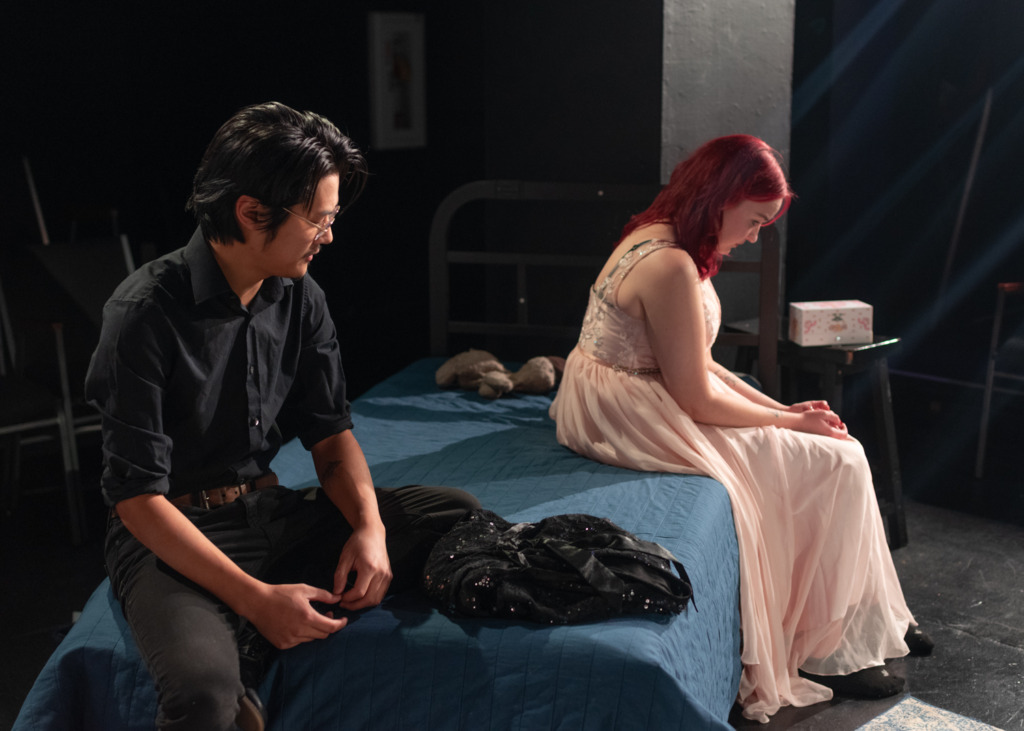
A simple set, simple lighting, two music cues— one at the top of the performance and one to signal the show’s conclusion— Red Hill Theatre Group isn’t breaking the bank with production values, but they’ve chosen performers with gumption and an edgier new, albeit flawed in its structure, script to engage the audience. Director Jacob Reese serves as the show’s set designer whilst Shayden Jamison crafts lighting and sound. Ambient interior lighting does the trick, though I suspect there’s a yen— both in the script and perhaps from the creative team— to do something more intense or at least less subtle when it comes to lighting and illuminating the arrival of the Grace character. Every time she enters the bedroom, one almost expects a pop of vivacious color or at least something really flashy coming from above. (It’s difficult to tell if the cues were there and just so subtle it was imperceptible— I point this out only because when she finally makes a stage exit through the upstage-left door, there is a noticeable difference in lighting in that moment— or if they were overlooked in favor of just letting the actor do their thing.) Ultimately the production values, minimally-focused though they are, enhance rather than detract from the experience and as the experience itself is about giving breath and life to an under-recognized work, that works in this case.
Directorially, Jacob Reese gets solid performances out of his cast of four and the show moves quickly. The major issue with this work is the playwright’s style and overall approach to the play. Chloë Whitehorn lacks a structural polish and a ‘finished’ finesse which makes it somewhat of a tasking watch— not because the acting isn’t good (it is) and not because the subject matter isn’t important (it is) but because the work itself feels more like a ‘workshop’ or rough-draft rather than a final product. Dressing Amelia clearly has an intent of emotional catharsis, discussing heavy topics surrounding death, rape, mental health, and relationships, and I would never take it upon myself to denigrate the playwright’s experiences in expressing them (the work reads largely as if Whitehorn needed a safe and creative space to express and vent these emotional experiences and that— at its core— is a structural tenant of what theatre can and should do), but in its present existence it feels clunky. Whitehorn dances all around the two main issues— the rape that the daughter Amelia experienced and the lack of parenting from the mother— without ever wholly addressing them. And while with a more stylistic approach or clever use of dialogue and stage directions this could be effectively achieved without ever having to actually mention the proverbial ‘elephant in the room’ it doesn’t quite land that mark as it stands. It also feels like the main goal of the play— expressing grief and coping with loss and coming to terms with both— is pulled in warring directions but not in a complimentary fashion.
There’s a clear notion of what Whitehorn was attempting to do with the ‘Grace’ character, having her appear in various iterations the way she appears in Amelia’s memory but even that lands unevenly at times and while it’s meant to be a ‘big reveal’ of sorts, most audience members twig pretty early to the fact that she is who she is and she isn’t where she is. There’s also a disconnect to the petulant attitude and overall behavior being presented in the Amelia character— the character is described as ‘nearly 30’ (and forget the fact that the actors in play are all quite young looking) the behavior feels much more aligned with a late-teenaged character or even someone fresh into their 20’s, which rankles somewhat in the ‘suspend your disbelief’ arena. (Same can be said for the Thomas character just based on his interactions with Amelia…the play might be better served if they were both 20 or 21 rather than nearly 30; you don’t lose anything contextually and as grief exists outside of a timestamp, the behaviors and reactions of the characters might sit more naturally in the play as a whole.)

If more time had been spent on each of the ‘outfits’ (since such a production is made of having the Grace character debut them and why they’re significant) the play might be better serviced; taking each of those five outfits and fleshing them out, even perhaps staging them as a living memory— show vs tell— would help solidify the experience and the narrative as a whole. Whitehorn also falls heavily into using repetition in a way that feels awkward and clunky, like she wasn’t certain that her points were being driven home so she got heavy-handed with her wording. There’s a particular delivery from the Grandma character where she says something about ‘…selfishness being an inherited trait…but you didn’t get that— not from your mother, not from my daughter, not from Grace…’ and that’s three-peating the same person unnecessarily where picking a singular superlative there would have sufficed. The topics contained in Whitehorn’s work are worth exploring and perhaps another draft or different work will do so more thoroughly.
The performers are solid, particularly emotional, and engaged with the text, though as previously mentioned the dialogue gets a bit repetitive and also feels stagnated. It starts with strong emotions, leading no place to really build to, and stays at that heightened plateau, making it difficult for the actors to really engage the audience in the story. Laura Richards Bakin, as Grandma, has one of the most compelling emotional outbursts in the performance and I find her character to be most believable, particularly in her distracted refusal to acknowledge what’s being discussed, right up until she goes full-bombacity on the experience and rages from her character’s viewpoint. Christopher Leatherman, as Thomas, has some quirky one-line responses that result in laughter and much needed levity-humor for the show. His character appears to be the least developed of the four that Whitehorn has created in Dressing Amelia (literally begging for more of his backstory and dynamic with Grace, especially as the play is so short there’s clearly room for it from a time-standpoint.)
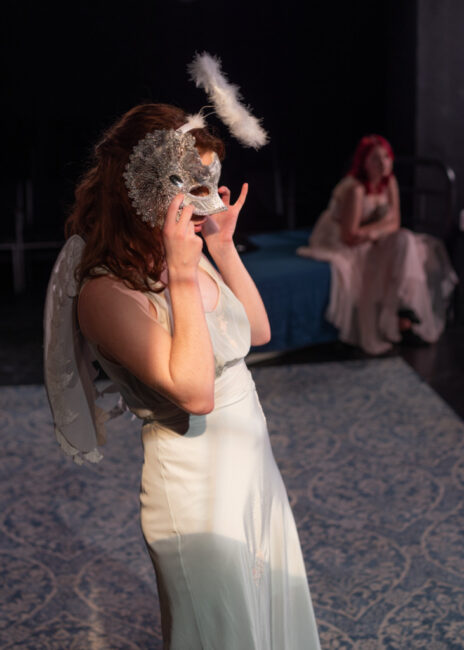
It’s a curious choice to write the character of Grace (played with effervescence by Abby Gaver) the way Whitehorn has, though it’s obvious the intent she was attempting to achieve. I do believe the character would be better perceived by an older actor (which is where the costuming can come in to play to create Grace as Amelia remembers her) but with the current casting selection it creates a level of confusion for the audience— only because Whitehorn’s intent of who and why Grace is when she first starts appearing is unclear (meant to be ‘secretively-revealing.) Director Jacob Reese does a brilliant job of spatially aligning Grace’s existence so that she’s only ever entering and existing through the upstage-right door (until that final moment) which helps define who and why she is before it’s finally explicitly stated by the Amelia character.
Taking the titular role in hand, Amanda Thomas brings a sophomoric petulance to the character which creates discord between the age of the character and the perceived behavior. I want to be clear, it’s fine acting on Thomas’ part but again the juxtaposition of what’s written verses behavior creates confusion (the burden of which falls back to Whitehorn.) Thomas does their best with the looping phrases that keep coming up over and over, though one of their strongest feats in this production is making a personalized connection— or in the case of the Grandmother character, a disconnection— with each of the three characters featured in the work.
Ultimately it feels like watching a ‘final project’ in a scene-writing class, and that’s not to denigrate Whitehorn’s experiences or feelings, but more to point out that this story is unfinished and could function more wholly with revisions and expansions. It’s still a really unique experience that isn’t being produced anywhere else and worth a look. Tickets are only $10 and it’s only an hour of your evening; support local, experimental theatre. It’s the stepping stone in our theatrical world that often gets overlooked.
Running Time: Approximately 65 minutes with no intermission
Dressing Amelia plays November 15th 2025 with performances on the 14th & 15th at 8:00pm and at 3pm on the 15th as a Red Hill Theatre Group Production, currently performing on the Maryland Ensemble Theatre’s FunCompany Stage— in the Historic FSK Hotel building— 31 W. Patrick street in downtown historic Frederick, MD. Tickets are available at the door or in advance online.