
Diplomacy is nothing but a cockfight. Sounds a bit too modern for something that happened almost 440 years ago. And yet the striking political relevance inside Friederich Schiller’s Mary Stuart (new version adapted by Peter Oswald and currently directed by Ian Gallanar) is both eerie and chilling to the world we’re presently living in. This evocative drama, despite its hefty run-time, is impressive and exceedingly well-polished upon the Chesapeake Shakespeare Company’s main stage for their final indoor show of the 2024/2025 season.
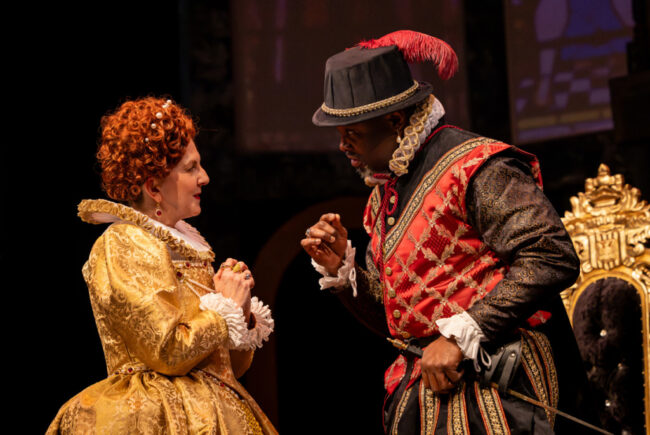
With a sweeping, yet simplistic set (Dan O’Brien, relying heavily on carefully curated projections to shift from inside various palatial and prion settings to the outdoors and back,- the stained glass panes are particularly gorgeous when showcasing the interior of Elizabeth’s various opulent living spaces) the show’s visual spectacles come into play by way of Costume Designer Kristina Lambdin. Masterfully displaying a keen understanding of Elizabethan era fashions, Lambdin’s sartorial selection for Elizabeth, Queen of England is striking. Decadent opulence reigns supreme on the sartorial selection for the Elizabeth character, whilst others in her court and service are outfitted with grandeur, though not quite as shiny. By comparison, the ordinary and almost banal pieces reserved for the titular character look paltry and create quite the disparity of ranking and importance by comparison. Hannah Brill, the show’s wig designer, has earned her praises as well, given the dueling red
Dialect Coach Gerrad Alex Taylor does an impeccable job of separating the sounds of the characters; Mary Stuart has a heavily steeped French sound that is still highly intelligible and easily understood, not something every professional dialect coach readily achieves when working in this vein of accent and affectation.
Herein lies the lone problem with CSC’s production, if one could even deign to call it that. “Everyone judges by appearances; nobody bothers to fathom reality.” And the appearance of a titillating queen show-down— wholly hyped by the house PR and Marketing Team members with ‘Team Mary/Team Elizabeth’ stickers that they encourage you to select and wear before the performance starts— is but a small fraction of the play’s reality, leaving a lot of languid, albeit necessary, build-up. The play has a running time of over three hours (including the intermission) and while it is exceptionally well-performed, even well-paced in so much as Director Ian Gallanar can master with what Schiller and Oswald have provided regarding source material, there’s just not enough happening to keep your average audient from noticing how slowly time seems to be slipping by. Perhaps modern audiences aren’t primed and prepared for the three-hour history plays anymore. Though it poses a far different question if you do see the show and then try to figure out what could have been cut (where, how, why, etc.) When there’s action, it’s brilliant. When there are devastating moments of emotional silence, it’s riveting. There just aren’t enough of these moments evenly distributed throughout Oswald’s adaptation of Schiller’s play to justify three hours of play-time.
Gallanar has a compelling company of actors at his command. It can even be said that amid the humdrum drudgery of some of the more mundane scenes, Gallanar finds those edgy little moments of humor— the darkly hysterical agony of William Davison (played expertly and earnestly by Isaiah Mason Harvey) trying to garner clarity from Elizabeth over what to do with a certain piece of very important paper, comes immediately to mind— or the three-way council session between Burleigh (Michael P. Sullivan), Shrewsberry (Gregory Burgess), and Leicester (DeJeanette Horne) where each of these men of influence and affluence bend Elizabeth’s ear on how to handle ‘The Stuart’ situation, resulting in a ‘kill her, free her, wait-n-see’ rinse-and-repeat cycle of pleading which adds dark chuckles to the audience’s experience.
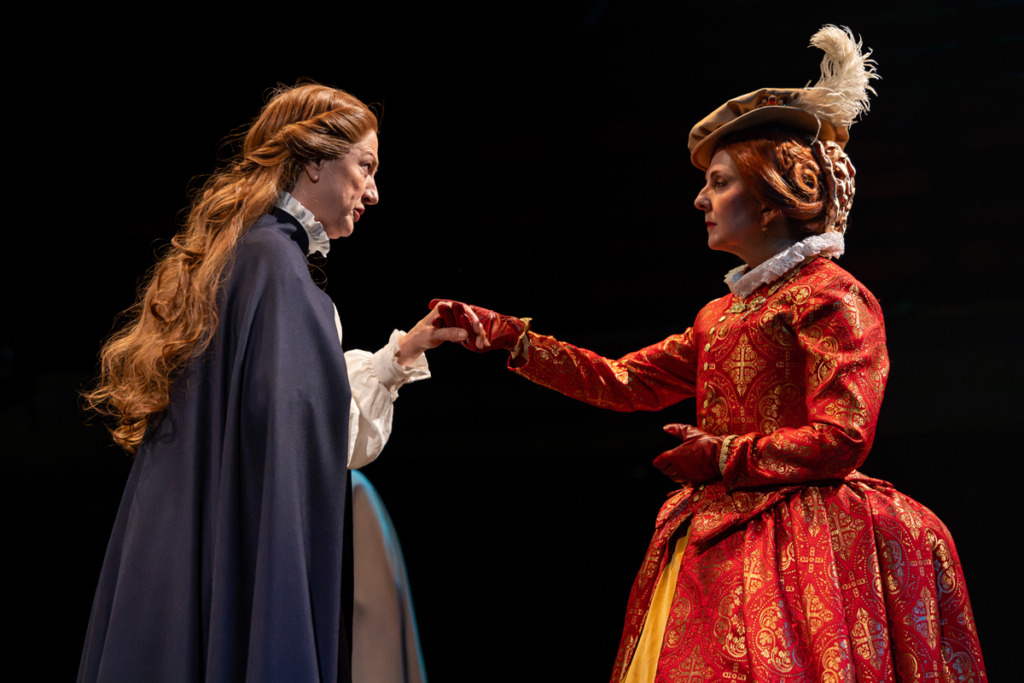
The character portrayals are sublime— again the only major misstep with this production seems to be producing it in its entirety and that falls largely on Peter Oswald for not finding a more succinct way to adapt the original. When the audience is finally treated to the much-anticipated two-queen show-down, it is everything one could hope for with two women verbally sparring at one another in a regal, merciless fashion. The blocking and pacing, the way the others are stacked around, the posturing, peacocking, parading, and ultimately pleading— everything that happens in that scene in the ‘woods’ between Elizabeth and Mary is striking, breathtaking, and arguably the most exhilarating scene in the performance, barring perhaps the lone moment at the end where Elizabeth finds herself seated alone on her throne (gloriously fabricated between the masterful talents of Dan O’Brien and Properties Artisan Paige Stone) delicately lit (shoutout to Dean Leong, the show’s lighting designer) and morosely contemplative, mulling over the consequences of her actions and inactions.
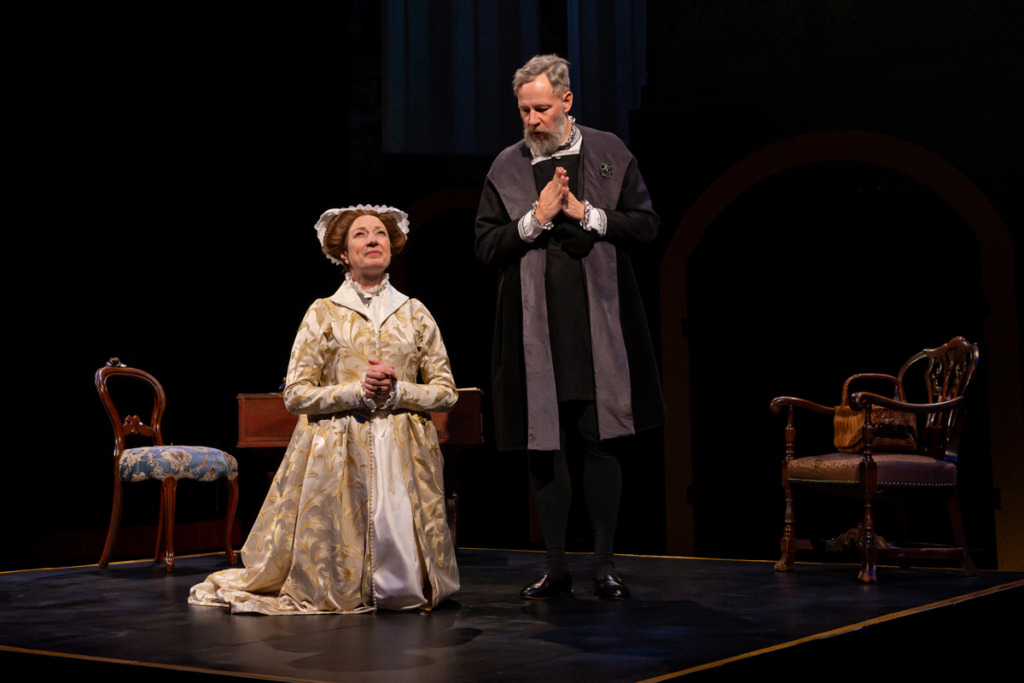
There’s ardor a plenty in this performance, presenting itself in a myriad of ways— the devoted tenderness and sororal love from Hanna (Jamie Virostko), the nurse to The Stuart. Virostko is supportive and nurturing and her Scottish accent is thick but intelligible, even ripe with prickly humor in moments where the script calls for it. There’s compassionate devotion, arriving in the eleven o’clock hour from Melvil (Paul Diem) who serves as the final confessional for The Stuart as her moment of ending approaches. Then you have rogue and piggish intent, guised as loyal devotion from Mortimer (Joshua Williams) who could arguably be said is the most explosively versatile performer in the production as he goes from one extreme to the other whilst the other leading characters have more intricate nuances to their extremes. There’s confused loyalty, which is its own sort of inflamed love, as displayed by Harvey’s portrayal of Elizabeth’s secretary in that aforementioned, darkly-humored scene.
But true ardor is perhaps best represented in DeJeanette Horne’s portrayal of Leicester (which creates a whole bunch of chaos and turmoil as it gets revealed, layered-back-up, and revealed again) There is an intrinsic and frenetic passion with which he approaches the character, well-hidden at first under the cover and justice and fairness. This makes for quite the sparked series of scenes with him and just about everyone, particularly Sullivan’s Lord Burleigh, who is a slimy incarnation of greed and corruption. Sullivan tackles the odiousness of this character with practiced ease, making it easy for the audience to dislike the character from the word ‘go.’
Two dominating forces upon the stage— one restrained tempest, one waffling pillar— it’s quite the show to watch them both, in their respective separate scenes and all the more so once they finally come together. It’s difficult to muster sympathy for Elizabeth, Queen of England, the script leaves her somewhat cold and unfeeling (arguably the most notable trait of a long line of English Queens) and Lesley Malin fills in that aloof, detached sense of regality and haughtiness while still finding just a touch of humanity that slips out of her frosty façade every so often. Though when she’s incensed, Malin lets the Queen’s temper fly at full-mast, making her previous callous and haughty airs seem like a thin veneer for a raging spirit.
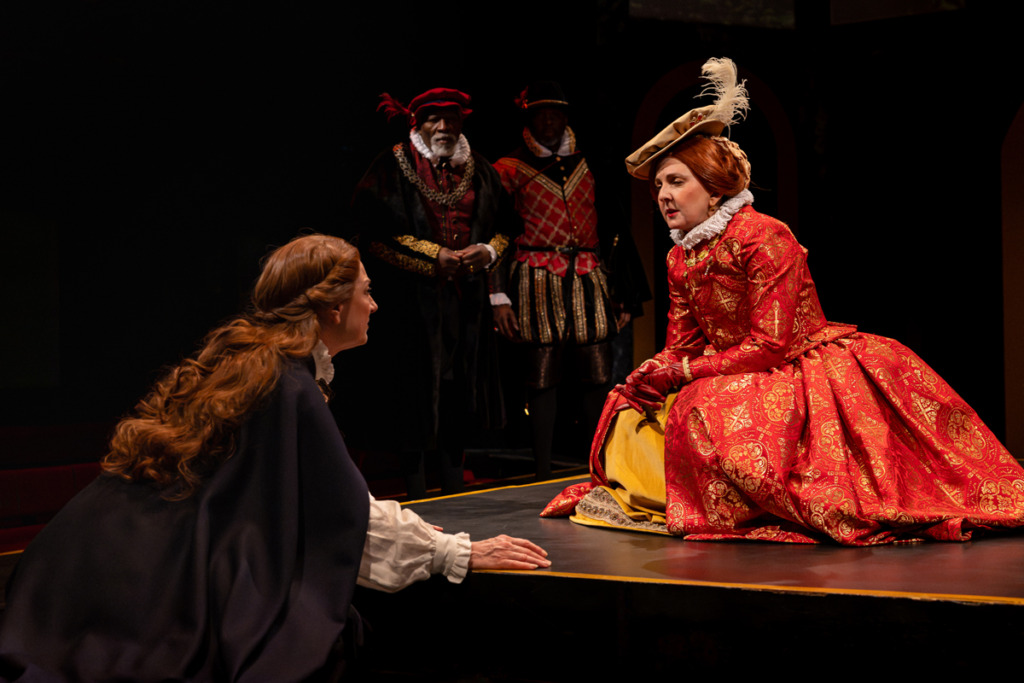
In the titular role, Lise Bruneau delivers composure, elegance, grace, and ultimately humility, though her character portrayal of Mary Stuart is not without its quietly seething and tempestuous nature. There is a jovial earnestness about Bruneau when her Mary Stuart tastes ‘freedom’ in the woods, running and playing like a school girl, dizzying herself about all over the stage. But for as free as she portrays the character in that moment is as quickly as she transforms that ease into trepidation and fear when the approach of Queen Elizabeth is announced. There is a subtlety to the way Bruneau traverses the emotional narrative and overall challenging experiences of Mary Stuart. Malin’s Elizabeth has more of a presentational nature, where the emotions are buried deep within her character portrayal and hardly ever exposed at the surface level for their true depths. This makes Malin and Bruneau indefinitely fascinating to watch, particularly in the lone scene that they share in the woods. Both women are graced with a sense of poise and composed civility though in very different veins, with vastly different mannerisms and approaches to the same character traits. Knowing which side history ended up favoring makes it that much more intriguing to see how the audience responds as neither woman plays the show’s ending like a foregone conclusion (even though it’s written to be historically accurate.)
Intriguing, albeit lengthy, this living history lesson is a curious though interesting way to end the indoor-mainstage season for Chesapeake Shakespeare Company’s 2024/2025 production year.
Running Time: Approximately 3 hours with one intermission
Mary Stuart plays through May 18th 2025 with Chesapeake Shakespeare Company— 7 S. Calvert Street in Baltimore, MD. Tickets are available by calling the box office at 410-244-8570 or purchasing them in advance online.