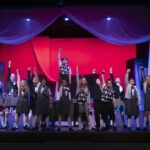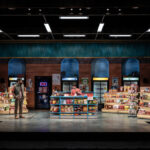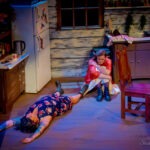
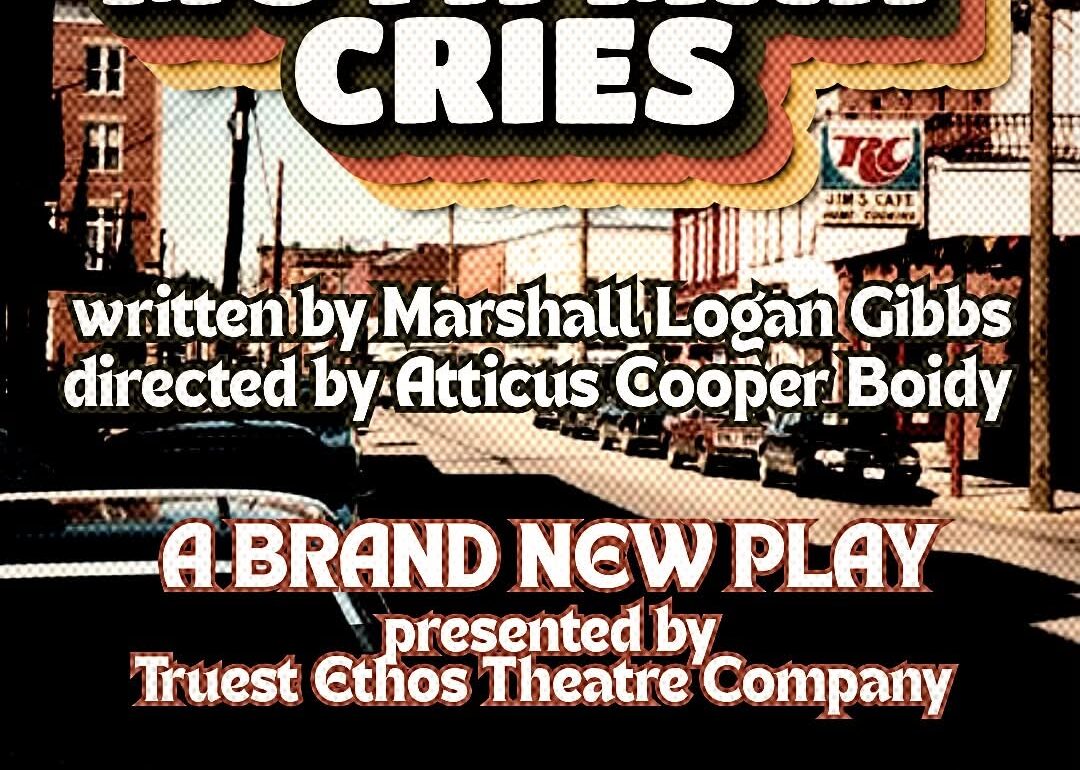
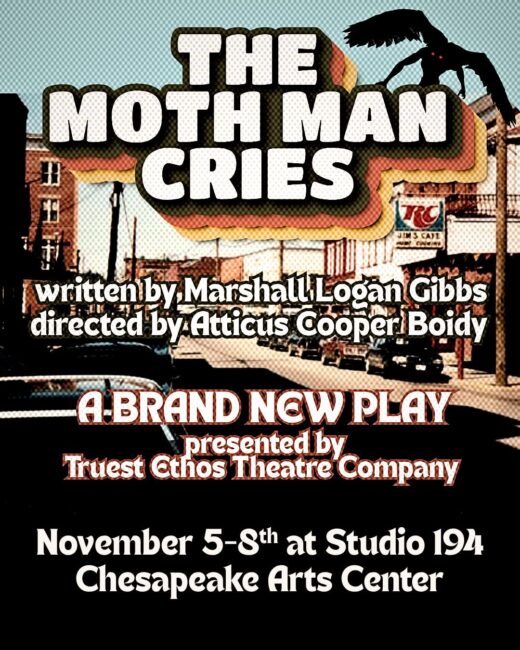
“You invite evil in and then you get scared when something comes crawling out.” A quote from Marshall Logan Gibbs’ newest work The Moth Man Cries, a play which circles around the iconic legend of the Mothman in Point Pleasant, West Virginia. A historical cryptid phenomenon, popularized first by John Keel’s book The Mothman Prophecies in 1975, which was later adapted to the silver screen in 2002 under the same name, starring Richard Gere. Gibbs’ play, Directed by Atticus Cooper Boidy, takes a centralized focus around the notion of cult-religion, the Shawnee historical legend component, and adds a queer lens to the story’s main protagonist, Dellie, to bristle against the times in this ‘finding yourself’ story that nestles into the popularized following of The Mothman.

The play itself is written with heart and passion, that much is clear and is evidently witnessed in the way Marshall Logan Gibbs constructs poignant arguments, dramatic tension, and overall character development. Some of the most compelling scenes are in emotional explosions, mostly erupting from the protagonist character of Dellie, where you can sense the confusion, the frustration, the deep curiosity of what life is versus what life should be like for this youth who disagrees with the situation in which she’s being raised. Gibbs, however, has a few scenes that feel a bit out of sorts with the play a whole, not a total sense of incongruity but just either surplus to requirement or ‘not-quite-right’ where they land overall. The first that comes to mind is the exchange with the Bonnie character and the Dorothy character, while it’s cute and cheeky, it feels very much like scenic filler (which doesn’t even appear to cover a costume change) and has this sense of “well, these two characters haven’t shared a scene together yet, let’s see what happens if the they do” and while the details that come out, regarding ‘The Beatles’ in that scene are silly and add humor to the play, it doesn’t appear to serve a function otherwise, especially as the moment that follows is Dellie saying goodbye to Bonnie, which Dorothy watches, so no true goodbye or exchange can really happen.
The other such scene that really sticks out in this way is unfortunately the most beautiful piece of playwright prose and arguably the most impressive performed monologue in the whole play. It’s the stand-alone moment with the Richard character in the woods, addressing the unseen Moth Man. Actor Gabe Webster does a stellar job with this scene, being wholly emotionally grounded, still and present, giving extraordinary depth and sincerity to this monologue. But the monologue itself, while making a striking and tragically beautiful comparison between creature and character, creates this notion of anthropomorphizing the phantom cryptid merely for the sake of doing so. It’s gorgeous writing, superb acting, but essentially works as a pacing leech to the play as a whole and just feels out of place. If the story had more of a divided split— focus on Dellie AND on Richard’s journey, there might be a way to have this striking piece of writing and performance fit the overall path of the plot, but as it stands, it’s a sidebar scene that just puts a hiccup in the show’s overall momentum.
There are a few little historic anachronisms that due to the intimate nature of the play and also the closeness of the venue audiences are likely to glom onto— the most noteworthy one being Aunt Dorothy saying they’ll “pop to Bob Evans for breakfast; biscuits and gravy.” (And yes, Bob Evans did have a singular restaurant, exclusively in Ohio in the 1966-1967 era, called The Sausage Stool, a second location didn’t open until 1970 or so and it wasn’t until the early 70’s after the bridge collapse that the franchise started to take off, and was still only in Ohio…and as one of the central conceits of the show is that these people in Point Pleasant never leave…it would hardly fit Dorothy’s character to suggest popping across the bridge into Ohio for post-church breakfast. It’s a simple enough fix, by just saying “we’ll go out for a nice breakfast after service” and then it doesn’t jar the ear to the tune of ‘that doesn’t seem right.’) The same with Richard’s Rolling Stones graphic t-shirt. While the idea is right, as graphic T’s did technically start appearing about that time, the iconic tongue of The Rolling Stones wasn’t public until 70/71 (and we don’t need anyone thinking Richard is a time traveler.)
Where Gibbs’ work is truly astonishing and really grabs the audience’s attention is in the historical narrative of the Curse of Chief Cornstalk. Having the Librarian character of Ruth, who’s grandmother is Shawnee, tell the tale to Dellie, and using her little models (though at times because they are so small and Ruth and Dellie are situated around their table in such a manner that it makes it difficult to see) to illustrate the anecdote is brilliant. The message behind ‘an omen’ is also powerful. And Gibbs’ overall penning of the religious cult-like existence which Richard and Dellie are both not cut out for is striking. Director Atticus Cooper Boidy hones in on the Dellie character’s closeted queerness during that first interaction with Bonnie; it’s subtle, smart, and really lovely to watch— that simple blocking choice of pulling back when they’re seated together on the bed, speaks volumes about their dynamic. And Gibbs’ wording— “doodles on a napkin, children’s temptations and distractions” is exquisite.
Gibbs doubles up as the show’s sound designer (with musical arrangements by C.C. Galagher) and 99% of the show’s sound effects are perfection. When the car peels out of the driveway, the ambient night sounds, even the way The Beatles’ records blend and flawlessly stop when the record player needle is moved away, it’s all smooth and a fantastic fit for the show. The background cinematic quality that creeps into the anecdote of Chief Cornstalk is haunting and a little disturbing too. If there’s one curious choice amid Gibbs’ sound design it’s the sound effect blend that gets used for the actual Moth Man. I know it’s meant to sound otherworldly and distorted and unsettling, but it generates this ‘wait— that doesn’t sound quite right, technically’ type of unsettling rather than the spiritually disturbed type. And it’s only quite so noticeable because the rest of the show’s sound design is so striking and smooth. The show’s lighting (which has no official credit in the program) is also quite impressive, particularly with the thumping flashes during the nightmare sequence at the top of the second at, the harsh strobing for the bridge incident and the overall ‘special effect’ for the two instances where The Moth Man is actually seen by the audience.
The show’s pacing overall moves well, though the scene changes are lengthy. Gibbs and Boidy do a smashing job, with Gibbs having various (mostly) Beatles tunes to cover the gaps and Boidy keeping the scenery shifts simplistic. It also feels like the play could go in two directions, either by fleshing out another scene or two of character with Richard or self-discovery with Dellie, or by trimming back quite a bit and making it a tighter, more progressive one-act. It’s stuck in the middle of these two compelling options at the moment but is still an enjoyable and intriguingly educational performance.
With a cast of just five actors, though the configuration never has Ruth interacting with anyone outside of Dellie (which adds a unique phantom component to the creepy-spooky factor of the play), the cast feels tightly knit and works well with one another. There’s actually something to be said for making nearly all of the scenes exclusively Dellie-centered, which would ultimately hone into the psychological component of her protagonistic journey (especially if the exchange, humorous though it is, between Dorothy and Bonnie is cut.) The tension-driven scene between Richard, Dellie, and Dorothy when the first return after the car wreck is deliciously intense and the conflict that’s barely held back between Dorothy and Richard is visceral and raw. When everyone leaves that scene, leaving Richard alone on the stage, the emotional expression given by Webster is a powerful gut punch.
As Richard, Webster creates a believable character, particularly when he’s trying to live his best life in that first scene in the car. It creates a striking juxtaposition and powerful dichotomy when flushed against the nervous, more internalized Dellie (Ray Jung.) Webster takes a more subtly approach to the West Virginia-Appalachia-Satanic Mills-regional accent and it suits the character divinely whereas you get a much harsher twang vibrating through with Jung’s Dellie as well as Dorothy (Elizabeth Darby) and Bonnie (Maggie Dennis.) The phone-call scene between Webster’s Richard and Jung’s Dellie is one of the most endearing moments in the script and it’s placed perfectly with just that hint of foreboding if you’ve watched the devil dance through the details of dialogue up to that point.
As Bonnie, Maggie Dennis has that exceptional jittery energy. She’s trying to be a good girl, trying to do what’s right by her raising. And although she’s only featured in a couple of scenes, you get this keen sense of how terrified she is to exist inside her own skin, outside the construct of ‘The Church’ in which she’s been rooted and raised. Dennis does an exceptional job of delivering that unsettling characterization in the nightmare sequence at the top of the second act; she gives you the shivers and it’s wild. As Dorothy, Elizbeth Darby plays beyond her years, really letting that cold, maternal, God-fearing woman settling into her bones before pushing it out through dialogue and facial expressions. The car-scene with her and Dellie as the penultimate scene is quite unsettling from a psychological and emotional standpoint.
Emma Hawthorn’s Ruth has a lot of quirky little hilarities that serve the storyline with micro-pops of humor, particularly when she’s encouraging Dellie to tear up the books in the library. There’s just something about her straight-forward delivery that really makes those moments land. And she’s a magnificent storyteller. You’ll find yourself hanging on every detail as she relays the account of The Curse of Chief Cornstalk. Hawthorn hauls double duty by making a cameo appearance at the end of the performance (that epilogue scene feels too cinematic, like the ‘cut-scene’ that you get at the end of the credits, welcoming people into the modern era after working so hard to preserve the illusion of 1966/1967 throughout the show) and her characterization there is matching who she’s emulating.
As for Ray Jung, in the protagonist’s seat of Dellie, there’s a solid performance being given, though at times one wishes for just a tiny bit more volume (this is also true for Hawthorn in places) and projection. Though when Jung has emotional outbursts for the character, there’s no issue hearing those. The twang, the cadence, the emotional expulsions all gel together in one solid, grounded performance from Jung and it serves as a hearty foundation for the protagonist’s journey.
It’s a fascinating watch, Gibbs has a lot of impressive things happening and shows great promise and potential for what this play could eventually evolve into, especially if Dellie’s existential ‘how to live out of the closet’ narrative and what that means for her religious upbringing is explored and unfurled in more detail and depth. The performers are impressive, the material is sound, and the sound is wild. It’s perfect for this season of year, especially those of us who don’t immediately yeet Halloween and the spookies out the window at midnight on October 31st. Catch The Moth Man Cries this weekend only at Chesapeake Arts Center.
Running Time: Approximately 1 hour and 45 minutes with one intermission
The Moth Man Cries plays one weekend only— through November 9th 2026 with Truest Ethos Theare Company at Studio 194 in the Chesapeake Arts Center— 194 Hammonds Lane in Brooklyn Park, MD 21225. Tickets are available at the door or in advance online.