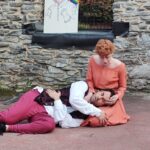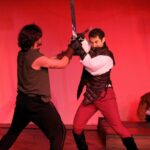
For let them be Diana’s foresters, gentlemen of the shade (and indoor air-conditioning!) minions of the moon! Said Falstaff, Act I Scene ii, more or less. In a TheatreBloom sit-down, we’re chit-chatting all around the moon minions— or at least with two of them— Evan Crump, Artistic Director of Unstrung Harpist and director of Henry IV Part I, and Aaron Angello, Co-Artistic Director of Ardeo Theatre Company and director of Much Ado About Nothing— AND they’re both acting in each other’s Shakespeare offerings in the 2026 Frederick Shakespeare Festival! With Henry IV opening first, we’ve shunted a little bit of our chatting focus to that production but are really excited about both performances!
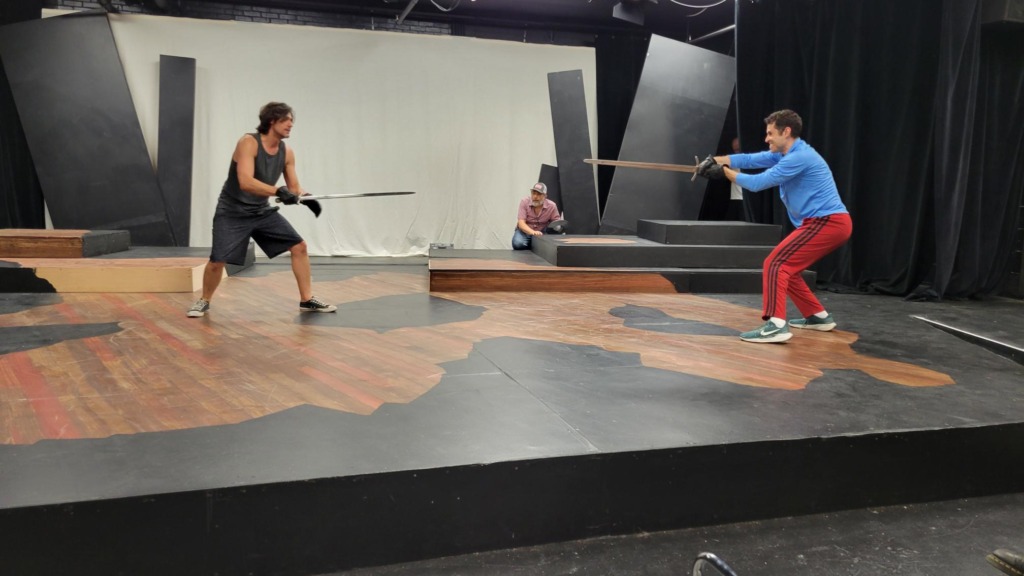
Thank you Evan, thank you Aaron, for giving me some time, and letting me crash the tail-end of the rehearsal! So sorry I missed the sword-fighting, I’m sure it was aces and I look forward to seeing it live in-action in just a few weeks! So Evan, you’re directing Henry IV?
Evan Crump: That’s right. I’m also playing Benedick in Much Ado About Nothing later in the festival.
And that’s the one that you’re directing, right, Aaron?
Aaron Angello: Yes. And I’m also playing Falstaff in Henry IV.
Perfect! Now we’ve got the who’s who and what’s what! And for those who are not in the know, Henry IV Part I follows immediately, at least historically, after Richard II, which Unstrung Harpist put on in the Frederick Shakespeare Festival in 2024. How did we not immediately do Henry IV last summer to keep the audiences’ brains on the history train?

Evan: I’ll tell you exactly why! There was a back and forth with Christine Mosere, one of the founders of the Frederick Shakespeare Festival, about who was going to be directing the outdoor, main-stage show, and what other shows we were going to do. It was decided that I would direct the outdoor, main-stage show and it was also decided that Henry IV Part I was not necessarily the best fit for that. So we pivoted to As You Like It. And then it ended up being the only show that happened last year, it was a festival of one. As You Like It was a very good fit for the outdoor space. We had tons of music and lots of frivolity. But Henry IV, as we did with Richard II, is being staged indoors at the black box theatre here at Hood College. It’s a more intimate show. It’s more dialogue and language driven. Producing it indoors will give the audience an opportunity to really pick up on more nuance in terms of the characters and the moments and situations that develop.
That’s a smart choice and makes a lot of sense, but how did that end up getting paired up with Much Ado About Nothing, which is presumably the “main-stage” outdoor show?
Aaron: Much Ado is outdoors. We did this with Hamlet too, we’ll end up doing a couple of the Much Ado matinees in here at the black box, because it’ll be too hot to do matinees out there. And then we also have the option to pull the show in here in the event of rain or other weather issues.
That is a beautiful option.
Aaron: And that’s actually a great reason to encourage early reservations, because if you didn’t reserve on a performance where either we’re scheduled to be inside or end up moving inside due to weather, it will be difficult to have them come in at the door.
Evan: There are definitely days for the outdoor shows when we exceed our 60-something seating capacity of the black box.
Aaron: We can do a couple hundred people outdoors, hypothetically.
And where is the outdoor theatre? Sky Stage? Banneker Park?
Aaron: No right here on campus.
Evan: They call it an Amphitheatre; it’s more of a field, really.
I do think I’ve seen one of the Shakespeare’s out there…once…maybe?
Aaron: You saw Midsummer, pre-pandemic. I directed that one. You wrote a thing about it. It was the first one we did outside.
Occasionally I do write things about stuff.
Evan: And there’s my connection to Aaron in this whole thing— first thing I did for him was playing Hamlet for him in Hamlet in 2022 and that was outdoors. Doing Hamlet outside is hard.
Doing Hamlet period is hard but you add to it all the unpredictable components of being outdoors and yeah, I’d not disagree with that. Now, it’s Unstrung Harpist? Or Ardeo Theatre Company— or who’s actually producing these productions?
Evan: So when I direct, it’s an Unstrung Harpist production, when he directs its an Ardeo production, but we’re all totally incestuous.
One big happy family. I realize that as we’re wandering down this faerie path, we still haven’t gotten back to “how did Much Ado” end up being the chosen couplet for Henry IV Part I as they’re being performed in rep?
Aaron: At the end of every summer, Evan, Gillian (Co-Artistic Director of Ardeo Theatre Company Gillian Shelly), and I pour ourselves a big glass of scotch and hang out at Gillian’s house and we just talk about the shows we would like to do over the course of the coming year, what we’d like to do in the summer, and we wanted to keep doing the histories. Now, we’ll probably not do Henry IV Part II, we’ll probably go straight to Henry V next year.
Evan: And I think Aaron wants to direct that one.
I’ve seen that one.
Evan: Yeah, but it’s also really good. We’re skipping the less-good histories and only doing the greats.
One day, ‘how Much Ado’ will get answered.
Aaron: Evan wants to play Benedick before he ages out.
Evan: Gillian and sort of harangued him for two years because before we age out, we’ve got to do it. Gillian is playing Beatrice.
Aaron: I do think Benedick and Beatrice can be any age and it’s actually really interesting when they’re a little older.
Agreed! I’ve seen some fascinating older B&B in Much Ado and it can be really fun, interesting, and relatable.
Evan: If you want a more ‘article-palatable’ answer—
No, I liked the fun, true answer.
Evan: Okay, but still, Much Ado does lend itself to the outdoor stage and it’s a big, fun, summery kind of show.
Aaron: I’ve done it a few times—
Directed it or been in it?
Aaron: I’ve never directed it, this will be my first time directing it but I’ve been in it before. Once as Benedick and Leonato more recently. I know the play really well. I think it’s going to be really fun. It’s going to be a tight cut. We’re setting it in the mid 1980s, so we’re doing all kinds of cool karaoke stuff. For instance, ‘…sigh no more…’ from Act II, Scene iii, is set to The Cure’s “Lovesong.” It’ll have that kind of vibe. And there’s no real reason for any of that except for that it will be tons of fun. The core of the play is always going to be the core of the play. One thing that Evan and I really agree on, the one place that he and I have connected since we met in Hamlet, is that we both really love Shakespeare and we both really appreciate text, so no matter what we do, conceptually, the play is first. We’re not trying to re-invent anything.
Evan: What I like to say is that we put an aesthetic on it. We don’t put a concept on it.
I like that. I think you can do a lot with an aesthetic that isn’t necessarily going to break the audience’s brains or confuse them or make them wonder what statement you were trying to make.
Aaron: I’m right there with you.
There is such a thing as over-conceptualization. All too often I see over-conceptualization and under-baked delivery.
Evan: If they don’t know what they’re saying? The actors? Then nothing else matters. And if you can’t convey to the audience the basic ideas, what makes these characters human and relatable, then you’re not doing it right. That’s why Shakespeare has endured for 400 years— it’s not because people are obsessed with English History.
That’s a beautiful point, Evan. Now, we know that Aaron studied as a contemporary of Shakespeare’s…
Aaron: He was just slightly older than I.
I tease, and Aaron takes my thumb-biting in good humor, thank you. Now, seriously, Evan, your Shakespeare background, that was part of your program in college?
Evan: Yes. The American Shakespeare Center, along with Mary Baldwin University, runs a three-year MFA program that I did about 20 years ago. I am 46 years of age. Anyway. The program is based in original practices of Shakespeare. So the American Shakespeare Center have a recreation of Shakespeare’s indoor theatre— The Black Friars. It’s beautiful. All my training is in talking to the audience and keeping the lights on and minimal stage and setting. You do a lot with costumes and live music and you just let the human element shine through.
Oh, you would have loved Baltimore Shakespeare Factory when they were around. That was their vibe. They even did a few productions in OP (original pronunciation.)
Evan: See for me, I think that’s a step too far. The whole point is to make it connect to the audience more and that feels like it would make it connect to the audience less. Respect to them for doing it but it’s not for me. I have nothing against them for doing that. But for me, my first and foremost goal is always to connect to the audience to make sure that they understand and appreciate what’s going on in the text.
They also, if memory serves…did a production of…ooh, hang on, being 40 now, my brain doesn’t remember all it used to…Comedy of Errors? We’re going with that until I go home and look it up otherwise, but they did Comedy of Errors in December of 2014? Late fall/end of year, and they sold/rented foam tomatoes to the audience and encouraged them to throw them at the performers at certain moments.
Aaron: Oh that sounds like fun.
It was! Now, Aaron, you also have real Shakespeare training, yes?
Aaron: I do. I’ve been doing Shakespeare for a long time. I went to acting school years ago, but I was more method-y and stuff. And then I moved to Los Angeles and I fell in with a theatre company out there, it was a big outdoor Shakespeare type theatre and I worked there for years. I got my classical training there a little bit. Then grad school where I studied English literature and poetry, and now I teach Shakespeare.
Evan: We’re both teachers, actually. We’re both English teachers, technically. But we both also do a lot of theatre stuff as a part of what we teach—
🎵An English Teacher…an English teacher… 🎵
Aaron: HA!
Yes, sorry not sorry, as a musical theatre girlie, I have sleeper-triggers that when certain phrases hit— I spontaneously combust into song. Sorry, now you were saying, Evan?
Evan: Aaron teaches here at Hood and I teach at Montgomery College.
Perfect. Now, before we move on to more about your respective shows— what’s your favorite Shakespeare— don’t overthink it!
Aaron: Hamlet.
Evan: Richard II, historically. Although my favorite to play is Hamlet. But Richard II, the language is just totally gorgeous.
Aaron: Also Lear. I love Lear. Evan doesn’t love Lear.
Evan: Not as much as he does.
Aaron: I’m also a really big fan of Henry V. It’s such a hard question. Much Ado is great. It’s hard to pick a favorite.
Evan: Twelfth Night is right up there for me as well. Oh, don’t you care for that one, Mandy?
There is nothing wrong with Twelfth Night, it is a perfectly serviceable show. It’s just the one I’ve seen more than enough times, and several times not done to a standard which would either entertain or educate.
Evan: It is performed very often.
It is. It’s easily accessible, so I get it.
Evan: It’s also one of the true ensemble shows in Shakespeare’s canon, so it’s a lot of fun to get a group of actors together to do it.
Agreed. It also lends itself to outdoor spaces, to those who have less of an experience in doing Shakespeare, and to audiences who are just dipping their toes in the Shakespeare pond.
Evan: I played Orsino in— when was that? Two years ago? Three years ago? It was the one Christine Mosere directed.
Aaron, you’re in Henry IV Part I, playing Falstaff. But if you could write your ticket and play any character, regardless of age, gender, etc.— NOT Falstaff— who would you play?
Aaron: In this production? Other than Falstaff? That’s tough.
Evan: Falstaff was who he wanted.
Aaron: Falstaff is one of those roles that I’m still not quite old enough to play but I’m calling this my first Falstaff. I think Falstaff is one of Shakespeare’s greatest creations. I think he’s so complex and so interesting and so philosophical and so funny. It’s not just me. Harold Bloom— Shakespeare scholar? He died recently actually, but he has a book “Shakespeare: The Invention of the Human” and he writes about Falstaff in that book. It’s his argument too, he writes about that in his book. It’s Falstaff and it’s Hamlet for me. The two most interesting characters in Shakespeare’s canon and I buy into that. I’ve always wanted to do this role and explore it. We’ll do some really great stuff with it but it’s the type of role where you could do multiple times and keep discovering what’s going on with this guy. There are so many levels to him. So anyway, Falstaff is the part that I wanted to play and I get to grow a gray beard now so let’s give it a go!
I’m really excited that you get to tick a dream role off your bucket list.
Evan: I mean that is one of the reasons that we do this. We can just talk to each other and say “this is what we want to try.”
Aaron: And we do it reasonably. I would say to him, “Evan, you’re not right for Benedick” if I thought that were true.
Evan: He told me that about Mercutio and I’m still mad at him.
Aaron: You’re too old.
Evan: That’s exactly what he said.
Aaron: I wouldn’t cast Evan as Mercutio. I would cast a teenager as Mercutio.
Evan: I think Mercutio’s a 30-year-old hanging out with a bunch of teenagers.
I think you’re right. Mercutio peaked in high school and is still hanging around the football field. I love this. Now, Evan, if you’re writing your ticket and not playing Benedick, who are you playing in Much Ado?
Evan: In Much Ado? I mean Beatrice, right?
Aaron: Good call.
Evan: Beatrice is a better part than Benedick by a wide margin. Who was I talking to about this earlier today? Of the great couples in Shakespeare, there’s usually one that’s the better part, and sometimes the gap is bigger than others. Like Hamlet is way better than Ophelia, right? Petruchio and Kate I call kind of even, though that play…
That one’s going to be left alone for a while, I imagine.
Evan: And usually in the couples, the male part has the upper hand. I think there’s two exceptions. And that’s Beatrice over Benedick, and of course Rosalind over Orlando.
Aaron: Juliet too.
Evan: You could make the argument.
I would actually make the argument for Lady M over M*
Aaron: Ah, true. She just has such a smaller role.
She does, but if you have the right actress, with the right director who can spin the onus of power onto her, it can read with her being greater than him.
Aaron: I actually see a lot of parallel between Lady M and Beatrice. They both do the thing where they emasculate someone to try to get them to do what they want. They’re both really powerful, strong women. Beatrice has got it together much more than Lady M, though.
One of them is on a comedy, the other not so much.
Aaron: Hey wait a minute— what are you saying? Which one is the comedy?
Clearly, that’s for you to decide, Aaron! You guys crack me up; I’m adoring my time with you both!
Evan: I think Benedick is struggling to keep up with Beatrice most of the time. I think that she’s a step ahead of him all the time.
Aaron: That’s good that you’re thinking about this because we haven’t started talking about that yet.
Ooh, that’s right, Much Ado isn’t officially in rehearsal yet.
Evan: Yeah, rehearsals for that start the day after this closes.
Aaron: Listen— Virginia Woolf closed. We showed up for rehearsal for this the next day.
Evan: It’s brutal.
For the three of you doing the Trifecta** I mean, that is some STAMINA!
Aaron: All four of us.
Evan: Steven’s not in Much Ado.***
Aaron: I meant you. Mandy, did you know that Evan was cast as Crazy Billy in Who’s Afraid of Virginia Woolf?
STOP! You are too funny!
Evan: I mean, Gillian gets a bit of break in this one? She’s not playing as big of a role? She’s playing Quickly.
True, but she deserves a break, she just came off of THE powerhouse role—
Aaron: In The Woolf.
Evan: And this guy gets no breaks because he’s going lead to lead to director.
Aaron: But directing’s easy.
Oh my goodness. Aaron, you said you’d been in Much Ado before, but if you could be in it as someone not Benedick or Leonato, who would you be?
Evan: If you don’t say Beatrice you’re wrong!
Aaron: Dogberry!
YES! CORRECT! That is the answer!
Evan: You could be Dogberry. You could do that tomorrow.
I actually saw one recently where Dogberry was on a mall segway.
Aaron: Oh I love that. Mallcop! That’s great.
Evan: If only those existed in the 80s…we could totally do that.
They had to have had something— oh! Marty McFly’s Hoverboard! Aaron, go call the Doc and get it! You guys really are a hoot. Evan— if you could put yourself into Henry IV, where are you putting yourself?
Evan: Hal is the dream role that I have already outgrown, unfortunately. That’s one of the few where I will agree with Aaron where you’ve got to cast younger.
Aaron: Now, historically, you could be Hotspur.
Evan: That is true. In actual history Hotspur is the same age as Hal’s Dad. That is not true at all in this play.
So I’ve heard. I think I heard that Hotspur’s Uncle is like four years younger than Hotspur or something.
Evan: Something like that! But what I love about this play is that there’s not one lead. Throughout the whole play you could root for Hal, you could root for Hotspur, you could follow Falstaff through the play…
Did you catch that, Aaron? Root for Hal. Root for Hotspur…Follow Falstaff.
Aaron: I know!
Evan: Wait, wait, the thing is they spend the entire play setting up the conflict between Hal and Hotspur. Everybody is pushing them together. The universe wants them to do battle and wants one to come out on top. Falstaff doesn’t have that problem.
You should be on top of both of them, clearly that’s how this works, Aaron.
Aaron: I agree.
Evan: Well there’s an argument that that is how this play ends. Hal doesn’t really get the happy ending, even though he’s the one that wins…what he ends up having to give up in order to achieve that, you could make the argument that he’s given up what would have ultimately been the better life. Living dissolutely with Falstaff.
Well that’s certainly a makable argument.
Aaron: Yeah, interesting take.
I love the deep-tracks take we’re making here. What is it that you are hoping that people will take away from coming out to see Henry IV Part I?
Evan: Henry IV is a play about fathers and sons, and surrogate fathers and sons. It is a play about masculinity and how we get all turned around about what that means. And making choices that lead us down some pretty dark paths because we’re trying to live up to what other people think we’re supposed to be in that regard. I think it’s also a play about war. And it’s a play about what war does to people and what it does to a country. What it does to the psyche of a country to be constantly at war. That’s something we wouldn’t know anything about, right? There’s an old expression “when two elephants fight it is the grass that suffers.” I think this play kind of shows—
Aaron: Wise old Evan over there…
Evan: I think this play shows that when these nobles with no concept of what it’s like to be a peasant or a merchant or a solider, when they make these decisions, people die. And what makes Hal such a cool character is that he is uniquely among the nobles and the royals who are making these awful decisions, but he has spent time amongst that hoi polloi, with those lower ranking persons, and he has a better perspective on what war really means because of that.
Aaron: Let me add to that. I also think this is a play about fathers and sons and the complexity of that relationship and de facto fathers and sons. Falstaff thinks of Hal as a son. And wants to treat him that way and wants to protect him the way a father does. And loves him the way that his father doesn’t. Hal has to earn his real father’s love. And what he’s ultimately going to have to do is sacrifice his de facto father’s love in order to gain his real father’s love. What’s interesting to me about that is that that’s the ahistorical part. I don’t know what Hal and Henry IV’s real relationship was like, but I do know that in history Hal was doing great things his whole teenage years. He was off fighting battles— he wasn’t just hanging out, that whole bit was made up. Shakespeare was interested in looking at this father-son thing, I think. So that’s a really important part of this play. It’s the heart of the play, the father-son dynamic.
Evan: He’s got to choose between two fathers and you could make the argument that even though he makes the choice that gives him the crown and gives him the glory and makes him the golden child of all of England, which you will see in Henry V, if and when that gets directed, but you could make the argument that it’s still the wrong choice. Because it sacrifices a part of his humanity in order to get there.
We all make choices. We don’t always make the right ones. And when we make our choices, we’ll do any number of things to make ourselves believe that we’ve made the right choice, even and especially if it isn’t turning out how we thought it would? What do they say? Grass is always greener until you get on the other side? Do either of you have kids?
Evan: I have three stepsons.
Aaron: I have a birdfeeder.
I have cats.
Aaron: Oh. They would love each other.
Evan: I have birds also.
This is gonna be a fun meet-n-greet.
Aaron: I have no children.
That’s okay.
Aaron: I know it’s okay! I am good with it! I am happy with it! I was just talking to someone about all that money that people spend on their children, I get to go to Europe.
I think I did something incorrectly here. I do not spend money on children and I still don’t get to go to Europe.
Aaron: It’s just a conceptual idea that we get to go places.
Evan: You get to spend more time in theatres!
Aaron: That’s very true. I don’t have to go home to my kids right now.
I don’t know how we got down the Daddy-Kids Rabbit Hole, but let me attempt to move us further afield here, and I know it’s further into the calendar field, but, Aaron, what are you hoping people are going to enjoy and felicitate upon over at Much Ado in the field-amphitheater?
Aaron: I think Much Ado is a joyful experience because it’s the age-old battle of wit. It’s the prototypical rom-com. It’s the same reason why I love to watch When Harry Met Sally over and over and over again. You know they’re going to get together. We get to watch these two people who obviously need to be together, there’s no other people that they could be with, and we get to be with them as they struggle against the inevitable conclusion of their being in love and their being together. It’s just lovely!
It really is.
Evan: I think it’s really relatable to see people try to convince themselves that their emotions are not leading themselves in the right direction, when it’s clearly leading them in the right direction.
Say it again for the people in the back!
Evan: Oh and can I just add… if I’ve given the impression that Henry is all doom and gloom, all war and death—
Oh you have not, that’s just my general take on most of the histories and somehow they manage to suck the joy out of the gloom and doom and darkness, which is what separates them from the angsty emo tragedies.
Evan: I promise it has a ton of humor in it. One thing that makes the play one of Shakespeare’s best— you know, there was a New York Times guy, I think it was, who recently ranked all of Shakespeare’s plays from least to most produceable and fun to watch. And Henry IV 1 & 2 won the whole thing. I can totally understand why. It blends the highest drama that you can find in Shakespeare with some of the lowest brow comedy and slapstick.
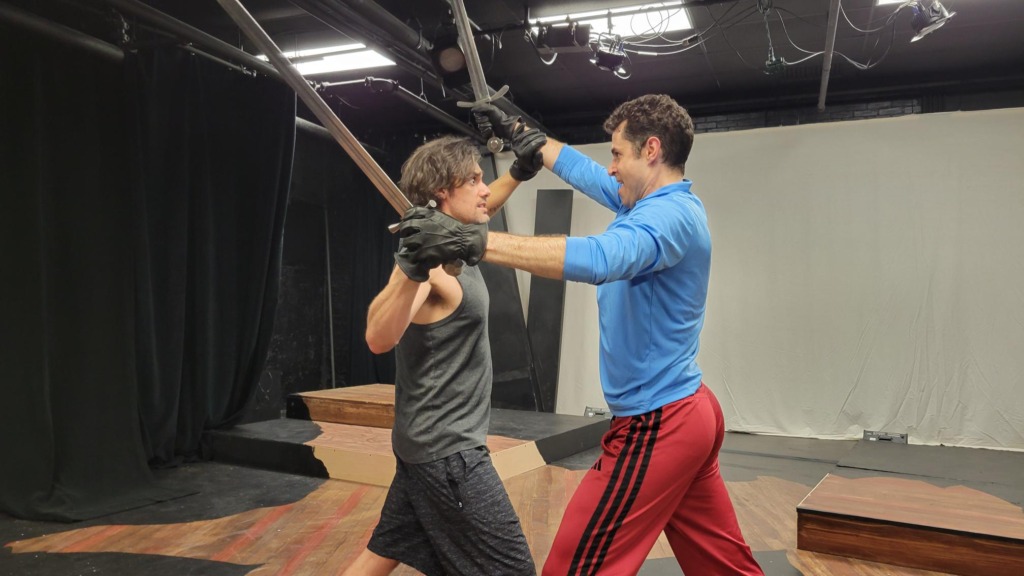
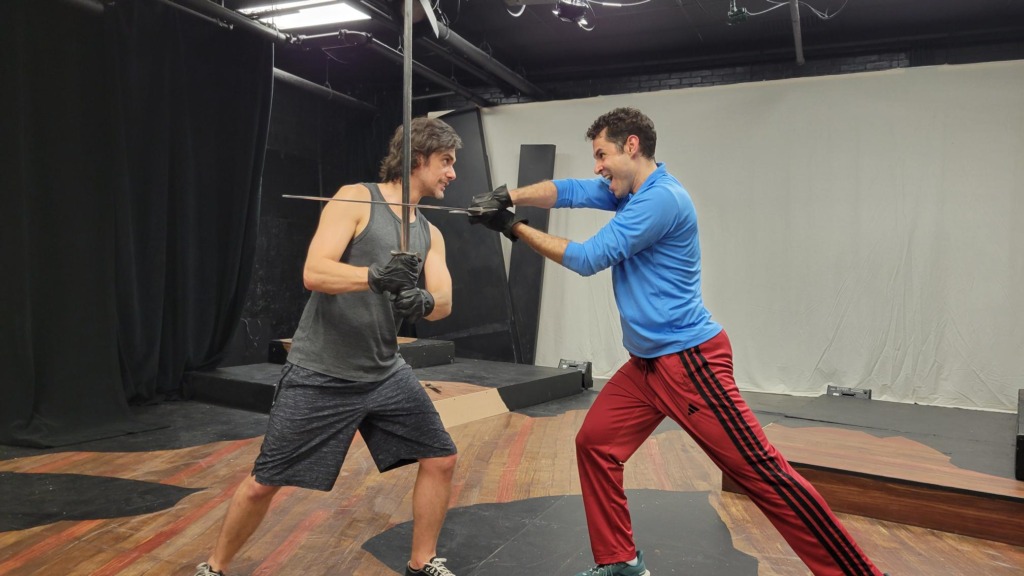
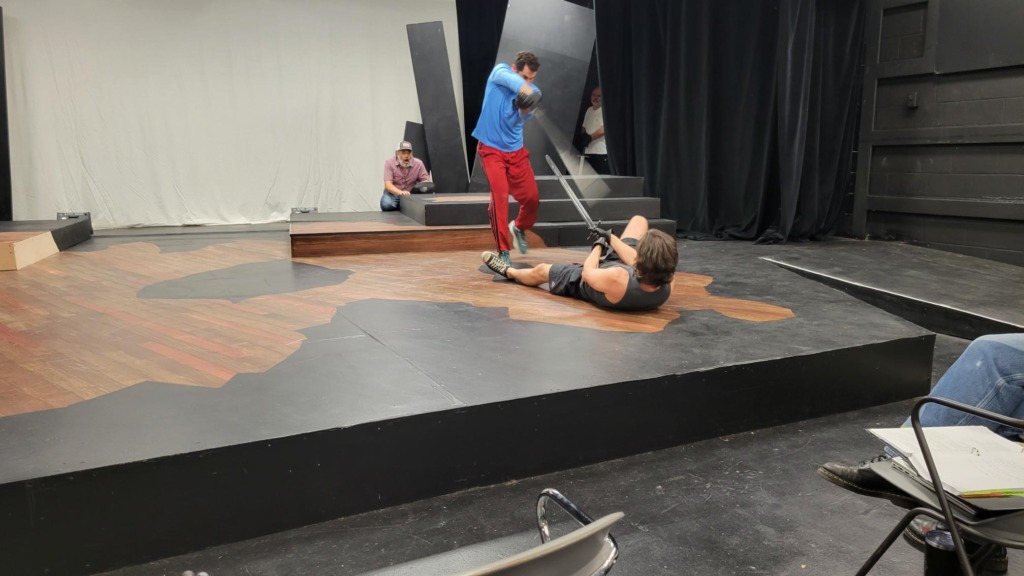
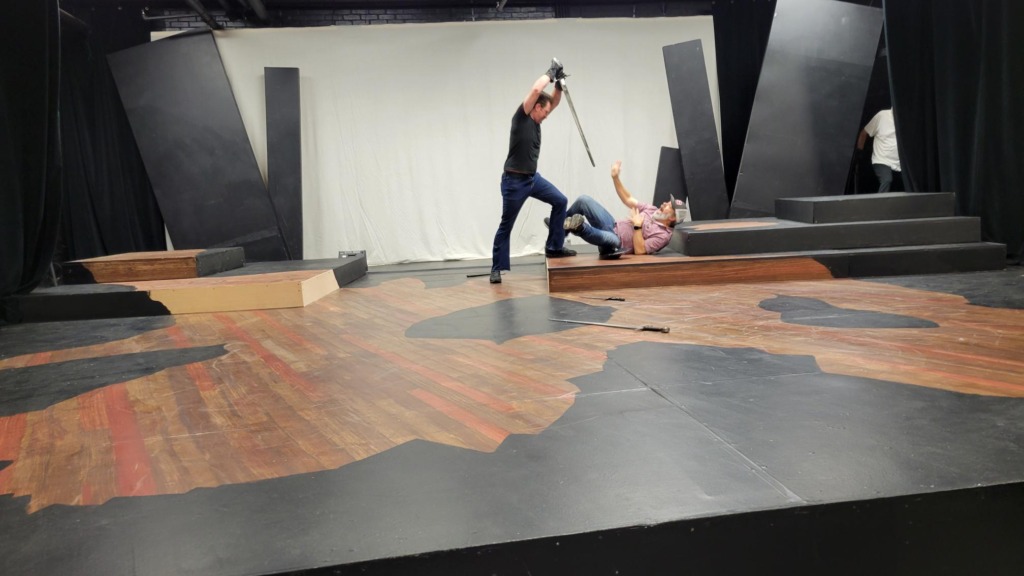
Aaron: Sword fights.
Evan: Yes. It’s got sword fights. And a little bit of music. It’s a ‘greatest hits of Shakespeare’ all in one play.
Do you sword fight, Aaron?
Evan: Not only does he sword fight but he is the fight director for our shows.
Aaron: One of my jobs when I lived in Los Angeles was as a fight choreographer and stunt guy. I was an active fight guy back in the day. I’m getting too old for it now. But I do choreograph all of our fights.
That’s amazing. Does Falstaff fight?
Aaron: Not really.
Evan: He gets his butt whooped.
Aaron: It’s fun. I’m not really fighting much but I do take a couple blows to my buckler.
Come for the sword fights, stay for the ass-kicking. Love it.
Evan: There’s a lot of really good fights in this show, in particular the Hal-Hotspur fight. It’s one of the great show pieces in all of Shakespeare. It’s right up there with Hamlet-Laertes, I would say.
And this is a smaller cast?
Evan: We’re doing 12 actors. That’s more than you will often see in a theatre this size. Usually they can’t afford them.
Aaron: And we can’t afford them.
Evan: Yeah not really. But seriously, there’s a couple of doublings that would not be done if we had infinite money. But honestly, keeping the cast small gives every actor more meat to chew on. I think you’re going to enjoy it.
I hope so. I’m looking forward to it and not just because it’s one of the few Shakespeares I haven’t seen. I actually— enjoyed is such the wrong word— but I knew going into Woolf that there was potential to not ‘enjoy’ it and I was really moved by that one and also it was really funny!
Aaron: There’s a lot of humor, it is funny! And this goes back to what I just said about Much Ado, one of the joys of watching Much Ado is watching the battle of wits. And that’s what George and Martha are. And if you did what we did, where we really focused on starting with the love, we focused on letting the play start somewhere and end somewhere else and not starting at the end, all that kind of stuff, the humor just bubbles up to the top.
I’m putting in my request for Ardeo’s next show. I want to see the Woolf cast do Noel Coward’s Private Lives.
Aaron: Ooh, yeah that would be awesome.
Evan: Stop telling him to do shows that I’m not in!
Aaron & Mandy: You can be the maid!
HA!! I love that.
Aaron: I told you he was Crazy Billy, right?
You had mentioned— the telegram boy.
Aaron: Western Union.
Did you know you can still send a telegram? There’s one lone place online and they will still deliver a telegram.
Aaron: Oh I love that.
Yeah me too. What has the directing process been like for Henry for you, Evan? Clearly this is a passion project.
Evan: So as I said before, Richard II was one of my first loves, when I was first falling in love with Shakespeare. I was a poetry person before I was a theatre person. And the poetry of Richard— I was just blown away. Obviously there’s some of that in Henry IV. My directing approach is clarity is the most important thing. We are not necessarily dealing with audiences who have a lot of familiarity with Shakespeare. I’m not trying to throw a bunch of spaghetti at the wall. I’m trying to get at the heart of the story, understand the language, make sure the actors understand and can convey the language. This story is good without any accoutrements or frippery. Not that we don’t have our fun with it. But first and foremost our goal is to make sure that the story is told well and meaningfully. And, you know, try to make everybody look good.
Beautifully spoken. And you have a true-to-text aesthetic for Henry?
Evan: True to text? We did go Medieval in term of the aesthetic but again, honestly, it doesn’t matter that much. If I did what Romeo + Juliet , you know the Leo version, and put them in Hawaiian shirts, it still wouldn’t matter as long as the text is supported. The fundamentals don’t change just because you layer an aesthetic over top of it.
Aaron: Evan is a great director. He understands the text as well as anybody, better than most, better than pretty much anyone, and he’s laid-back. One of the things that I think makes a good director a good director is that you feel like you’re taken care of. You feel like someone is steering the ship and you don’t have to worry about it. The worst thing in the world is when you feel like a director is out of control.
Evan: A big part of being a good director is hiring really competent, dedicated, talented people and letting them do their jobs. I have had a lot of actors come back after I’ve directed them once.
Aaron: That’s always a good sign.
You’re highly spoken of amongst those I know who have and are being directed by you.
Evan: I feel very grateful. I feel very lucky to be doing what I’m doing right now. I’m so glad that I fell in with this crowd and that we get to have the opportunity to do this. The biggest barrier to making good theatre is not lack of talented people, it’s lack of money. It’s always money. We have a lot talented people and we don’t have a lot of money but because of the benefits that we have in having access to this space, the opportunity to be a part of the festival and the audience that comes to that, it’s given us a lot of freedom to get to do what we love to do.
Now does Unstrung Harpist do things outside of FSF?
Evan: Sometimes! We’re a theatre that only exists when we’re actively producing something.
A little like Ardeo, got it.
Evan: We don’t have a standing season or anything like that.
I have more respect for a company that recognizes their present but necessarily permanent financial constraints. And adjusts accordingly. If you’re looking at it from the model of “I have to have a season that’s modeled in a certain way” you’re not going to get to produce every single thing passionately or get all the extraordinary talent that you want. And it’s not always going to be the caliber of work that you’re hoping to achieve if you’re modeling your existence around traditional seasonal structure when that doesn’t fit your budget.
Evan: Yeah. I mean we got started back in 2010 at the Capital Fringe Festival producing a lot of my original work.
Do you still produce any of your original work?
Evan: We’re about to do one, actually. In October. We are going to be performing our first musical. It is a new musical that I wrote with the late, great, Talia Segal and it’s called Welcome to Quarantino’s. It’s about a bar that is closing because of the pandemic, and the whacky patrons therein. It’s got a meta-theme.
Where and when?
Evan: Here. In the black box in late October.
Cannot wait!
Evan: I have not pivoted to that yet, but I guess I’m going to have to soon.
Yes. Live theatre is so very important. Here we have a history that nobody does and a comedy that everybody does, paired up in rep— how’s that working? Good experience and yay we’ll rep-forever? Or more ‘oh my gosh this chaos and never again?’ How’s Rep working?
Evan: Our initial reason for wanting to do it in rep was that we knew we both wanted to direct and we knew we both wanted the same talent pool. The number of really talented Shakespeare actors who will work for peanuts in Frederick is not a large number. But we haven’t even started show two yet and maybe we’ll both be so burnt out by the end that we’ll not want to do it again, but if I had to guess, I’d say we will want to do this again. We really all do just love each other and we love doing this together.
And do we have designs on next season? I know I’ve heard you mention Henry V.
Evan: If its Henry V then it’s Aaron directing that.
And what would you do on the main-stage outdoors then, Evan?
Evan: I don’t know, I have a lot of comedies that I like. I like Romeo & Juliet a lot.
I like that you also think Romeo & Juliet is a comedy.
Evan: That is not what I was saying!
Aaron: But it is a comedy! Until the end.
It is! It’s a dark comedy!
Evan: Maybe first half comedy second half tragedy. I think when Mercutio dies is when it pivots.
Fair.
Aaron: You know, we could also, for instance, do something like Winter’s Tale in here and we could do Henry V outdoors.
Evan: Henry V is a better show for outdoors than Henry IV.
Apropos of nothing, Cymbeline is a very good one.
Aaron: I love Cymbeline.
Evan: I haven’t seen that one done in a long time.
See? There you go. Cymbeline. It’s not done often, I think I’ve only seen it thrice in 15 years, there are definitely people out there for whom it is a passion, so I’m making a pitch for it.
Evan: So noted. There are so many we love. We haven’t even gotten through the chestnuts to get to the weird ones. I mean, Richard II is a chestnut for me, but that may be true for literally no one else.
Aaron: I think Richard II is a Shakespearean person’s Shakespeare.
Shakespearean catnip.
Aaron: Yeah. People who are really into Shakespeare love Richard II, like that weird beer that beer-people like.
Or how really nerdy musical theatre people LOVE [Title of Show].
Aaron: Exactly!
Evan: It’s the IPA of Shakespeares.
Beers and chestnuts and all that jazz aside, what are you, Evan, learning from this experience? As a human being, as a director, what’s your takeaway at the end of the day?
Evan: I’m learning as a director where a light touch can be better than a heavy one. As a person, I am learning that people use humor to cover a lot of things. Pain, fear, guilt, or even love.
Oh wow. Aaron, as a person, as a human, as an actor, what are you learning at the end of it?
Aaron: One thing that I’ve been thinking about a lot, this last bit, that no matter what you’re doing as an actor, particularly, to always remember that we do this because we love it and because it gives us so much. I’m allowing myself to just be happy and love what I’m doing. I went through a phase where I was getting really caught up and in my head and getting anxious about it and stressed out about it.
Evan: I could see some of that in Richard II.
Aaron: I wasn’t in a good head space then. I’m really finding, if you just remind yourself to be present, to connect with your scene partners, and remember that you love this and it’s beautiful and it’s not AI— there is so much value in that. That’s been my driving MO throughout this whole process.
I love hearing that; growth is beautiful. Now, I’d love to sit and talk both your ears off all the live long night but I’ve got quite the drive ahead of me and I know you both do too. So, to conclude… if you had to sum up your experience working on Henry IV using just one word, what word would you use?
Evan: That’s hard.
That’s two words.
Aaron: Hahaha! That’s what I was going to say!
Evan: I would say… Electric.
Aaron: Oooh. Joyful.
Henry IV Part I runs July 10th 2026 through July 18th 2026 as an Unstrung Harpist production, the first of two repertory productions in the 2026 Frederick Shakespeare Festival. All performances are pay-what-you-can but advance ticket reservations are strongly encouraged and can be booked online.
*This interview took place in a theatre, and you simply do not say THAT WORD in a theatre unless you’re actively in production of it.
**Maureen O’Neill and Gillian Shelly performed, are performing, and will perform in Who’s Afraid of Virginia Woolf, Henry IV Part I, and Much Ado About Nothing; Aaron Angello performed in Virginia Woolf, is performing in Henry, and will direct Much Ado.
*** Steven Todd Smith performed in Woolf and is performing in H-IV-Pt1.