From the court to the country— Arden is your stage! And your stage of Arden is currently being staged at The Folger Theatre. Oh, look— unicorn! As You Like It is sliding onto The Folger Theatre stage just in time for spring and it’s as refreshing and revitalizing as the much-needed warmer weather in the nation’s capital. Directed by the insanely talented Timothy Douglas, this production of one of Shakespeare’s more popular comedies— as envisioned by The Folger Theatre’s Artistic Director Karen Ann Daniels— is effervescent in its existence, casting a superb balance between the modernity of the show’s setting against the traditions of the Bard’s text, with whooshing infusions of present-day, high-humor, and a healthy dose of edginess. As the kids might say, this one is GOAT.
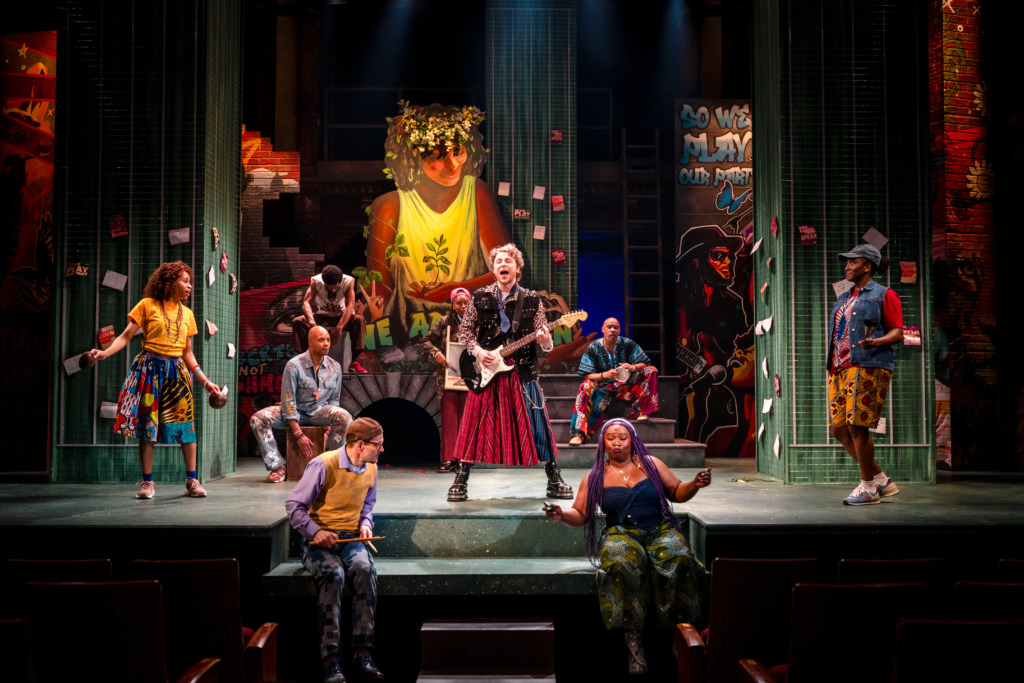
Don’t let the simplicity of the set fool you, lest you be a fool— sometimes less is more! And with Scenic Designer Gisela Estrada’s vision aligning so perfectly to Karen Ann Daniels’ “Love letter to DC” concept for this production, you’re getting both the less and the more in equal parts and it’s brilliant. You get lights and fence-gridding on load-bearing support columns that exist on The Folger Stage, and a scrim with the Capital being projected on it for Court. And that’s all you need. Because when the scrim disappears and Arden hits the stage (for the traditionalists, that’s ‘forest of Arden’) the mural-art and spray-paint visuals of a DC street scene (Scenic Painter Penny Hauffe) are nothing short of spectacular. This colorful, bohemian-metropolitan aesthetic just pops— much like the characters, the overall adaptation, and the costumes in this production.
Celeste Jennings, responsible for said costumes, puts a lot of red into the characters of court. That’s not unintentional but handled in such a subtle fashion that you get the politically-edged memo without feeling like a brazen attempt to make a statement is guiding her vision. That borderline-pimp suit in raw burgundy featured on Duke Frederick, along with the glaring glitter-red tracksuit for Charles, his wrestler, speak volumes about exactly where ‘Court sits.’ But once Jennings ventures out into Arden— it’s a myriad of colors and styles— not the least of which is the banana-bright sweatsuit with flashy pink undershirts for Touchstone, some zen-feeling, busy-patterned flowing pants on Duke Senior, and beatnik hipster togs featured on Silvius. Jennings’ work matches the energy and overall vibes of what’s happening both on the set and in the characterizations. You’re getting perfection from the production team both visually and in the way it aligns with the overall vision of the show.
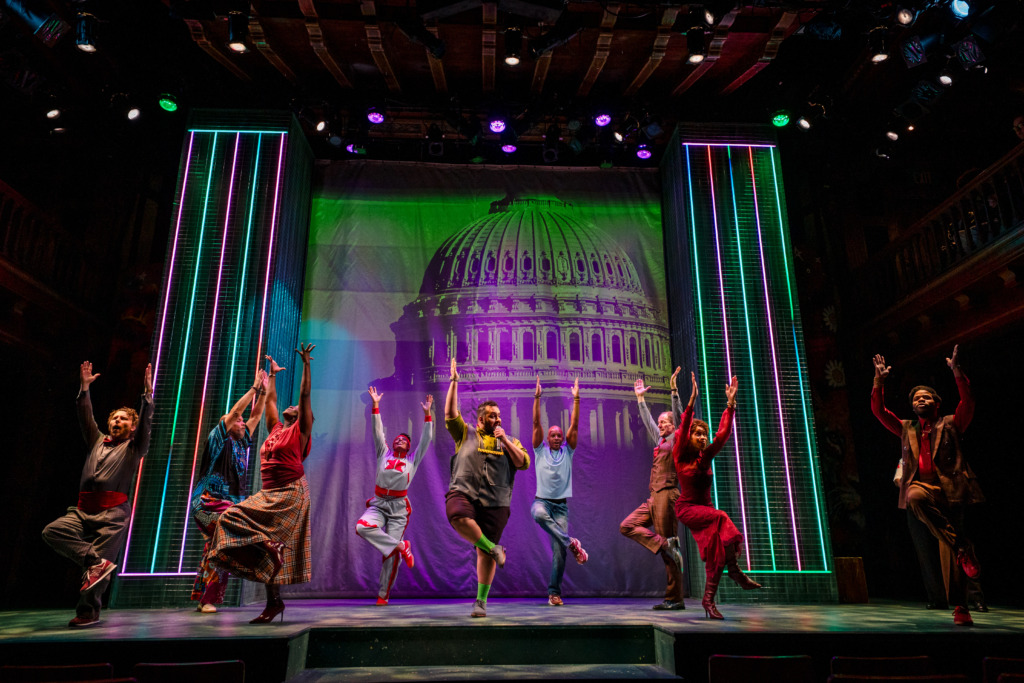
Shakespeare is not without its music. And for this production choreographer Tony Thomas, composer Kokayi, and original lyricist and sound designer Miki Vale are pulling out all the stops to add that extra element of epic enjoyment when it comes to embracing As You Like It. The show opens with a really fun feel-good song and dance number that just amps up the energy, sets the tone for the overall show experience, and above all, invites the audience into this space where you can just react and respond openly, which really allows for theatergoers to feel a sense of involvement in the performance. (This comes on the hot tails of a cleverly disguised Raven Lorraine, who looks like a Folger Security Guard, pacing the aisle before getting up on the stage to kick-off the curtain space.) The show features a few other song and dance components (shout-out to John Sygar live on guitar!) which are seamlessly infused into the scene work and the overriding vision, making them wholly enjoyable.
Any Shakespeare can die on the vine if the pacing is off— too fast, too slow, endless pauses between scenes— and As You Like It at The Folger has ZERO of those problems. It’s a rarity of Holy-Grail levels for a show to move so flawlessly, particularly when modernity and English Renaissance get together and have a stage-child. Karen Ann Daniels and Director Timothy Douglas achieve that perfection with this production. You get fluid movement— scenes have perfect pacing; those that need to move— move and yet there is breath, beat, pause, and consideration given to those fleeting moments when stillness and heaviness percolate from the belly of the text. And there’s plenty of hilarity to go around. (Seriously— that ‘unicorn-callback’ is sublime in its essence and existence!) The ‘Elphaba-holler’ makes its way into the show at least twice and you get some snappy silliness from Corin, who refers to Touchstone as both ‘Touchscreen’ and ‘Stonehenge.’ And while these seem like minutia, it’s these devilish details that set the production apart from the ordinary, making it extraordinary. There’s also moments of audience engagement— particularly noteworthy being Orlando looking for ‘starter-line-help’ at the top of the second act. And it never feels forced. (You get some of that with Touchstone up in the balcony too and its that same, authentic and earnest vibe.) Douglas makes exceptional use of the full theatre space— onstage, in the house, and up the aisle.
Douglas and Daniels take 17 characters and divvy up the role assignments across ten exceptionally talented actors. And you never feel like you’ve been slighted or are somehow missing out just because roles are doubled up. In fact, it low-key hits on powerful thematics and imagery, much of which reinforce the overall vision— two sides of the same coin can exist in one city. The Court and The Forest (DC’s political scene and its arts scene) share the same space and should co-exist, even if one half of said coin has fallen to the evils of corruption. (The dual-casting of Jefferson A. Russell as both Duke Frederick and Duke Senior is the perfect fit for this concept and feels wholly intentional.) There’s even a subtler hint at this with Nikkole Salter playing both Charles the Wrestler (and that ‘recount’ tantrum moment is uproarious!) and as Jacques, very, very gently insinuating that perhaps the melancholy-morose Jaques was a former politician who recognizes the error of her ways but has no moral path forward to correct prior actions. It’s an insanely striking way to mirror the city in which the theatre presently stands and again feels like an edgy nudge rather than an overt smack. There just aren’t enough ways to praise the precision that has gone into Douglas and Daniels’ work— particularly with balancing the concept into the original text whilst still allowing for those organic moments of modern, everyday humor to roll right in (note the telephone that makes itself useful at the very end of the first act!) It’s simply said that this is stellar beyond compare in both its creation, implementation, and overall execution as a Shakespearean Sonnet of passion and love to the city of Washington D.C.
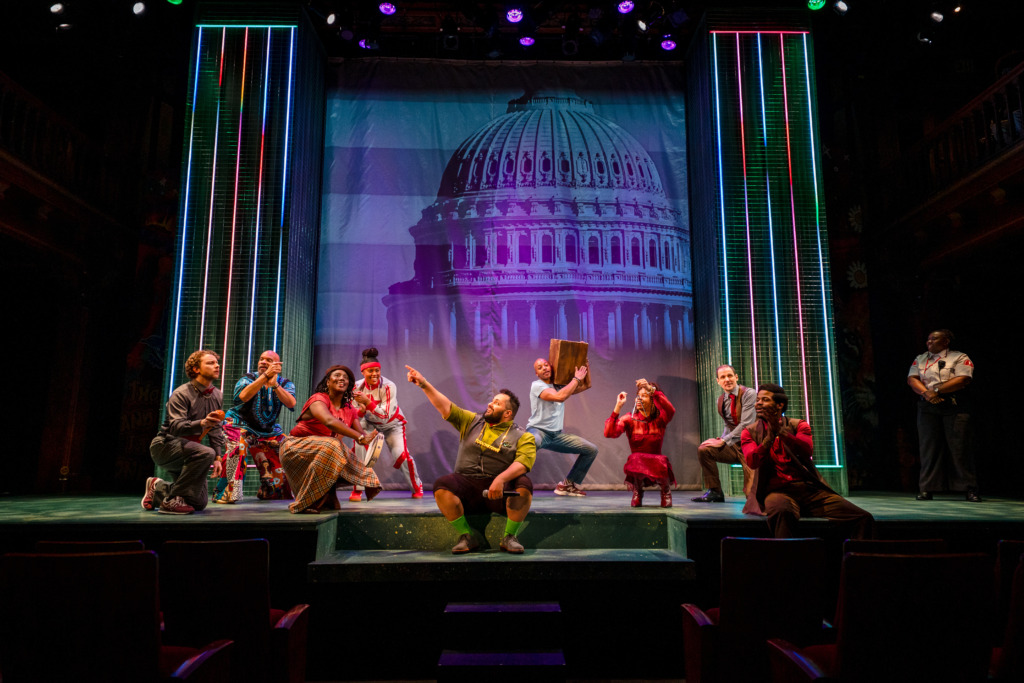
The cast of ten are some of the finest talents to tread the boards in the nation’s capital. The interconnectivity and overall level of playfulness shared amongst them strengthens the theatrical experience, particularly when things get a little chaotic inside the work. There’s a pretty intense fraternal brawl between Orlando and Ollie (praises to Fight & Intimacy Choreographer for Casey Kaleba for the effective verisimilitude) and although you get a cheeky and clever cut to dark (mad-props to Lighting Designer Minjoo Kim, whose overall work in isolating moments of soliloquy is both impressive and emotional) for the wrestling match, that same sense of physical turmoil is reflected between Charles and Orlando during that scene. The levels of interaction, engagement, and connection amongst this cast is uplifting and ultimately amazing.
Tripled up as Musician (and the show’s Music Director), Amiens, and LeBeau, John Sygar feels like a main player in these three cameo-style parts. The off-stage pronouncement of his arrival as LeBeau (literally Sygar shouting his character’s namesake before charging into he scene) is as funny as his music-making is mellow. You also get a favorable versatility from Joey Collins’ Adam/Silvius portrayal. As the latter, Collins is oozing and ebbing through the vibes of a faded beatnik with all the confidence of damp painter’s cloth being used to mop Phebe’s brow. But as Adam, the interplay— particularly upon being supine-piggybacked up the aisle— between him and Orlando is full of seasoned wit and a good deal of fiery engagement.
You get a similar showcase of differences from Terrance Fleming in his singular role as Ollie, brother to Orlando. The vitriol and level of animosity projected toward his brother, particularly when attempting to align his fortunes with Duke Frederick (Jefferson A. Russell) are deeply unsettling. But when juxtaposed against his earnest sense of humility and regret by the time he resurfaces late in the second act, it’s a masterclass in character growth on display. There’s also a level of spatial awareness and stage presence that Fleming brings to his portrayal of Ollie that really makes you hang on his every word, whether it be distasteful disdain toward Orlando or simpering sentiments in the general way of Celia. Russell, pulling double-duty as both Dukes, is lending similar auras of character differentiation with a haughtiness and arrogance that grounds his performance as Duke Frederick and an easy-breezy je ne sais quoi that allows his Duke Senior character to simply exist in all the mellowness, openness, and acceptance that is Arden. Russell has expressive facial reactions (more noticeable as Duke Senior as his face is half-obscured in shadow from the brim of his burgundy hat whilst playing Duke Frederick, though it suits the character both in sartorial selection and in attribute) that engage the audience and his fellow performers every step of the journey throughout the performance.
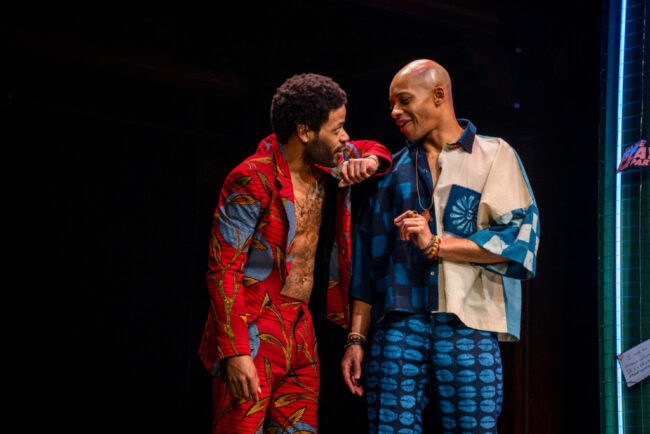
Raven Lorraine’s duality as both Corin and Phebe is on the same plane as the aforementioned role-doubles in this production. There’s a sharpness to her Phebe that really makes you feel for Silvius and a cheekiness that she directs at Ganymede that just feels like it smacks in a way that both stings and amuses. It’s her interactions and engagements with Touchstone (a category all on his own) that keeps the audience laughing, however, particularly when she teases at him with intentional bungles of his name. (See if you catch the moment when his eponymous bling makes its way to her and what level of entertainment that therein implies!)
Much of the show’s moments that are more deeply steeped in emotional gravitas stem fro Celia (Sabrina Lynne Sawyer.) In fact, upon first being introduced to her character, it’s implied that she’s the more mature, more level-headed and grounded of the two cousins. Her pleas to flee and be banished with her cousin are stirring and erupt with an unbreakable sense of sororal bondedness. Sawyer also has a hilarious side to her character portrayal (and she gets props for being the first to layout the unicorn callback!) Relying heavily on body language, gesture, and facial expressions, Sawyer’s Celia/Aliena generates much laughter and good humor from the audience, particularly once everyone’s settled into Arden.
Though her appearance as Charles the Wrestler be but brief, she be but hysterical in the part. Nikkole Salter, who spends the better part of the production as the lamentable Jaques, has the audience in stitches when she shows up with machismo pride, ready to slay in the wrestling match, all hopped up on hot air. It’s a really fun moment to watch, both leading up to and follow up after, the dark-out. Salter takes this meandering detour through the murky melancholy that is Jaques and it’s a refreshing change of pace for the character. A little over the top, a little ‘leans-towards-drunk’ a little moody, a little attitude-y, and a whole lot of depth from what can otherwise be written off a somewhat static side-plot feature. There’s just this zest that Salter imbues to the character, which ebbs and flows throughout her performance in an oddly serene striking balance that just makes Jaques so much more intriguing and fun to observe.
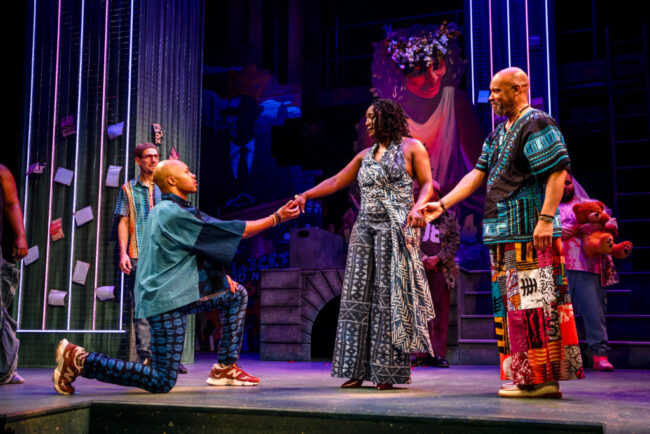
The speechless meet-cute; the fumbling, mumbling, and gibbering over words upon greeting; the nonsense that serves as the heartbeat for the play as a whole— the love-coaster that is Orlando (Manu Kumasi) and Rosalind (Tsilala Brock.) When we’re first introduced to Kumasi’s Orlando the vibe is instant ‘tortured artist’ with ‘beautiful soul’ (and an ammo-style strap loaded up with paint brushes.) Brock’s Rosalind gets introduced with a naivete, a youthful eagerness, and overall a sense of ‘I don’t belong here’ to her present lifestyle in court.
There’s a fieriness, a scrappiness that radiates in waves off of Kumasi’s character early on— particularly when almost choking the life out of Ollie— which transforms into this smoldering passion— not for art, not for his rightful place in life, but for his pining love for Rosalind. Kumasi is a gem to watch— particularly when twitterpated with speechlessness, thrusting into ‘lunge’ at Rosalind— and whenever it is he’s trying to prove how ill-stricken with love he truly is. The handle he has on the text, flawlessly flipping from metered mark of the Bard to more modern phrases, is truly impressive. When he ambushes Duke Senior’s encampment there’s something so striking— both harrowing and beautiful— about the way he delivers the line— “…I thought that all things had been savage here…” which directly reflects the stereotypes that permeate perceptions of certain neighborhoods in DC. Pair that against any of his more humorous moments— like when he’s desperately trying an failing to give Jaques the slip— and you’ve got a magical theatrical experience in Kumasi’s hands.
Living up to the quote of “…I am woman, when I think, I must speak!” you get a world of emotion, expression, and meticulous textual delivery from Brock’s Rosalind/Ganymede. That entire scene with the bloody cloth (and the wild glances and exchanges with Terrance Fleming’s Ollie) is brilliance perfected. And whether she’s hauling Celia up the aisle or being frightened out of her shoes by the sudden appearance of Touchstone, each and every wild action and reaction feels enticingly genuine.
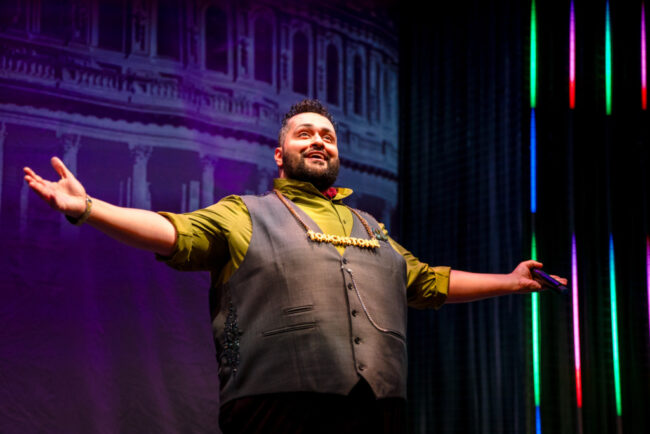
As fools go, Ahmad Kamal’s Touchstone is in a category all its own. Kamal’s character is perhaps the most ‘detached’ from the traditional narrative but the whole of the audience is here for it. The fact that this version of Touchstone drifts seamlessly between being in the play, being of the play, and being on Team-Audience, is wild. And yet wholly believable. One might expect such an amalgamation of ‘styles in which to play fool’ to fall apart or be a mess or just not read— but not with Kamal— he masters all of it. You’ve got the over-the-top antics— like rolling up with the broomstick and doing the Elphaba-cry or literally erupting from a sewer/drain hole in Arden to scare the living daylights out of Rosalind— all of which he executes sublimely. His cheeky exchanges with Corin are a scream, his commanding engagement with the audience is just one more reason to love both Touchstone and the show as a whole. He’s Emcee, Influencer, Narrator, hapless hilarity, and all that jazz, pouring outrageous energy into each exchange he shares with the other characters on stage and with the audience; it’s a truly intense and wildly hilarious ride with Kamal’s Touchstone.
Truly exhilarating, this delightfully stimulating and invigorating vision of As You Like It is a must-see this spring season at Folger Theatre; don’t delay as you wouldn’t want this golden opportunity (or the unicorn) to escape you!
Running Time: Approximately 2 hours and 40 minutes with one intermission
As You Like It plays through April 12th 2026 at the Folger Theatre— in The Folger Shakespeare Library 201 E. Capitol Street in Washington, DC. Tickets are available by calling the box office 202-544-7077 at or in advance online.