Oh what tangled webs we weave when we practice to— get out from under the manipulative fist of the patriarchy who relies heavily on the normalization of harmful tactics like gaslighting. Not the single-word response you were expecting? Good. Because this isn’t your grandma’s Gaslight. Though it’s been adapted from that play (by Patrick Hamilton) by Johnna Wright and Patty Jamieson, this ‘gaslight of a thriller’— Deceived is not your classic case of a woman being manipulated into questioning her own sanity, desperately waiting for another man to save her. No, no. This adaptation gives the female protagonist a dose of much-deserved agency to correct the emotionally abusive narrative that’s been thrust upon her. Directed by Vincent M. Lancisi, this is one mystery you’ll be on the edge of your seat hoping to solve before time runs out.

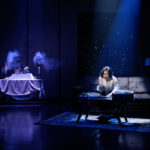
While the play itself features just four characters, Daniel Ettinger’s scenic design— coupled with Harold F. Burgess II’s lighting design— become a fifth player in the game. The opulence that Ettinger sublimates into the ordinary structure of the ‘townhome to let’ is an ominously foreboding entity in and of itself. The muddled teal coloring, accented with gold, tastefully furnished with an air of lavish intent, decadence without arrogance; it’s a breathtaking set. But it breathes with spine-tingling suspense once Burgess II’s light work comes into play. The way the gas lamps not only brighten the entirety of the room when they’re lit, each in a segment as one by one they are torched to lie, but cast a sense of unease about the play space is marvelously wicked. Interior lighting seldom feels so significant; Burgess II’s work is sublime for this production. Enmesh that with Sun Hee Kil’s sound design and you have perfection in nearly all corners of the show’s production values. Kil’s work is an exacting aural trickle of meticulously articulated music that deftly underscores moments of true tension, all the while being practically imperceptible until you realize that it’s the music or the sound effects that have been pushing the hairs on the back of your neck upright, moving your body just a little bit closer to the edge of your seat. Burgess II and Kil’s combined effects to create the ‘storm’ moment is striking as well.
While three of the four characters are offered little by way of sartorial selection, David Burdick’s Costume Design is well-met when it comes to outfitting Bella. Darker, more melancholy colors in the Edwardian upper-middle societal scheme of dress cling to the character as if they were a physical manifestation of her moods and nerves. A nod to wig designer Denise O’Brien is also owed here, particularly when it comes to the perfectly manicured updo featured on Bella.
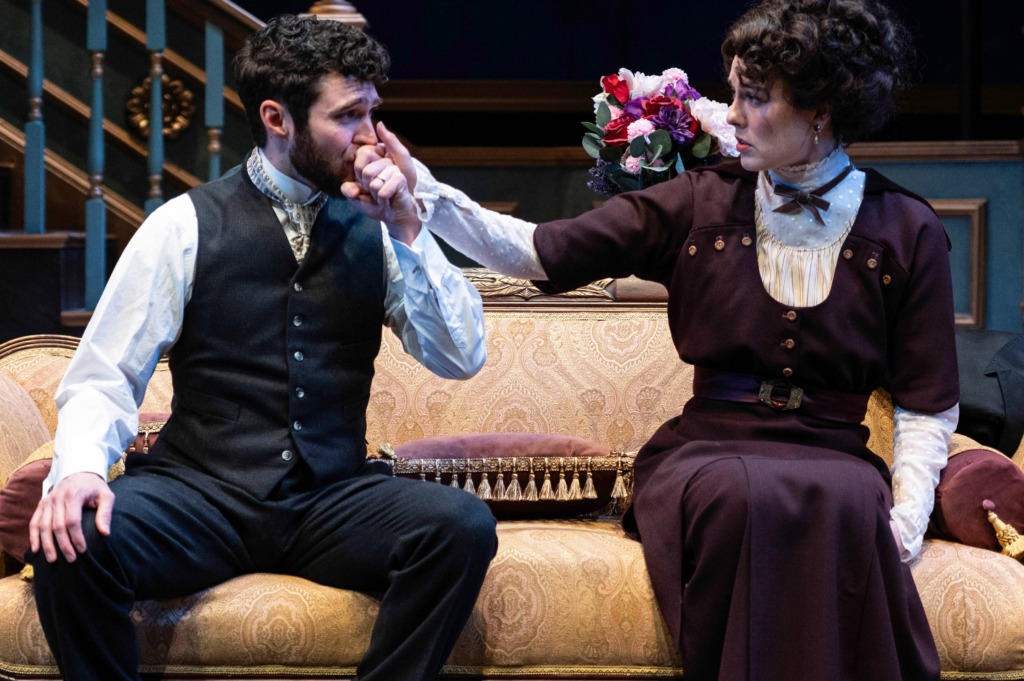
Pacing is exquisite across the board and the little moments, predominantly conducted between Elizabeth and Nancy between the scenic transitions play into the overt notions that the long-term housekeeper cares not a wit for the new hire. This is Director Vincent M. Lancisi’s artistic mind at work, drawing connections, establishing emotional pathways between characters that would otherwise not exist outside of the script; it makes for that much more of an interesting theatrical experience and ultimately adds a cheeky dash of dark humor to the performance.
While a great deal of their interactions are silent (in those aforementioned, brilliantly crafted moments that occur between scenes) the dynamic between Nancy (Em Whitworth) and Elizabeth (Deborah Hazlett) is enthralling to watch and highly underrated. Both Whitworth and Hazlett have more interactions with the other two characters, this cheeky and rather brusque relationship adds a little zest to the play. Whitworth has this smarmy smugness about her, which just flounces through her body whenever she enters and exits the stage, particularly when she’s carrying the lighter-pole for the gas lamps. And though her words are few, her body language and prevailing physical attitude says it all. Hazlett, of a more composed nature, has an incredibly satisfying moment near the end of the production, which both uplifts and supports Bella’s overall exertion of agency in the presiding situation. (Shoutout to dialect coach Gary Logan for giving both Hazlett and Whitworth just enough of that working class sound to help differentiate their two characters from Bella and Jack.)
Playing a truly deceptive character, both in his duplicitous actions and in the way in which he’s perceived (by the audience and Bella) Zack Powell as Jack makes for a riveting enigma. It’s difficult to want to invest an interest in an antagonistic character whose true colors are rather revolting (even if that isn’t learned until later, or implied subtly early on if you know what sort of behavior you’re observing.) Powell has a slipperiness about his portrayal, one that allows him to glide into dialogue exchanges with a too-readily accepted ease, making it that much more harrowing and gut-punching when the ‘other shoe’ finally drops. His interactions, primarily with Bella, feel genuine, which makes the deception of Jack’s existence that much more of a stinging blow when it lands.
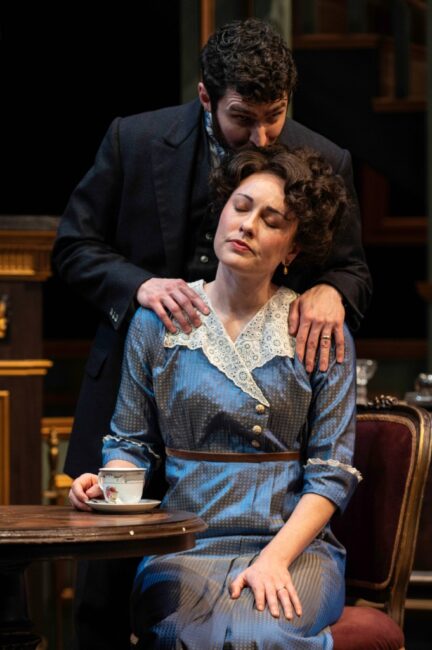
As for Bella (Katie Kleiger) there is this transient uncertainty about her. The madness, the questioning sanity, the swallowing back thoughts and words, the feeling as if every step she takes, every move she makes might cause the floorboards to clatter apart and swallow her up whole; Kleiger does a remarkable job of expressing that in her fixed posture, her quickly-retracted facial expressions and her overall demeanor. The emotional energy that Kleiger generates into the character of Bella is ferociously palpable. And the shift— when it hits at the end of the first act— is visceral and stunning. As the story winds round and unravels to its conclusion in the second act, you see dynamic shifts in Kleiger’s approach to Bella; it’s fascinating to watch, particularly in those moments where she’s forced to shift her behavioral patterns and even the way in which she speaks to keep up the façade. Kleiger does an exemplary job of handling such a varied character, making her (and the audience) question her sanity whilst simultaneously finding a way to rise above and give her existence and her voice agency.
It’s a true psychological thriller though this particular adaptation is moving and evocative, forcing the narrative to course-correct beyond the emotional abuse of the gaslight. Do not delay— get your tickets to see Deceived this winter season at Everyman Theatre.
Running Time: Approximately 2 hours and 10 minutes with one intermission
Deceived plays through January 4th 2026 at Everyman Theatre— 315 W. Fayette Street in the Bromo Arts District of Baltimore, MD. For tickets call the box office at (410) 752-2208 or purchase them online.