
I dreamed last night I got on a boat to Frederick! And by some chance— found a ticket in my hand!
And as I looked, to see what was printed on the ticket— an usher told me take a seat and not to stand!
And the people all said— Sit Down! Sit down, you’re seeing a show!
The People all said— Sit down! Sit down, you’re seeing a show!
And Other Voices Theatre will drag you in there, to see Guys & Dolls, it’s a must-see: Go!
Sit down, sit down, sit down, sit down! Sit down you’re seeing a show!
Frank Loesser I am not, as clearly indicated by those bad repeating rhymes and slides above, but Guys & Dolls I have a working familiarity with— it’s getting to the point where I’ve covered it nearly as often as I’ve covered Spelling Bee or Seussical; and lemme tell ya, Other Voices Theatre has a pretty darn-close-to-perfect production going on. Their Guys & Dolls, as directed by Lee Rosenthal with Musical Direction by Angelica Ramos and Choreography by Shari Seymour, is pretty much the bees knees, give or take a hiccup or two here or there. It’s a splashy golden Broadway classic and it packed the house for opening night, which is an impressive feat in and of itself as theatres seem to really be struggling to get folks out on a Friday night.
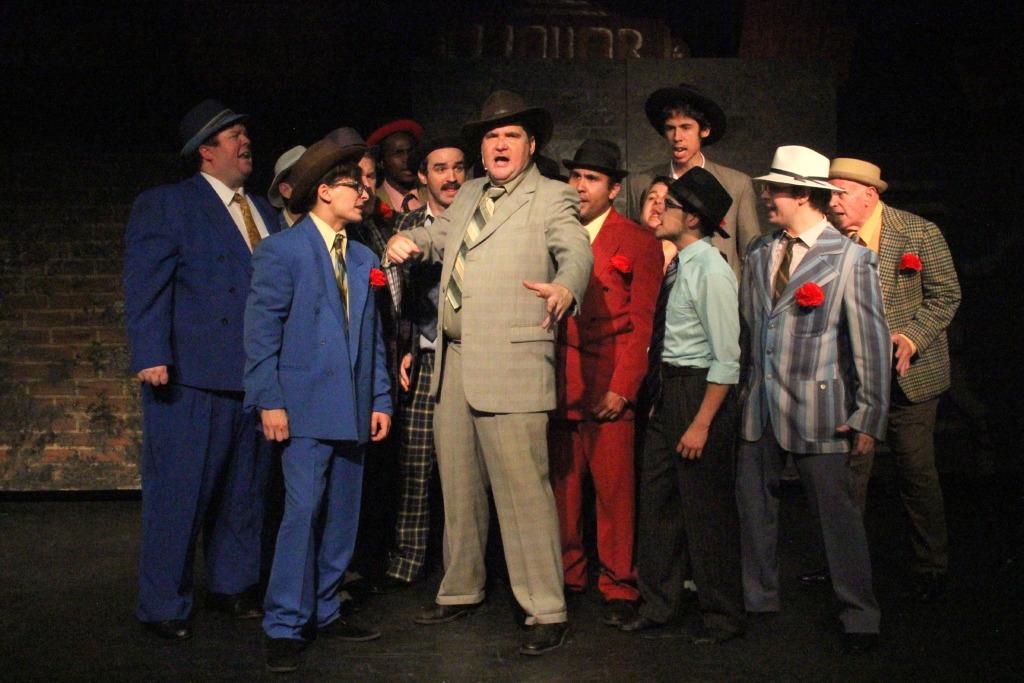
For being a tried-and-true musical theatre chestnut, Director Lee Rosenthal and her creative production team have breathed some much-needed revitalizing life into the show, mostly by way of color schemes, letting lots of ensemble characters find their extremely memorable cameo moments, and above all with their pacing. Guys & Dolls is a three-hour show no matter which way you split it but the difference with Rosenthal’s production is that you don’t feel those three hours; you find yourself toe-tapping along to the up-tempo numbers, chuckling at the jokes, and hanging onto those little dramatic nuggets like a chipmunk with stuffed cheeks. It’s a beautiful thing that the pacing is expedited in this show, the timing for dialogue delivery is meticulously paced without being rushed, and the sense of understanding the time stamp on the piece is ingrained in all of the performers.
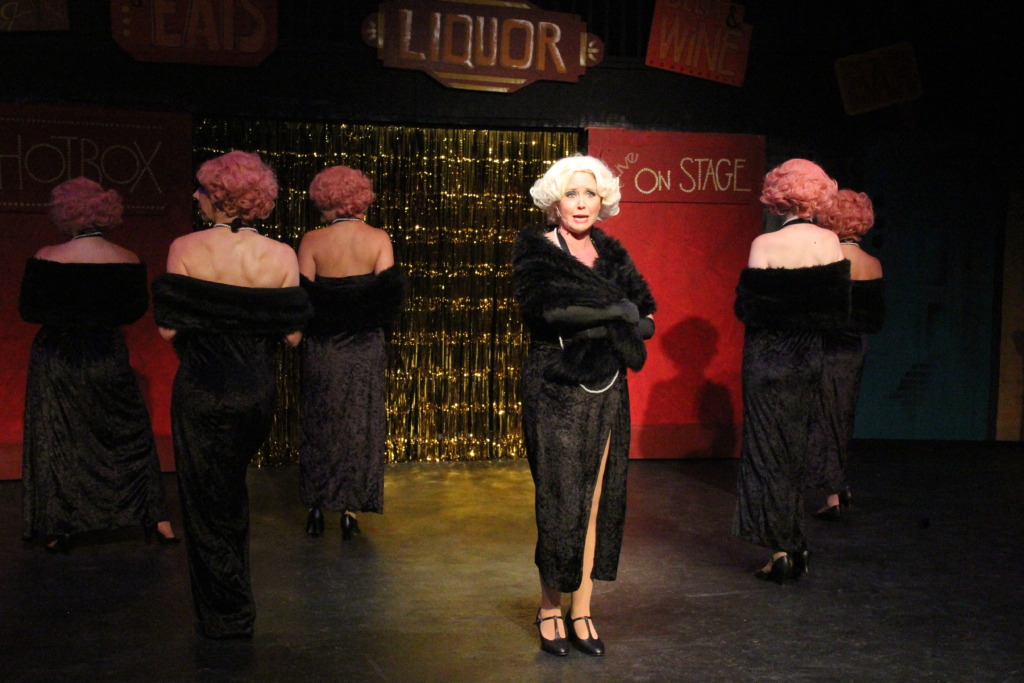
Visually the show is stimulating. Everything from the vibrant saturation of the colorful New York Street scene background to the rich, popping jewel tone suits featured on various of the gamblin’ guys. There’s a production-team-village hard at work to execute the vivacity behind Rosenthal’s vision for the show and it seems to be starting with Set Painters Jeff Elkins and Jeanne Lloyd. The ground level of the background has primary and secondary colors that just pop with the more muted pastels come in on the panted roller flats for Havana and the sewer scenes. Bill Brown gets credit for the ‘set concept’ and the backing wall pops open to reveal a gold shimmer-streamer curtain and red interior doors with lightbulb lettering that says ‘Hot Box.’ It’s a clever juxtaposition— New York is richly colorful, glittering and shimmering, whilst the sewer and ‘far off places’ (like Havana) are muted and less inviting. This particular scenic presentation stands in staunch opposition to the more traditional staging approaches to the show, though if you stop and think about it— all the action (minus the café-bar-fight-in-Cuba) happens in New York so why shouldn’t it be perceived as popping and colorful?
Matching those colors, tone for tone, Costumers Ginger Ager and Sarah Ward come up with some fabulous couture for the show. Many of the gambling guys have suits in one solid, saturated color— most notably being that grimace purple on Rusty Charlie, that bright sapphire on Benny Southstreet and the salmon-carnation on Big Jule— and some of the street-gal-ensemble do too. The Hot Box Dancer costumes are also delightful— the Daisy-Duke cut-off overalls with the red gingham checker-plaid shirts for “Bushel and a Peck”, with Adeliade of course having a sky blue checker paid version to differentiate her from the others— and those black velvet rip-away gowns for “Take Back Your Mink” are spot-on. Some of the show’s wigs just look a little…off? (Minor, nit-picking detail, really but when you’re in an intimate venue and the rest of the show is pretty astonishing, you want the wigs to look as close to perfect as possible; Nikki Ottoviano did a great job, however, on helping get the makeup style of the time period correct for all the dolls in the show, Adelaide in particular!)
The show’s lighting isn’t anything spectacular to write home about and that isn’t to say that Lighting Designer Marlie Mitchell hasn’t done a good job; it’s just not a spectacle and honestly given the nature of the set and the show as a whole, it doesn’t need to be. The show’s lone production value issue is the sound, designed by David Kron. Using tracks is one thing but having the drop mics not really pick up and then not lowering the levels on the tracks created some inconsistencies in the overall aural quality of the show. Several of the performers navigated their way around this with seasoned flare, knowing to project and sing out or speak out, others were not as successful in their attempts to be heard. The space can be tricky, but there are ways to bring down the volume of the tracks so that the actors can still hear and be heard.
Musically the show is a success. Music Director Angelica Ramos has schooled these performers well, particularly in their efforts to chase and catch the pre-recorded track music. There are definitely moments where singers get both ahead of and behind the track-recordings of various songs. But much to my personal astonishment, the handful of times that this did happen, every single soloist managed to catch it within a note or two and some of the lyrical acrobatics they did to make it work were striking and impressive. Most of the performers also carried with great consistency their chosen character accents and affectations into their singing voices and nearly everyone in the performance had a rich, robust sound when singing. Three-part harmonies blended sublimely at the end of “Fugue for Tinhorns” and there was sublime duet pairing at the end of “Marry the Man Today” and when the ensemble creeps in for “Sit Down You’re Rocking the Boat” not only does it sound fully blended but the shock-response on Nicely-Nicely’s face is out of this world. Ramos knows Loesser’s score and all its intricate nuances and that is more than adequately reflected in the way this cast sings their hearts and souls (how do you spell soul?) into these iconic musical numbers.
Shari Seymour puts enthusiastic choreography on the table for a bunch of different numbers. While some of the choreography is at times repetitive, it’s consistently clean, executed with precision, and it maintains all of its intended energy and effervescence. “The Crapshooters’ Dance” becomes a hybrid of pop-shot gestures, ballet sweeps and twirls and some straight-up Looney-Tunes cartoon-style animations— particularly every time Big Jule gets to throwing dice during that dance-only number. The two hot box numbers— “Take Back Your Mink” and “Bushel and a Peck” features a lot of perfectly synchronized moves among the Hot Box Dolls (Madelyn Behling, Michelle Boizelle, Diana Robertson, Erin McNerney Smith, Madeline Soypher) though a lot of Seymour’s true dance magic is witnessed in “Havana” where Rusty Charlie (Sam Abrahams) and Erin McNerney Smith— as their Cuban-dancing alter egos— really salsa, shimmy, and spin up the life fantastic. There’s also a pair of featured dancers toward the end of that whole chaotic affair— Justin Oratohai (who in New York is Angie the Ox) and Madeline Soypher; watching the two of them, especially toward the end of the scene, is pretty terrific as well.
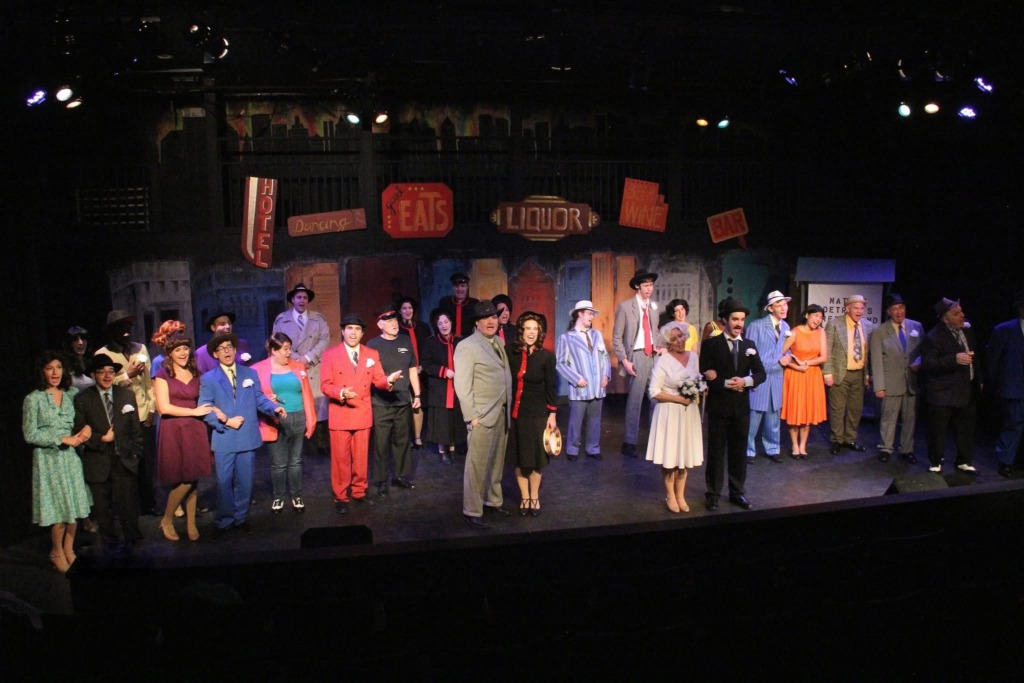
There is something to be said and praised for Lee Rosenthal’s understanding of the show. Specifically the way she imports the cadence and patois of speech patterns to the actors. You get the notion that from jump-street you’re in a different time period; nothing reads modern and it feels deeply satisfying to see performers of all ages on stage understanding this. If there’s a complaint to be had about Rosenthal’s overall directorial approach it’s the slight hiccups that happen a few times with a few bits of furnishings failing to make their way off-stage in the most timely of manners. Rosenthal has the entire ensemble shunting benches, flats, and that rattling scaffold-staircase on and off, and for the most part it happens pretty quickly. The staircase, while exceptionally well placed and used during the sewer scene, hardly seems worth the trouble to trot it out in Havana especially since Sky and Sarah only climb it momentarily and the same effect of “overseeing” could be achieved by simply running them to the lip of the stage. There’s also a lot of linearity in Rosenthal’s blocking and while this isn’t a problem, per say, it just begs to be busted up in places. (Making an excellent show extraordinary.) Ultimately Rosenthal delivers a product that’s well worthy of praise, particularly when it comes to letting the ensemble find moments to really make themselves known, in a humorous and eye-catching way that is not detracting from the main action but rather becoming a part of it.
Speaking of action— all them gamblin’ guys are winging dice left, right, and center to get their moment in the lime light and tensy-come-again-sy, they’re rollin’ straight sevens every time! Like Harry the Horse (Richie Dobson) and his off-piece utterance of “I slipped!” when he flubs-up in front of Lt. Brannigan about the ‘getaway car’ or the shifty-shady eyes on poor Rusty Charlie (Sam Abrahams) as he tries desperately to slink out of that crowd scene. (It’s a total cover for a costume change but so in character that it’s hysterical and well-worth mentioning.) All those fellas are finding epic ways to chew scenery and really pop in moments that need a little extra umph from the ensemble.
Cameo performances from characters like General Cartwright (Courtney Knoerlein) and Arvide Abernathy (at this performance Bruce Rosenberg) are fitted meticulously into the narrative in a way that is both outstanding and sentimental. While Knoerlein’s character shows up to essentially, albeit unintentionally, ruin what’s happening with the mission, her enthusiastic response to the all-night prayer meeting is top-notch. Rosenberg steps right into the role of Arvide Abernathy and delivers a delicate and dulcet rendition of “More I Cannot Wish You” and when he calls Sky out at the end of that number, it’s on-point comedy that leaves the audience in stitches. Kirk Patton, as the irritating Lt. Brannigan, deserves a cameo-nod-of-praise as well for his subtle Irish accent and his flawless delivery of one of the funniest lines in the show— the one about ‘holy rollers.’
Now if you came to shoot crap— Big Jule is your guy. Or in this case, your gal. Taking up the breeches role here, Alissa Margolis does a stellar job of making Big Jule a real caricature gangster, complete with Looney-Tune level antics during the “Gambler’s Ballet”, pulling facials and gestures that are fondly reminiscent of both Daffy Duck and Wile E. Coyote. Margolis delivers that tough-gruff-guy sound, with a hint of East Cicero nicely nestled into her accent. Margolis understands stage presence and manages to do a lot simply by glaring, posturing, or using precision in her one-liners, giving you that intimidating yet hilarious gangster character that is necessary for that character.
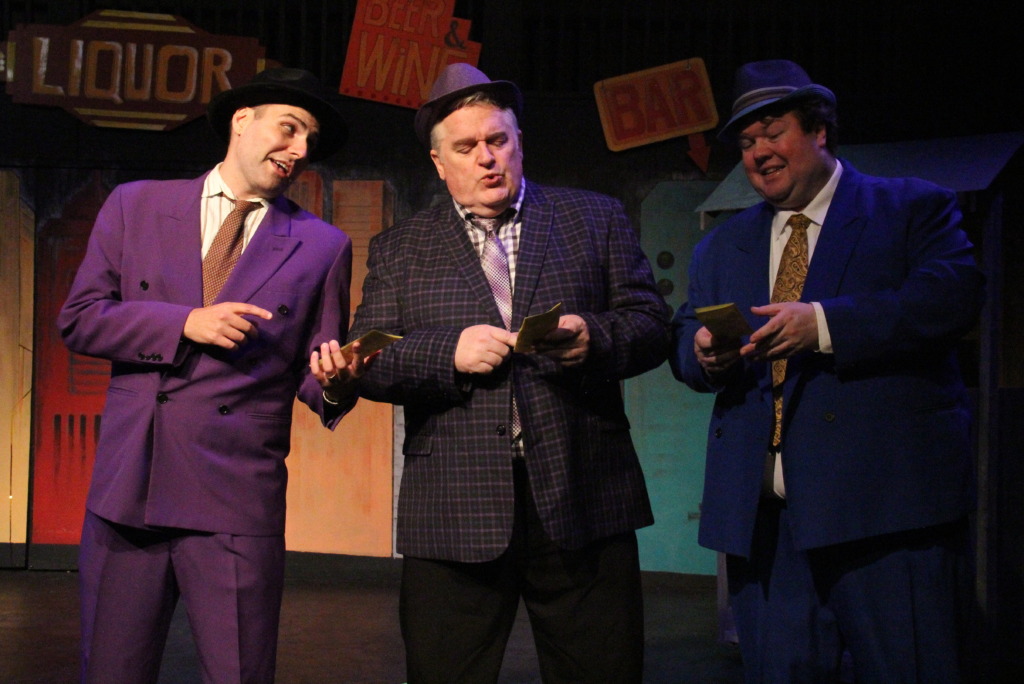
You want birds of a feather— you got ‘em in Nicely-Nicely Johnson (Will Hayden) and Benny Southstreet (Tyler Hansen.) Not only do they open the show (alongside Abrahams’ Rusty Charlie) with “Fugue For Tinhorns) but they get the iconic titular number, which can honestly make or break a production of Guys & Dolls. And these two play well off one another, with Hayden bringing the seasoned air of a well-practiced stage veteran and Hansen matching his energy with a more youthful verve. Their dancing antics in that number are a scream, particularly when they exit the stage and the pair of them do delightfully on mastering those ‘big apple city’ style accents, particularly Hayden. And when he’s gassing on about Nathan’s rare tropical aunt, watch his facial expressions, they’re giving classic animation a la Rodney Dangerfield. Hayden also gets the distinguished honor of leading the cast (sans Sky) through “Sit Down, You’re Rocking the Boat” and the party vibes are there, along with Hayden’s cheeky ‘make-it-up-as-you-go-along’ vibe, which is an excellent comedic component to this scene and song.
Colleen Prior is serving up textbook Sgt. Sarah Brown, complete with that Frank Loesser warble-vibrato in those soprano sustains for nearly every song she sings. There’s something convivial about her portrayal that just makes you want to pity her but in a ‘let me hug you until your story gets better’ sort of way. She amps the energy when she gets to Havana, particularly when she delves into “If I Were a Bell” and the slow-to-build chemistry that eventually blossoms between her Sarah and Sky Masterson (Bill Brown) feels accurately aligned with the narrative arch of the story. Her duet, “I’ll Know” showcases her range, though it’s her moment of silent, absorbent reaction during Arvide’s “More I Cannot Wish You” that really showcases her sentimentality as a character.
Chalk it up to opening night jitters but Bill Brown’s Sky Masterson didn’t really burst to life until “Luck Be a Lady” late in the second act. This was ever so slightly disappointing as he’s the epitome age-bracket for what a Sky Masterson should be. A few stumbled lines and muddled deliveries all through the first act left Brown’s Sky feeling just a little hollow, but he found his footing in the second act, particularly when he started climbing the stairs back out of the sewer, hot-shot-flipping around for the ‘make a pass to save your soul’ line. Channeling a little bit of Brando and a little bit of Sinatra, he put the gusto into “Luck Be a Lady.” Brown has a solid vocal range for singing his various numbers in the first act, good tonal control, and will hopefully up the ante in Act I for the remaining performances.
Plucky and oddly perky, Fred Fletcher-Jackson is bringing the perfect balance of caricature-antics and in-moment sincerity to the role of Nathan Detroit, even if during “The Oldest Established…” he’s cheating out and eye-brow waggling at the audience just a bit much. Fletcher-Jackson is wildly animated, particularly in his facial expressions, which serves the character well, particularly during the letter scene where Adelaide explains that her mother has written him a letter too. And while Fletcher-Jackson doesn’t get as many songs as one might suspect, given the importance of the character, when he glides into “Sue Me”, a duet with Adelaide, his clear tone and emotional intent behind the number is pristine. There’s a hint of that ‘Nathan Lane’ enthusiasm going on in his rendition of this duet but it’s balanced properly so as not to be too over-the-top. And all of his lines during the mission-scene leading up to the big ‘boat-rocking’ number are delivered with exceptional intent.
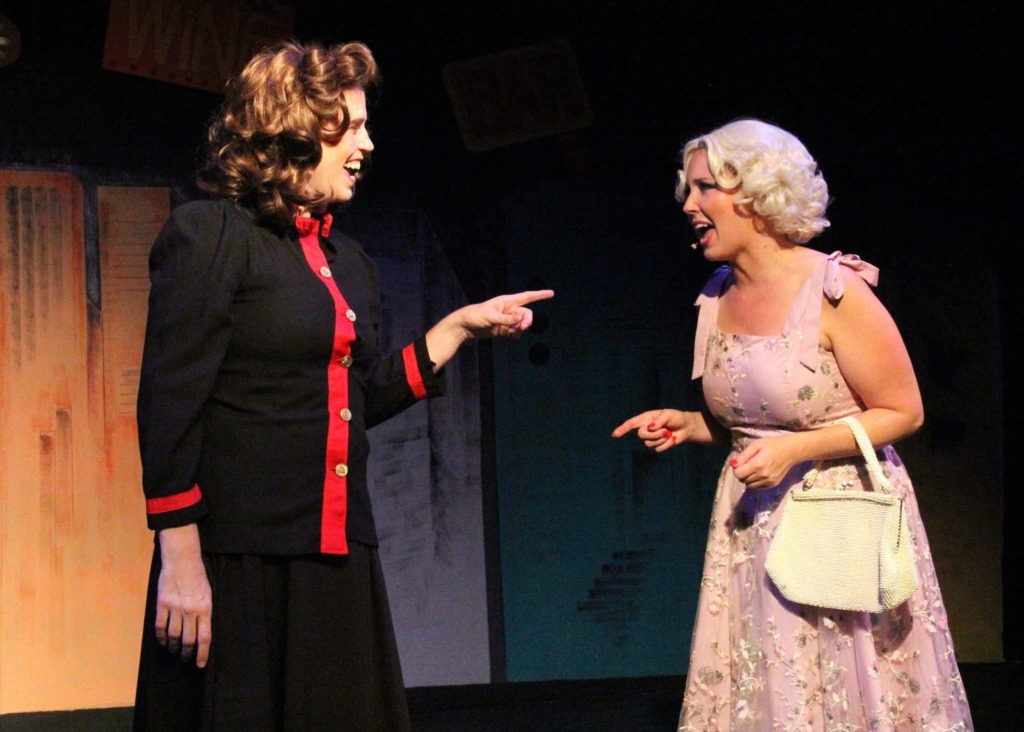
Stealing the show on her returnable-mink, Miss Adelaide (Leslie Lewis) is the perfect Hot Box Doll. Her accent is sublime, her vocal intonation is impeccable, and the way she engages with everyone is just extraordinary. She gets little moments with her Hot Box Dancer Girls, like when they throw her a ‘surprise kitchen shower’ and you feel like these five girls are her best friends in the world. When she gets carried off by Nicely-Nicely and Benny, you feel like she’s known them at least all 14 years she’s known Nathan. And when she has her momentary meeting with Sarah Brown on the bench before their hilarious duet “Marry the Man Today”, you get the sense that she’s a kind soul who would and could make friends with any woman in distress. Her rendition of “Adelaide’s Lament” is beyond iconic and just has the audience whooping and hollering for her by the time she hits her big belt-and-sneeze at the end. And when she patters through “Sue Me” her articulation is astonishing, each and every pattered word being delivered with precision so that all of those humorous lyrics are fully understood. She leads the girls through “Take Back Your Mink” with such enthusiasm and animated moves you could see her being a regular Betty Boop.
Take a gamble— roll the dice on Other Voice Theatre’s Guys & Dolls; I promise it won’t be snake-eyes! They’re on for another weekend— don’t miss your chance to check them out!
Running Time: Approximately 3 hours with one intermission
Guys & Dolls plays through August 10th 2025 with Other Voices Theatre Other Voices Theatre at The Performance Factory— 244-B South Jefferson Street in Frederick, MD. Tickets are available by calling the box office at (301) 662-3722 or by purchasing them in advance online.
