

author: Wes Dennis
Hungry for a show filled with fun performances, (mostly) fun and engaging writing, and more characters (and costumes!) than you’d potentially encounter across a marathon weekend of productions? Bowie Community Theatre has a place set for you with A.R. Gurney’s The Dining Room, a delightful dish that offers a smorgasbord of theatricality that sees eight actors performing no less than 18 (!) vignettes during its 2-hour, 10-minute runtime.
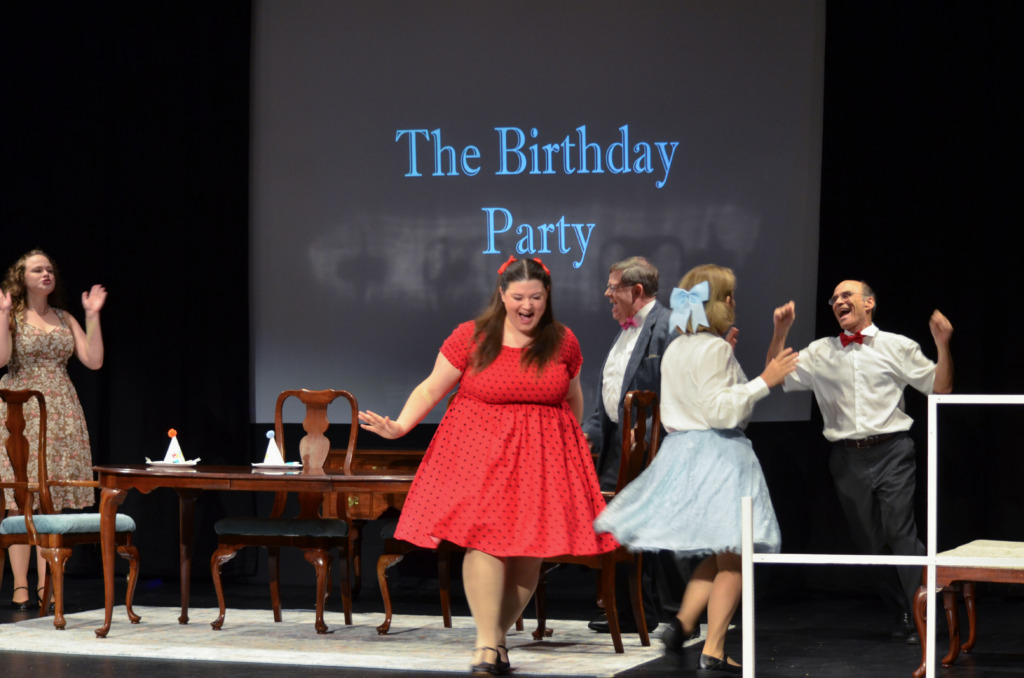
Director Stacy Kessler has done amazing work making each scene feel distinct. One can imagine a staging of this play where it is difficult to tell where one scene ends and the next begins (and admittedly some early moments of overlap do potentially make for some head-scratching moments), but overall — and especially once the show finds its rhythm — it’s remarkably easy to identify scene changes and follow the action as actors exit one scene set in 1943 and others emerge in 1972. Costume consultant Jeano Binney also deserves praise here; while the program addendum denoting the year during which each scene takes place is invaluable (nod to program designer Reed Sigmon), the juxtapositions of different dress styles do further signal the changes in time and progression of scenes to an audience that might otherwise have remained ignorant of the shifting temporal settings (though the writing and performances also shoulder some of the burden).
What largely does not give the audience further cues — and this is not a criticism! — is the set design by Abby Martin. While there *is* a rear projector that inconsistently spoon-feeds the audience some details (some but not all of the vignette titles appear on it; at other times it relates to the discussions taking place onstage) and Kessler’s work as the props designer is noteworthy as a supplement to the action (the various dishes and glasses were believable as the objects they claimed to be, with expensive antique finger bowls and different glassware styles looking the part), these additions mostly do not steal focus. The same goes for the sound (designed by Fred Nelson) and lighting (designed by the Bowie Playhouse staff): they’re fine and unobtrusive, mostly neither calling attention to themselves nor hindering the unfolding scenes. The occasional underscoring, with songs that appropriately reflect the period of the scenes in question, is nice if you can place the selections.
But if those details are appetizers (or, as with some of the projections, the equivalent of the lemon wedge on the rim of your water glass), the main course is the old dining room — here represented by a dining room table with various chairs (set at the table or off to the side depending upon the scene) and a bureau directly behind it — in which each vignette takes place, hence the title of the play and the one thread connecting these disparate scenes. That long table in the center of the stage does so much work here that it practically deserves an actor credit: in some scenes the table is treated as relatively new; in others its antique quality and/or disrepair is remarked upon; in all cases we’re invited to use our imaginations to supply what the set otherwise lacks. This quasi-minimalist approach works exceedingly well. No complex scene changes (various maid characters cleverly handle, in character, what little additional setting is required) keep the action moving at a brisk pace and ensure that there’s rarely a dull moment or unintentional downtime. (Several scenes and performances definitely deserved actor bumps, but I found it difficult to find pauses for extra applause given the pace of the action!) The few moments when the action slows — such as when one character lingers onstage while silently contemplating his father’s impending death — are meaningful, and all the while the table serves as a silent, solemn witness to the events playing out before our eyes.
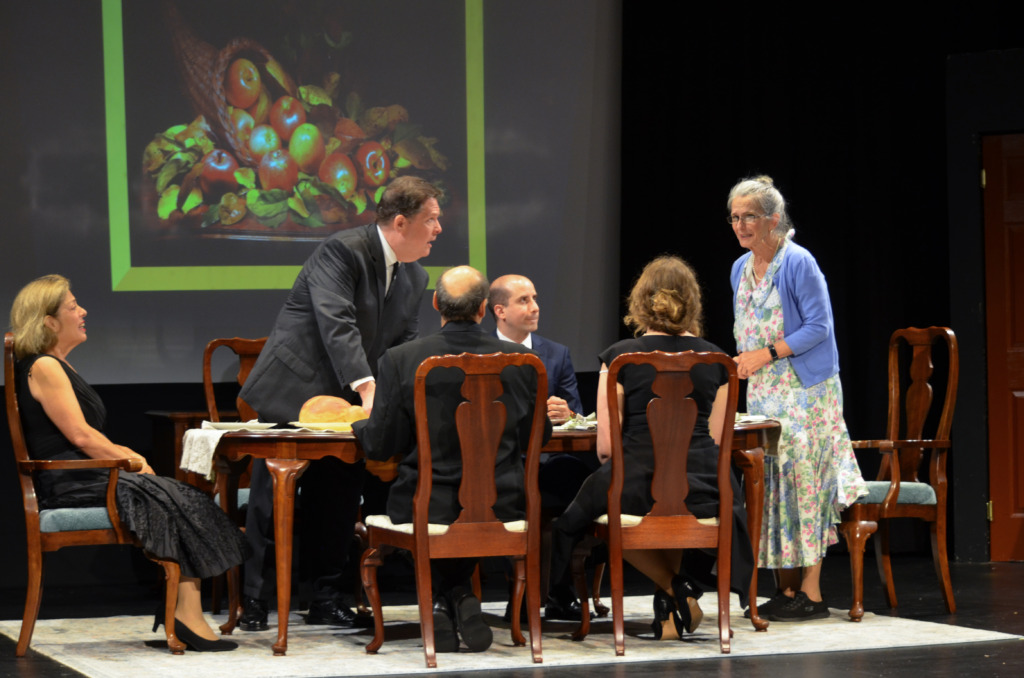
And then there are the scenes themselves and the performances that bring them to life. First, kudos and a standing ovation to stage manager Mattea Horton — shepherding the actors through 40+ costume changes and so many entrances and exits is an impressive feat of coordination that almost beggars belief. As for the actors, watching them made this a truly inspiring and encouraging piece of community theatre. The vignettes themselves vary in depth and writing quality, with some that overstay their welcome despite their short length (a very few feel like the stuff of a first draft) and others that provide welcome entertainment but lack the punch of the more poignant segments, so the actors don’t always have the most compelling material to work with. But — still — wow. The range that every actor is forced to demonstrate — actors are required not only to play characters inhabiting different decades, but also characters spanning different age groups and social classes — had me grinning throughout and in constant awe of their commitment and ability to rise to the occasion. Every actor was given at least one truly standout moment that would have inspired a bump if the play moved at a *slightly* more leisurely clip.
At the risk of spoiling your dinner: in addition to putting in an impressive turn as a precocious child in an early scene, Jim Adams truly shined in “The Incident,” which depicts a brother apoplectic about a comment that impugns his family’s honor. Alan Barnett’s work in “The Funeral,” in which he plays a son receiving his father’s funeral instructions, is incredibly moving and relatable for anyone who’s had occasion to contemplate that unfortunate eventuality. Penni Barnett and Rosalie Daelemans are both delightful in their performances of two teens raiding the liquor cabinet of one’s absentee parents in “The Teenagers” — which also has me determined to try their makeshift cocktail of vodka, Fresca, and watered-down gin. In a scene that otherwise grates (not unrealistically; I certainly don’t want to be the lone adult host of a children’s birthday party), Ansley Gerhard is believable and sympathetic as the host child’s mother in “The Birthday Party.” For my part, Amanda Matousek and Andrew Rappa earned the biggest laughs of the night in “The Partnership” — which is actually probably among the weaker vignettes and would hardly work as well without their HILARIOUS delivery of lines that have no earthly right to be as funny as they are. Tom Schiller does a great job playing similar no-nonsense dads in “The Father” and “The Funeral” (both frown upon “smart-aleck, wise guy” statements, which also possibly illustrates how times have changed: in similar instances, a number of parents today would be genuinely impressed with their offsprings’ wit). And everyone in “The Thanksgiving Dinner” — that’s Penni Barnett, Ansley Gerhard, Jim Adams, Rosalie Daelemans, Alan Barnett, and Andrew Rappa — has my sincere respect for their work in the most powerful and challenging vignette in the show. It is ROUGH and asks so much of the performers, and every single one of them truly delivers. (Fortunately, as that segment immediately preceded the 15-minute intermission, they got the applause bump they rightly deserved during the performance I saw.)
A.R. Gurney’s The Dining Room doesn’t always serve up the freshest ingredients or the most innovative dishes, but the presentation — and the obvious dedication and heart that went into crafting each of the 18 courses — is on par with even the priciest Michelin meal. Truly a five-star dining experience. My compliments to the chef.
Running Time: Approximately 2 hours and 10 minutes with one intermission
The Dining Room plays through August 10th 2025 with Bowie Community Theatre at The Bowie Playhouse in White Marsh Park— 16500 White Marsh Park Drive in Bowie, MD. For tickets please call the box office at (301) 805-0219 or purchase them online