
How much can we ever know of anyone? We are all blind to ourselves, after all. But don’t be blind to Baltimore Center Stage. And know that they are currently producing a spectacular production of Pride & Prejudice (by Kate Hamill, adapted from Jane Austen’s novel.) It’s a wildly comedic reimagining of Regency life with colorful characters, twisted societal demands, and a bunch of other little quirky gems that will keep you snickering and enjoying yourself from start to finish. Directed by Ken-Matt Martin, this production of Pride & Prejudice is lively and engaging, offering a most delightfully splendid evening’s entertainment to all in attendance.
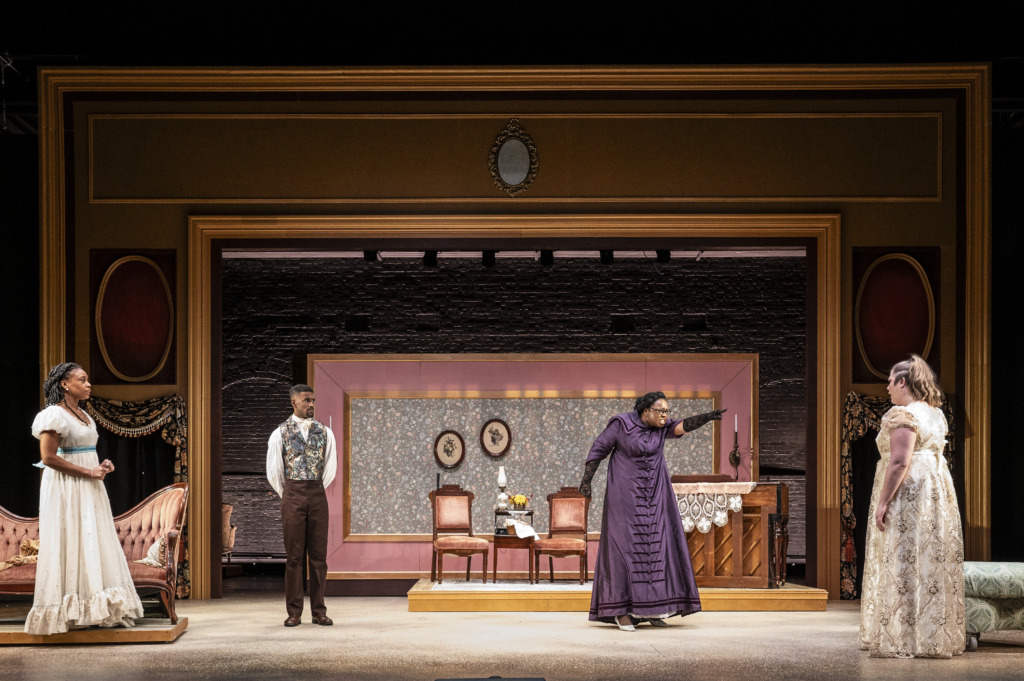
Lush and lavish are the hallmarks of Regency living and both Scenic Designer Sydney Lynne and Costume Designer Celeste Jennings (and Wig Designer MD Hunter) have the production covered on that front. The rolling pop-out scenery walls allow for fluid transitions between the lesser Bennet household and all of the fancier residences that are visited throughout the course of the performance. Detailed and bedecked in patterns and styles of the era, Lynne’s scenic aesthetic is a wonderful service to Austen’s original text and the mobility and utility of her design is perfectly aligned with Hamill’s fast-paced, farcical adaptation. Jennings’ sartorial selection for the show is sublime. Each of the dresses on the four Bennet daughters is most agreeable for their constitution and nature. (High praise should also be paid here to Stage Manager Luisa Ann Torres, ASM Makayla Beckles, production assistant V Brown,) for the expedience with which they execute those off-stage costume changes. Particularly for the roles of Mr. Bennet and Charlotte Lucas (played by the same actor) where breeches and waist coat go into formal dress in the blink of an eye. Noticeable standouts among Jennings’ fine fabrications for this production include that striking sapphire affair and accenting-peacock hat seen on Lady Catherine and the gilded gold shimmer gown featured on Jane in the second act.
Associate Director and Sound Designer Jeremiah Davison primes the audience with notions of modernity in the pre-show musical sampling but what really draws theatergoers in is the robust, luscious swells of full-string orchestral renditions of modern musical numbers like Kanye West’s “Gold Digger”, featured as scenic transitional sound immediately following a scene where Mrs. Bennet’s scheming ways are in full vigor. There’s another excellent example— the scene which ends with Lizzy insisting that she walk to Bingley’s estate to visit poor, sickly Jane after mother refuses her the carriage and Vanessa Carlton’s “A Thousand Miles” is featured, once again in vividly swanky full-string orchestral rendition as the scenic interplay music. Davison’s use of moments like this— including Taylor Swift’s “Shake It Off” after the awkwardly disastrous ball-scene in the first act— are glorious. It does beg the question as to why Davison doesn’t continue in this rich vein of orchestral pop tunes in the second act. The tone of the play stays approximately the same as it does in the first act, but Davison switches to more obscure— but still aural-verve-appropriate— orchestrations for the scenic shifts in Act II.
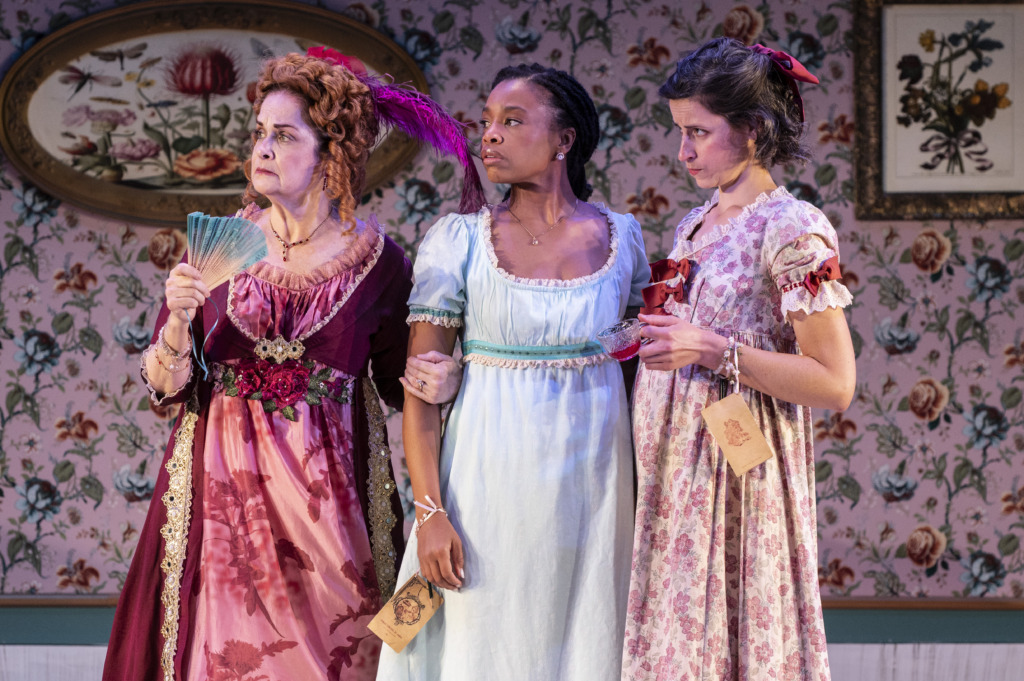
If there’s an odd moment to be had in the production it’s the ‘asides’ that seem to be sprinkled at random near the very end of the performance. (It’s unclear if this is a part of Kate Hamill’s adaptation or something delicately woven into the work as an artistic choice by Director Ken-Matt Martin) but the women— particularly Mary— go off-piece in these little asides, which are highlighted by shadowy-frozen-feature lighting tricks (compliments of Lighting Designer Levi Wilkins.) Mary’s one in particular turns into a poetry slam of sorts about how women end up tarnished and tainted over one simple mistake and how we as a whole are deserving of better when it comes to how we’re viewed in society. And the audience seems to eat these little moments up, particularly Mary’s poetry-slam instance, but they feel odd, especially as they only happen in this ‘reflectively self-aware’ fashion— where the characters acknowledge that they are dissolving from the narrative to address the audience directly— for the final few scenes of the performance. Not wholly unacceptable or disagreeable, just odd, to the point of calling into question whether this is as written or something else coming to play.
Ken-Matt Martin’s overall approach to the show keeps the audience thoroughly engaged and thoroughly amused, if not a little lovesick over the whole affair. The pacing is crisp, adding to the effective farcical layer that Kate Hamill’s adaptation sets over Austen’s initial text. And the choice to play Bingley like a sprightly young puppy— complete with head scratches, ‘squirrel-attention-spans’ and use of ball— juxtaposed against the grizzled, senior-owner caricature of Darcy is fascinating. There’s also a great deal of barnyard animal influence going to the character work of Lady Catherine De Bourgh and daughter Ann. The vocal delivers and physicality of these two roles have overtones of sheep, angry geese, and other such livestock. And one doesn’t even know where to begin the commentary on the over-the-top direction in which Martin has thrown the character of Mr. Collins. It’s hilarious and hysterical and so over-the-top it feels like it was dropped in via airlift from a farce someplace else in time and space. Martin should also be praised for his notion of masking the run-crew in servant’s livery; maid togs and houseboy-threads are featured whenever one of the run-crew appears to move furniture— and even to ring bells and hand-deliver notes.
The show moves with such vigor and intensity that even in the slow moments you feel like the world on stage is rushing by you and this isn’t a bad thing as the production itself runs just a little over two and a half hours (including the intermission.) But it’s funny; there’s heartfelt sincerity in addition to high-gasping humor that infiltrates each of the moments. Of the eight performers, only three do not get the honor of doubling and tripling up (per Hamill’s parsing of her adaptation) but the show reads as a thorough ensemble piece, particularly from the opening moment, where Ken-Matt Martin has staged the four Bennet daughters running in blindfolded and dizzying themselves about until the dialogue gets underway properly.
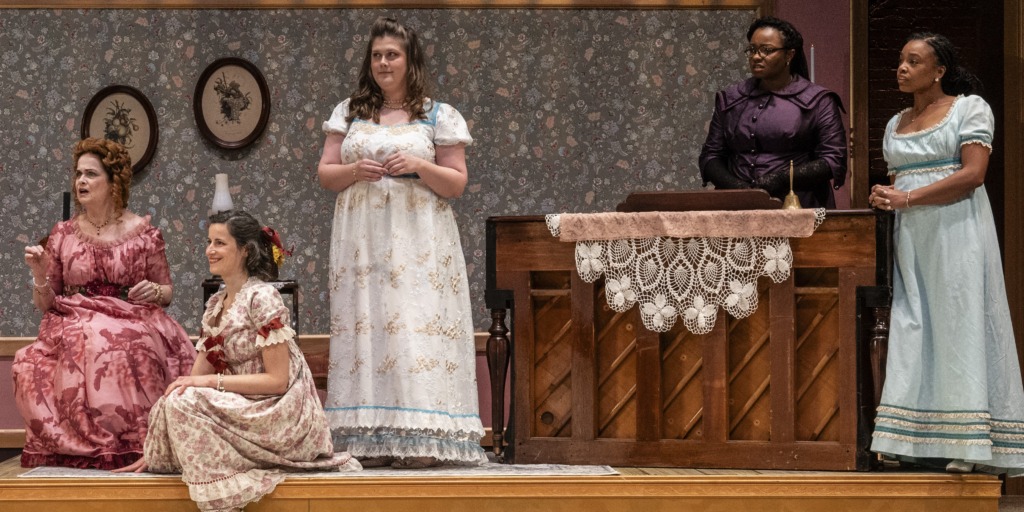
Kathryn Pryor deserves multiple nods of high praise for doubling up as both Mr. Bennet and Charlotte Lucas. While the Charlotte Lucas character isn’t much to write home about (Jane Austen’s fault, not Pryor’s) you get a series of hilarious moments from Pryor when playing the character, mostly deadpan ‘I have no bothers left to give’ style in response to her interactions with, of, and around Mr. Collins. But as Mr. Bennet, Pryor is shining like a radiant north star…particularly when it comes to exuding intentional apathy and indifference to the chaos of the Bennet household. A simple look, quick cutting one-liner, or shuffling-shrug has the audience in stitches from Pryor’s work in this role, but she’s got her grounded moments of severity and sincerity too, making for an extremely well-rounded and strong performance.
Playing opposite is Alanna Hamill Newton, tackling the role of the obnoxiously high-strung, gold-digging shriek-monger Mrs. Bennet with more gust than a Cat5 hurricane. Her antics and histrionics are played at an eleven or higher for nearly all of the performance. It serves its purpose in making the character most disagreeable, having the audience want to laugh her out of existence. Newton really throws the audience into hysterics and peak fits of giggles whenever she’s gushing on about “you were always my favorite” a distinguishment she reserves for whichever daughter is doing something appropriately-gold-digging-ish in the moment that she decries it. When Newton’s character hits that catastrophic meltdown, which is cartoonish and provides thorough laughter for the audience, if not annoyance for the poor characters stuck on stage with her, it’s a viral cocktail of two parts harpy, one part harridan, shaken over crocodile tears and wails for good measure.
Frothed up in a rage for most of her arrivals into scene, the character of Mary (L’oreal Lampley) is ‘the other’ Bennet sister. Constantly hacking like she’s gotten a hairball stuck in the back of her throat, the character rubs everyone the wrong way, mostly by appearing without warning and whining about being left out. Lampley does a splendid job of living up to the notion that this character, like the Mrs. Bennet and Mr. Collins character, are being played at an over-the-top level of melodramatic engagement and it makes for good entertainment. Doubling up as the haughty, albeit obnoxious and disingenuous Miss Bingley, Lampley showcases her capable versatility and finds humors to be had in that stringent stuffy character as well as her less graceless character, Mary. Lampley wins the audience over whole-heartedly in the questionable placed ‘poetry slam’ where the fourth wall shimmers away, albeit momentarily, for the true plight of Regency women to be felt, heard, and understood.
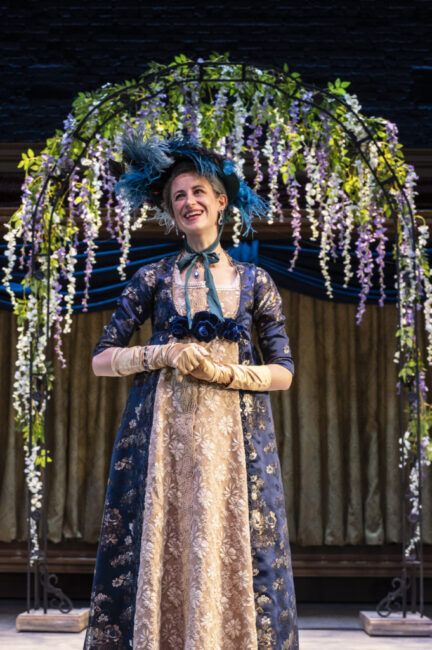
Lizzy Lewis could not be playing more opposite roles in her dual portrayal of the obstreperous and petulant ‘youngest sister’ Lydia Bennet and the severely pinched, cavalier societal woman Lady Catherine De Bourgh. While Lewis’ portrayal of Lydia is flighty and simpering, flitting about on fleet foot as if she could fly away on her own bratty merit, her rigid and stiff composure as she stalks about the stage playing Lady Catherine puts your teeth on edge. The punch-drunk antics of Lewis’ Lydia are as festively giggle-worthy as the barnyard-squawking that Lewis does when Lady Catherine is attempting to instill the fear of good-breeding and etiquette into everyone around her. It’s hilarious and delightfully unhinged in two separate veins, both of which make for excellent entertainment.
While Jane Bennet may be the quieter of the sisters, save for when she’s gushing like a gooey-eyed ingenue over Bingley, Caro Dubberly easily blasts their way into the audiences’ head-space rent free as the odious Miss Ann De Bourgh. There’s something toad-like and vexing about their portrayal of this character, which has the audience rolling with laughter, busting a gut with guffaws, and simply losing their collective minds over the character’s behavior. Dubberly, as Miss Ann De Bourgh, traipses about after Lady Catherine like a snooty gosling or prideful lamb, casting feral facial expressions poor Lizzy which leaves the audience in stitches. You get hints of the same breed of humor when Dubberly plays Jane, though only when they’re choking through their ‘cold’ at Bingley’s place. Dubberly’s Jane is otherwise very demure, very mindful of spatial relationships and behavior that is to be expected of the eldest Bennet daughter.
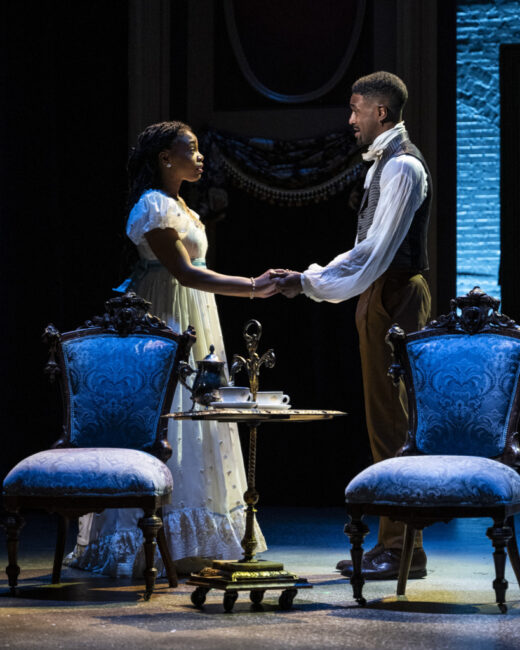
One of just three actors who plays only a singular role, Malik Esoj Childs lives uneasily in the skin that is the dour Mr. Darcy. Childs has a frenetic energy burbling just beneath the surface of his character’s portrayal that proves to be a challenge in those moments of restrictive conversation and otherwise social disinterest, for which Fitzwilliam Darcy is so known. Childs pairs perfectly up against Alexander Matos, who plays Mr. Bingley (among others), and they serve as each other’s perfect foils. Childs is aloof, detached, jaded, and withdrawn into a moody sense of melancholy, though not without his physically expressive moments of humor— particularly at the party with the ‘punch-spill’— while Matos is bright, sprightly, lively, emphatically bouncing about like the puppy his character is being portrayed as. When Childs has biting moments of spark between his character and Lizzy Bennet (Lizzy Brooks), you can feel the subtle flames attempting to burst forth and consume the scene, which makes for a passionate build-up of all sorts of tension.
Being the moodiest of the four Bennet daughters, Lizzy Brooks’ portrayal of Lizzy is textbook Jane Austen, though there are definitely moments when little wisps of modernity flareup into her performance, which is a subtle nod at how even though the Regency era has long since passed society by, the issues contained therein are still among us, lurking in the shadows, breaking through and stirring up our lives. While there is no churlish petulance in Brooks’ Lizzy like there is in Lewis’ Lydia or even Dubberly’s Miss Ann De Bourgh, Brooks brings this sense of stubborn pride to the forefront of her portrayal, which gives Lizzy a solid base from which to work, making her a more dynamic character on the whole. You do get moments of bombastic explosion from Brooks’ Lizzy, no matter how sensible and grounded the character may otherwise be— that one that comes readily to mind is when she shoots Mr. Collins firmly back into his place despite his rather indecent proposal.
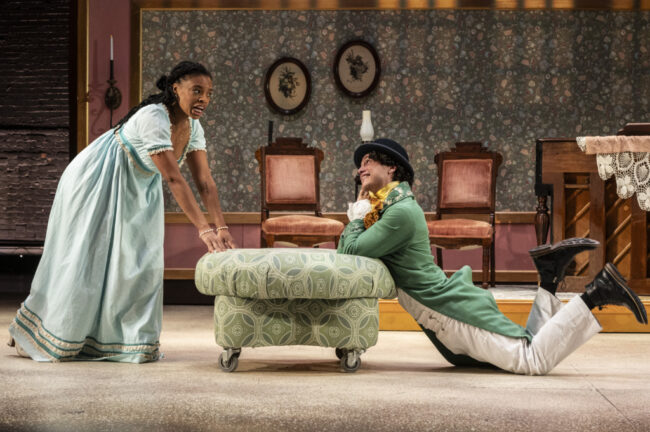
Running away with the show on his shoulders, the aforementioned Alexander Matos is pulling triple overtime playing not only Mr. Bingley but Mr. Wickham and Mr. Collins as well. His puerile puppy behavior is cute well-serves the way Bingle is penned into this adaptation, and his Wickham is so dull that it’s almost not worth mentioning except in contrast to the vivacious livelihood of his other two characters— though to be certain, when Wickham’s colors turn over, the smug sneers and haughty airs are firmly in place in Matos’ portrayal. It’s his work as Mr. Collins that has the audience screaming encore. So flamingly flamboyant, furiously over-the-top with melodramatic theatrical expressions, Matos is scene-stealing even when he’s just hollering his head off about flora from off-stage as Mr. Collins. The extreme over-the-top physicality that accompanies the Mr. Collins character is uproariously unhinged and the vocal affectation is second to none in this production.
Pride & Prejudice is a theatrical treat, a comedic gem arriving early in the season at Baltimore Center Stage and you won’t want to miss it, playing now through the middle of November in the Head Theatre!
Running Time: 2 hours and 35 minutes with one intermission
Pride & Prejudice plays through November 10th 2024 in the Head Theatre (upstairs; 4th Floor) at Baltimore Center Stage— 700 North Calvert Street in Baltimore, MD. For tickets, please call the box office at 410-332-0033 or purchase them online.