
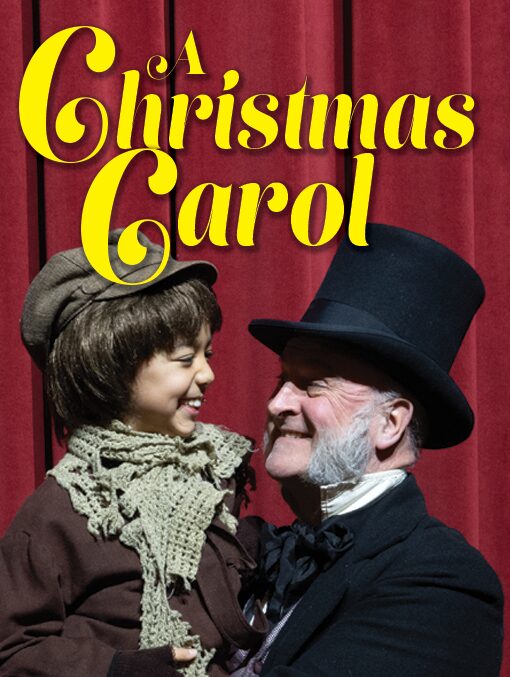
It’s that time of year when the stage seems to play— every show you see— Christmas Carol – may three ghosts be haunting you… and this review of mine, in the nick of time, wishes you and yours— to experience one too. Why not experience the Maryland Ensemble Theatre production of the Dickens’ classic, A Christmas Carol presently running through this weekend at the Weinberg Center for the Arts cattycorner to the MET’s home stage in downtown Frederick? It’s a textbook production nestled in the core of MET’s ‘ensemble & family’ values, with a cheeky little nod to being self aware of a production that comes round once a year at Christmas time. Directed and Choreographed by Julie Herber (with musical underscoring composed by John Walker) this timeless holiday classic hones in on the true notion of family and adjusts its focus to the darker and spookier side of Dickens’ ‘ghost story.’
Stage Manager Devin Gaither-Andrews (with ASM Rebecaa Carroll and Stage Manager Assistant Harper Lare) allow for Director Julie Herber’s fluidity of movement to occur readily. The Scenic Design belongs to Tad Janes (who might wear a different hat a bit further down in this review) and Steph Knapp is on lights (both design and ops) with Kaydin Hamby on sound. The show itself appears deceptively simple when it comes to its technical components because the theatrical magic is executed so wonderfully. The most impressive ‘effect’, that almost doubles up as a character, is the million-gallon fog bath that leaks its way out across the stage with great frequency and intensity throughout the production. Fog is an effect, yes. But here— in MET’s A Christmas Carol its almost like the fifth ghost— serving to hide performers in a most sublime fashion so that at the exact moment they can appear like a pop or burst of magic through memory. It’s truly a tremendous experience to see these things— particularly when it comes to the arrival of Marley and the first encounter with Young Ebenezer.
The opening of the show— which features that almost playground-like structure (complete with winding metal staircase) coming into existence under the enchanting and spooky-but-whimsical lighting (designed by Knapp)— is a nod to the self-awareness of the players. This is a troupe, ready to once again take up the mantle of the holiday, festively festooning themselves with their featured play: A Christmas Carol. It’s a glorious dance (a true slow-motion dervish of action and lots of twirling that has Julie Herber’s signature style of movement work and choreography stamped all over it) where these actors are catching props (or swooping through with them) that are most notably associated with the show— the masks of spirits, the chains of Marley, a certain tombstone— and even a crutch that comes rocketing up from the hidden hole in the stage. It’s an exquisite start to the performance and engages the audience readily for the magic that’s yet to come.
But the opening isn’t the only time such magical dances are experienced. Though I crave a touch more of the ‘actors-in-a-play-self-awareness’ concept that Herber has very, very subtly laced in. (You see it somewhat in the ensemble as they linger and loom around the scenes unfolding, watching them playout, though the moment that’s really delightful and truly chuckle-worthy is when the actor playing Scrooge’s nephew tries to refuse entering the scene; he doesn’t want to. Scrooge is too off-putting!) Marvelous wonders are contained within so many of the movement-based moments on the show, all of which focus heavily on the tinsel-like threads of family, togetherness, unity, ensemble; it’s a brilliant reflection of the MET as a company and within the confines of this staged narrative.
One of the most evocative moments on stage is the way that the motion between Fezziwig (James McGarvey) and Young Ebenezer (Sean Byrne) freezes at the end of the Fezziwig Christmas Party and they are held in this fraternal embrace, wholly frozen in time as a snapshot of sheer joy and merriment whilst real-time Scrooge and the Ghost of Christmas Past discuss what it means to create happiness and how it cannot be metered in mere mortal money. There’s another such moment— though not frozen, but dual-action— where as Belle departs, Young Ebenezer (Byrne) stands like a double-cast image beside real-time Ebenezer, both clutching the rejected engagement ring, both crying out in unison; it’s harrowing and tragically beautiful, sending rippling echoes of memory to stir Scrooge’s soul in that very intense breath of scene work.
Julie Herber is the show’s chief magician of movement, let’s call her, as the movement of this piece— both from a scenic standpoint and the physicality and overall utilization of the players— is truly the stuff of pixie-dust and whatever is wafting out of Christmas Present’s horn-o-plenty. (Seriously, the confetti and fog in this production must be the highest line-item in the show’s operating budget, but holy moses is it worth it!) here she thrives, (and this was a difficult one for me to swallow and accept but the more I watched it, the more I engaged with it, the more I loved it) is the way she deftly manipulates the scenic route of linear action. You can change but so much within the confines of Dickens’ story— and I’m not talking about adding unlimited Cratchit children or deleting scenes at sea or in the workhouses…or that ill-fated move of ever stage-production ever to only have a singular Marley Brother (#IYKYK)— but Herber finds a way to reroute the ‘order of operations’, so to speak, in the exposure to ‘Ghost of Christmas Present (Jack Evans.) They visit the Cratchit home first. Then his nephew’s and then a scene in the streets, with a homeless family at the end of their chain. It’s dark, it takes you down a devious path that is ominous, foreboding, and far less cheery than the comfort those scenes generally tend to provide. It also villainizes Evans’ portrayal just a bit (not unlike that angry demonic cackle from Pete in the original animated Mickey’s Christmas Carol where Scrooge McDuck falls down into the fiery grave-hole right before waking up.) And then Herber hits you hard with striking symbolism in her representation of Ghost of Christmas Future. It’s become popular to utilize puppets and larger than life entities; Herber has done both and neither at the same time—I won’t spoil specifically what, but it’s a truly reflective moment that chills you, chills you to the bone. Of course she balances this darkness out with much light during the arrival of Ghost of Christmas Past (Gené Fouché), with the glowing parachute and all that.
With two casts of young performers (at this performance— Holy Cast featuring Liz Bitto, Luca Milliken, Lucy Foster, Ella Griffin, Alexandria Harris, Layla Vanadio as ensemble, Zach Bitto as Tiny Tim, Colin Wittich as Boy Scrooge, Ripley Damanti as Fan, Carter Hammock as Peter Cratchit, Ysa Seltzer as Martha Cratchit, Tallulah Hammel as Belinda Cratchit, Sophia Mordkofsky as Ella Rose Cratchit, Rhys Berg as Ignorance, and Nicolette Harris as Want) Herber finds wonderful things for them to stay engaged with— along with the rest of the ensemble who pop in and out of characters here, there, and everywhere, in addition to serving as narrative beacons all throughout the tale.
While the aforementioned Jack Evans may be an initially-jovial-come-darkened spirit of Christmas Present, his cameo as Mrs. Dilber, the Charwoman, is hilariously noteworthy. Lisa Burl plays a heartily maternal Mrs. Cratchit and the beauty of that scene in ‘future’ is how Burl’s character stays composed, but Herber guides the scene to let Bob Cratchit (Jeremy Myers) fall apart. That is one of those ‘hits you out of left field’ moments because even though you know how the scene goes, it’s been twisted just enough to draw fresh, painful emotions from the depths of your soul. Of course there may be no more busier used ensemble performer than James McGarvey, who’s telling tales, popping up as Marlye, Fezziwig, the poulterer, the charity man, some others (I stopped keeping track) and he makes distinctive strides to make them all superbly different from one another.
Gené Fouché as the tender but firm Ghost of Christmas Past creates a fascinating juxtaposition against Jack Evans’ boldly boisterous and dark Ghost of Christmas Present. Lena Janes, playing Belle and the real-time wife of nephew Fred (Sean Byrne) finds delicate little moments to embrace. Jeremy Myers’ Bob Cratchit is convivial to the last, even in that haunting moment from scenes in the future. All of the actors have this shimmering throughline, tied most heavily to Ebenezer Scrooge (Tad Janes) which seems expected for this particular show, but feels so much more earnest, genuinely honest, when it comes to this bunch of performers and this particularly Scrooge. Janes, who has been playing the central character for nearly two decades (if not longer now) strikes his bargain with the Dickensian creation, leaving the embrace of his transformative moment until the very last— making it a real nail-biter to see if he’s going to find that moment of clarity and discovery. He’s growly, grouchy, and grumpy; a textbook Scrooge, but also a lively one.
The production is impressive; it moves— in so many indescribable ways. A perfect holiday tradition and well-worth attending at this festive time of the year.
Running Time: Approximately 90 minutes with one intermission
A Christmas Carol plays with Maryland Ensemble Theatre December 12th, 13th, and 14th at Weinberg Center for the Arts— 20 W. Patrick street in downtown Frederick, MD. Tickets are available by calling the box office at 301-600-2828 or by purchasing them in advance online.