
All that we see or seem, is but a dream within— BAH. HUMBUG! Wait a minute… that’s not right.
Let me try again.
The scariest monsters are the ones that would rather die? Then they’d better do so and decrease the surplus population! No… that’s— hold on a minute.
One more try—
I would define, in brief, the poetry of words as— singing in street corner choir! It’s going home and getting warm by the fire— it’s true wherever you find love, it feels like Christmas!
Yikes. That last one wasn’t even really truly Dickens! (But the best adaptation of A Christmas Carol ever. The one with TWO Marley brothers. #IYKYK.)
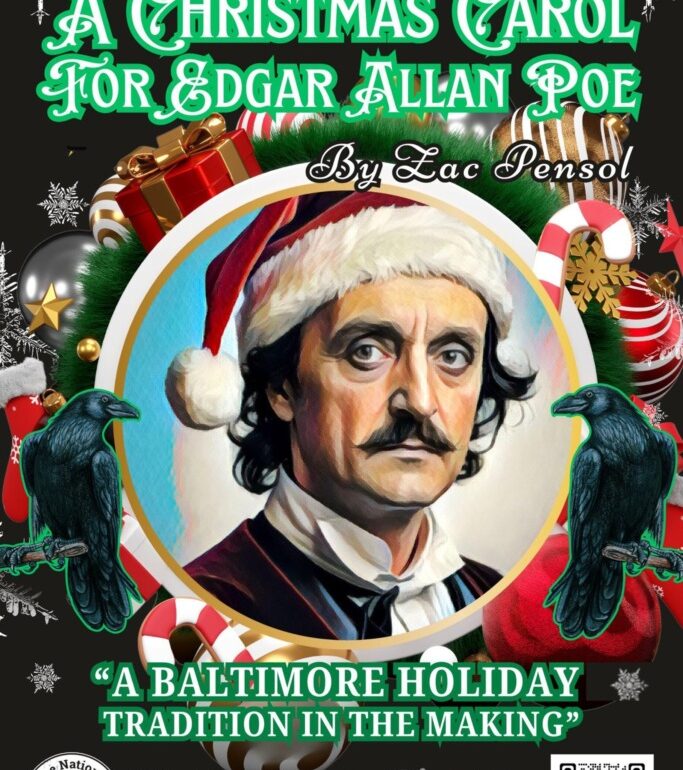
But here we are, alas, not with The Muppets, but with— Edgar Allan Poe!? Or some facsimile thereof? It would appear so as The National Edgar Allan Poe Theatre prepares to launch their own attempt at the Dickensian holiday classic: A Christmas Carol for Edgar Allan Poe by Zac Pensol. In a sit-down theatre exclusive, we’ve had a chat with the show’s director— Mark Kamie— with some sideline commentary from the company’s Artistic Founder, Alex Zavistovich.

Really lovely to meet you, Mark. And thank you for chatting with me. And you mentioned you’re a DC area person? Were you born and raised in the DC-area…wait, is anyone actually born or raised in DC?
Mark Kaime: A few? There’s a few, right? This is a transient area. I would say— except for Alex over here (National Edgar Allan Poe Theatre Artistic Founder, Alex Zavistovich)— that they’re pretty rare. I’m a Michigan native.
Aah, Upper or Lower?
Mark: Lower. Ooh, you speak the language. Eight Mile, you know the movie? There you go. Coney dog fan, Detroit Lions fan, Chicago…I lived there for about ten years, acting and directing. Got the directing bug, went to grad school at Indiana University, so it’s all Midwest. You’re going to get very Midwest vibes from me. I met my wife there and then she got a job at The University of Maryland (College Park) and that’s what brought us here. Now, my first few gigs here, one was working with Alex’s former company— Molotov Theatre Group— and it was a play about Edgar Allan Poe. Nightfall with Edgar Allan Poe. I was working on that and also working on a new play called Tiny Tim’s Christmas Carol at Adventure Theatre, written by Ken Ludwig. So now, ten plus years later, I get to marry both of those together, and kind of come full circle with Poe going through the grinder that is Charles Dickens.
Oh I love a full-circle moment. Poe meets A Christmas Carol. Sounds lovely. Now, how is this version of A Christmas Carol, other than the fact that it’s Poe’d, different from a more traditional production or what people think of when they think about Christmas Carol?
Mark: Right. Well, they can expect the structure. The structure is broken down into five staves, much like Dickens’ story itself. The playwright (Zac Pensol) has that setup, that structure. Within the structure, we’re using Poe’s psyche. So it is a little more dreamlike, entertaining fantasy, entertaining true things that have happened in his life— so autobiographical— and fans of Poe will really appreciate this. It’s almost like a Christmas card to fans of Poe. In addition to that, we get to see the artist and the artist process all this trauma and all this stuff in his life, and that he can use all of it to be inspired by the night, and to become a better person and a better artist at the end of the night.
Well that is sort of the track that OG-Scrooge travels down, so if you’ve taken that path and transmuted it to feature Poe, that sounds like it will work.
Mark: Poe wants to repress all of that stuff. He has selective memory, he doesn’t want to go there, so the ghosts that he confronts really are trying to prod it out of him. For example, Christmas Fortune— points out that there is joy in your life, you should see it, and that joy in how you respond to it— you responded to it almost pessimistically. You can experience joy in your life and it’s a good thing and it can fill you as a writer and you can appreciate your current set of circumstances a little bit better.
I like this, this sounds exciting. So in this iteration, or reworking, or however we’re phrasing it, you have Poe…as the Scrooge. And the three— wait, I always forget Marley— four ghosts. Who is your Marley figure for Poe?
Mark: Well I would love to keep that a surprise for our audience.
We can absolutely keep that as a surprise for the audience. Is there a way to talk about it that sort of hints or maybe alludes to it without spoiling it outright?
Mark: It’s based upon a lot of Poe’s literary writings. We have four ghosts that visit Poe throughout the night. What Zac Pensol (playwright) did, which is really inspired, is where he set the play. It’s 1844, a year after Dickens wrote A Christmas Carol. And then a month or two later, Poe writes “The Raven.” The first ghost we encounter, the ‘Marley Ghost’ inspires Poe. And we do nods to being inspired by the night in our set design and then we have the ‘Ghost of Memory’ or as most readers would know him better— The Ghost of Christmas Past. And there’s a really beautiful plot-twist in there that I don’t want to give away too much on, but it’s deeply rooted in Poe’s biography.
I think I know exactly where that’s going, but I won’t say anything.
Mark: I’m curious what you’re thinking on that one.
*makes a hand gesture to inform said thoughts*
Alex Zavistovich: Oh wow, yes. You know your Poe.
That I do. Back to the other ghosts.
Mark: The second ghost is inspired by a short story of Poe’s and then third is inspired by another story of Poe’s.
I can tell you’re giving us a lot to go on here. Surprises abound for Christmas! As a director, who has the directing bug and has had other directing credits in the area, what has been your biggest challenge about taking what are essentially two well-known facets of the literary canon, Poe and Dickens’ A Christmas Carol, and fusing them in this way to a stage adaptation?
Mark: Yeah it’s a wonderful challenge but you have a team with you. You have someone working as a dramaturg on the production. You have a resident, expert Poe historian, if you will, working on it. And it’s very exciting to work on a new script because you get contact with the playwright as well, and you get to work on developing the script a little bit. So that’s really important. I really think of it more as not A Christmas Carol fitted to Poe, but more as Poe’s journey through A Christmas Carol. Really leaning more into Poe’s world and Poe’s psyche, that’s where I’m taking it.
Do you have a moment in the show that just sort of speaks to you and you can say, ‘this is the moment that defines this show?’
Mark: Ooh. I love that question. There are so many wonderful moments that are ringing true right now. I think the thing that lands the heaviest on me is the big reveal, the big secret of who the ‘Ghost of Christmas Memory’ is. It is this powerful moment. It blends Poe’s first…tragedy in his life—
*makes the hand gesture again*
Mark: Oh. Wow. Yeah. You got it.
Told ya! That’s going to be fascinating to see who in the audience twigs to that.
Mark: I think there are some nice trail mixes along the way for people to think, “oh, could it be…?
I love this for the audience. Now, almost every production of A Christmas Carol I’ve ever seen— no, I’m going to say every, seeing as I cannot think of a single one that I’ve seen ever that doesn’t— but every Christmas Carol I’ve ever seen, be it on stage or screen, has some humorous component to pull us up and out of the dark mire of haunted ghosts and such. And yours does this, yes?
Mark: Oh yes. What’s wonderful is we have this wonderful actor, Ian Blackwell Rogers, tackling the challenging role of Edgar Allan Poe. This guy’s instincts for humor within the piece— pure gold. And it’s written there but you really have to attack it with that lens. Poe, in this play, uses sarcasm as a defense mechanism. He doesn’t want to admit his pain and he uses witty remarks to deflect blame and whatnot. And then the character of Fortune is wonderfully written and tackled by a wonderful actor/wordsmith in the area, who goes by the name Wordsmith—
Alex: Anthony Parker.
Ooh! I have absolutely heard that name before and in conjunction with his moniker, Wordsmith as well.
Alex: He runs his own non-profit organization to support the community called Rise With A Purpose. He’s a producer and a rapper and he’s won a number of different awards, he’s a wonderful talent, a really nice person, just a genuinely kind, nice person.
I’m glad to hear that we’ve got such wonderful people involved and that there will in fact be some humor in this show! What has getting to work on this project taught you about yourself, as a director, as a Poe-enthusiast, as a human being involved in the theatre?
Mark: It’s about being present and being collaborative. You have to show up every day and you have to work with the actors to shape the moments to get them to articulate the subtext and all that fun stuff. For me, I just appreciate actors so much. And how much they give to the roles, how much of themselves they’re connecting to the roles, the curiosity that they bring to it is so inspiring.
That sounds super inspiring. Do you act at all?
Mark: I used to.
If you could write your own ticket and be any character in this iteration of A Christmas Carol for Edgar Allan Poe, who would you be?
Mark: That’s a great question. That I would get cast as? Or that I would like to play…
Oof. That you would like to play. Getting cast as…that opens up a whole ocean of stuff for consideration, so let’s go with ‘that you’d like to play.’
Mark: I would love to take on the central role, right? But would I do it justice like Ian Blackwell Rogers? No, of course not. This guy is firing on all cylinders; he’s awesome. He’s just bringing it.
That’s excellent. Going back to something you said earlier, about you having a village— you’re directing and also set designing? Or is that a part of your team?
Mark: I am not set designing.
Alex: Can I just say— sorry, Mark, not to step on your interview toes here— but that is one of the challenges of doing a show here at Motor House. Because it’s not a dedicated venue for us, so we have to strike the set and make sure it all goes back up. I’m hopeful that we can actually keep it up and assembled during the weekends but during the week, we will have to strike it. And also, we have to Tetris-it into a very small storage space. So having something like that which still conveys the dreamlike qualities we’re looking for but also has luxurious high-production values…that’s portable and easily struck…that’s a huge challenge.
Goodness! So, Mark, if you’re not designing the dreamlike, portable, tetrisable set, who is?
Mark: We have James Raymond. With James, he is extremely resourceful. What’s beautiful about working with James is I’ll give him a general vision to go off of with some specific ideas to work within, and then he has all these wonderful ideas that he brings to the party. And we’re just bouncing ideas off of one another, making it work within the confines of the space, within the confines of our contractual agreement and the budget, and all that fun stuff. It’s been a pleasure. He’s really leaning into the dreamlike quality, he’s really leaning into putting in some ‘Poe Easter Eggs’ as well. We’ll have some nods to Poe being inspired by the night within the set design.
I love that. Now, as a Poe-person, what is your favorite work by Poe, or do you have a favorite work by Poe?
Mark: You know, I just read one for the ‘Doomsday Project’ and it’s slipping my mind. It’s about the guy at sea— help me out here, Alex…
Alex: Is it Descent Into the Maelstrom or Manuscript Found in a Bottle?
Mark: Manuscript Found in a Bottle!
I’m not familiar with that one, is that a poem or a short story?
Mark: It’s a short story.
Alex: Manuscript Found in a Bottle was actually written during Poe’s time here in Baltimore. He received a cash prize from “The Saturday Visiter”, the local paper at the time, and it actually kicked off his professional writing career here in Baltimore.
That’s actually a beautiful irony because I feel like most laypeople associate Poe with The Raven and Baltimore with Poe and The Raven but he didn’t write that one here in Baltimore.
Alex: That’s correct. He wrote a variety of other very good ones— Morella, Berenice, Manuscript Found in a Bottle, Shadow— A Parable, Ligeia— but you’re right. The big heavy hitters, ‘the greatest hits’ are not among the ones he wrote while here.
What is it that you are hoping that audiences are going to walk away from this experience, feeling, experiencing, thinking, chatting about as they walk out the door, what is the hope?
Mark: The hope is that they get a better understanding of Poe’s biography for folks who don’t know it, in addition to the way that Poe is inspired by the night. I think really good theatre makes people reflect upon themselves. To make them think, what parts of my life would I not want to revisit or what parts of my life are bittersweet and that I would like to revisit one more time? This play, to a degree, reminds me a bit of the ending scene in Our Town, so when you go to revisit your life, there’s a bittersweet resonance to it. You know you’re witnessing it and you want to do something different about it but you can’t.
It will be interesting to hear what our audience thinks about what moments in their life would they want to explore. What moments in their life would they want to have a second chance at? Or are there some dark moments in your life that are maybe so repressed that you might just want to take a peek with one eye open and see what that was all about and why is it still living there? In this play, Poe goes through it. He’s cracked open at the end. It’s not a transformation of convenience, right? He absolutely is at a low point when the play starts off. His wife is ill, he’s not making a lot of money, he’s comparing himself to other artists, he has a beef with God, he feels cursed. And it’s all about him and his ego. Throughout the night, he’s learning, through process, that he’s got to open himself up to more than just that.
I love that you recognize it as ‘not a transformation of convenience’ because I feel like in the Christmas Carol source material, for Dickens’ Scrooge, it is a transformation of convenience. The play has to go somewhere, so— poof, transformation. Because let’s be honest, he was perfectly happy to be a bitter old bitch and keep his money to himself. There was no real ‘I need to be a better person and here’s why’ until the ghost’s disrupted a night’s sleep, and poof— transformation. I like that you’ve pointed out that this production does that differently. And as an improv person—
Mark: Oh, you’re in an improv person, you’re speaking my language!
I am definitely an improv person, have you not figured out that I’ve been making these questions up as I go? But as an improv person, here’s an on-the-fly question— what is a moment where if you could look back on your life—
Mark: Oh boy. So that’s where your improv-person-question is going?
Yep. If you could take a closer examination at something in your life— and you don’t have to be any more personal than you feel comfortable being, because this will be out there on the internet for all to read for all of eternity— and please don’t say anything that will get you arrested—
Mark: I would like to say I’ve been pretty Midwestern good throughout my life! But…have you ever had those moments in your life where your elders know a little bit better but you think you know better? I would like to revisit some of those moments and be like, ‘hey, maybe you should go to Grandma’s house and hang out with her more.’
Why should people want to come out and see A Christmas Carol for Edgar Allan Poe?
Mark: We do have discounted tickets, which is nice. But more importantly, it’s the story. It’s a different type of Christmas Carol. It’s a darker Christmas Carol with moments of humor and levity within it. Within it we have fighting, we have stage combat, we have singing, we have dreamlike sequences—
There’s singing!? In A Christmas Carol!? COLOR ME CHRISTMAST SURPRISED!!!
Mark: Yes! There’s a lot of bells and whistles within in the production.
Alex: That seems like a good place to mention James Watson, our sound-designer. He’s developing not only all the sound effects but all of the music for this show.
Mark: Yeah, they’re all original compositions that he’s created for this specific show.
That’s extraordinary. We love original compositions.
Mark: It’s been great. Everyone on the team, including getting to work directly with the playwright, Zac, who back and forth for about a month leading up to this, he took into account a lot of the suggestions that we made.
It’s nice that the playwright worked with you guys. Because as I’m sure you both know, there are definitely playwrights out there who are of the belief that they have written brilliance and perfection and how dare you change a word.
Alex: Oh yeah, we know. Zac has been great. Contractually we agreed to two revisions with him, and we needed one pretty much right off the bat because he was trying to boil the ocean— and I mean this in the nicest way but he was taking almost absolutely everything about Poe’s life and trying to dovetail it with everything that people know and don’t know about A Christmas Carol, and that was a lot. We ended up saying, ‘you sort of have to just hit the points that everyone thinks they know about A Christmas Carol and Poe and then make that work.’ And he’s been good about that.
That’s an excellent way to put it. It’s the penny-pinching geezer, three ghosts, a miracle-revelation, and if you’re like me…a furry blue narrator, a rat, and two Marleys. And that is the hill I will die on. TWO. MARLEYS.
Alex: Oh boy. Moving on… in addition to knowing the broad strokes of Dickens, you need to know the basics of Poe, you need to know about Virginia and about some of his problems with addiction.
Drinking, gambling, flirting, The Raven, early death. What else is there to know?
Alex: And two Marleys, apparently. But seriously, as Mark said, Zac was very generous and not just because of contractual reasons, but like we do, he wants this project to succeed!
Lovely! What is your favorite version of A Christmas Carol, Mark?
Mark: This one. I got paid to say that. No, I’ll say this one is really good. But in terms of watching it on television or in performances and whatnot? I love Scrooged. I also love, I think it was— was it The Muppets Christmas Carol? I was charmed by that one.
I’m going to pretend to not be insulted as Muppets Christmas Carol is the only version that matters. I mean, I’m sure this one will be good. But Michael Caine, The Marley Brothers, as played by Statler & Waldorf…that’s A Christmas Carol. And every production that fails to provide two Marleys is just a little disappointing…
Alex: We have no Marleys so we’re above that?
You’re a whole raven’s flight above, Alex.
Mark: Oh my!
Alex: Well, it may be vanity on my part, I’m a vain person, but I do hope that it stands up to the marketing position that I’ve had on it, which is that this is going to be a new, Baltimore holiday tradition.
I hope you’re right. It will be nice for Baltimore to have a new holiday tradition, especially one that is so very rooted in Baltimore. Back to poor Mark over here…is there a poem or short story or unfinished work of Poe’s that you wish featured in this production that is not currently included?
Mark: That’s a great question. I’ll say this, Zac has done his homework. Throughout the piece it is peppered. Our dramaturg, Adam Atkins, has a packet and it’s over 15 works referenced within it. What’s important as the throughline of the play is that Poe has these words stuck inside of him and he wants to release them, he’s so obsessed about it. One of the great scenes in the play is a scene between Alex’s character, Future Edgar Allan Poe, and Ian as Poe, in which Alex releases those words to our Poe and all the things throughout the night are adding up. He’s transformed by the night, he’s inspired by the night, I don’t think we can add anymore references in at the rate we’re going!
I’m a huge fan of The Conqueror Worm.
Alex: You’ll find it!
Mark: It’s in there. There’s a reference at any rate.
Alex: For example, there are a couple of times where Future Poe comes in working on…works…and one of them is a line from the poem, ‘El Dorado’ another one is from my personal favorite, The Facts in the Case of M. Valdemar. But these are just little lines and moments, so only your truly die-hard fans are going to catch those.
This sounds thrilling. And very not your granny’s Christmas Poe. Did we talk about your costumes for this show?
Mark: We have a woman of many hats on this production. Sarah Bella Joyce is playing Virginia Poe and is our costume designer.
Alex: And she’s handling social media for us as well!
We love a social media handler! Now is the sartorial selection more doom and gloom and dark despair a la Poe or more Dickensian timestamp a la Christmas Carol proper?
Mark: That’s historically in the ballpark there. Sarah leaned into historical accuracy with a macabre touch to it because we’ve got some aberrations and all that fun stuff.
Do we have puppets?
Mark: We talked about it.
Alex: You know how you have a production wish list that’s like a mile long… but then reality sets in.
Ah, that blasted reality. Mark, anything else you’d like to say about the process, the production, the Poe?
Mark: It’s great to come full circle and work with Alex again.
I’ll bet you got paid to say that too.
Mark: Yeah, he paid me to say this. No, seriously, you think about people you’ve worked with in the past and you think about them and you wonder what’s going on in their life, and you find yourself curious. So to reconnect with him, he’s the same. He’s just Alex, right? He can command a room like no one’s business, he’s a great marketer, and in addition to that, he’s a hell of an actor. And now we get to see Alex working a role that is going to be special. I’ll just leave it at that. He’s doing great work.
That is truly lovely. Now, final question. If you had to sum up your whole experience of working here on A Christmas Carol for Edgar Allan Poe using just one word, which word do you use?
Mark: Grateful.
A Christmas Carol for Edgar Allan Poe, a National Edgar Allan Poe Theatre production, plays December 5th 2025 through December 21st 2025 at Motor House Theater— 120W. North Avenue in the Station North Arts District of Baltimore. Tickets are available at the door and in advance online. Advanced reservations are strongly recommended.
Related posts:
 A Christmas Carol For Edgar Allan Poe at The National Edgar Allan Poe Theatre
 Bah! Humbug! Christmas Chatter with Greg Burgess on 11 years of playing Ebenezer Scrooge with Chesapeake Shakespeare Company
 A Christmas Carol at The Colonial Players of Annapolis: A Holiday Tradition
 A Christmas Carol at Silver Spring Stage