
author: Chris Pence
It’s just one of those days that goes on, and on and on. Annapolis Summer Garden Theatre lets audiences relive that day again and again with Groundhog Day: The Musical, an uproarious musical rom-com about a frustrated weatherman, a lovelorn producer, and a rodent who’s always living it its own shadow.
Based on the 1993 movie of the same name, Groundhog Day: The Musical follows Phil Conners, a petulant weatherman sent to Punxsutawney, PA to cover the annual Groundhog Day celebration that gives the small town its only recognition. After an aggravating day of meeting up with the locals, Phil falls asleep, only to wake up the next morning to find that he’s still in Punxsutawney, and it’s still February 2nd. Stuck in a seemingly endless loop of monotony, repetition, and rodential forecasting, Phil learns about love, consequence, and what makes a small town seem much greater than it appears. With music and lyrics by Tim Minchin and book by Danny Rubin, Groundhog Day: The MusicalM opened on Broadway in January 2017, running just 176 performances, yet gaining seven Tony nominations, including Best Musical and Best Actor in a Leading Role.
Leading the famed “Theatre Under the Stars,” ASGT Director Jerry Vess brings Conners’ endless day to Annapolis audiences with zeal. Vess’ casting is superb, and double-casting benefits both functionality and story, emphasizing the small-town mood with familiar faces in various roles. For instance, who’d have known that the town’s Sheriff and Deputy (Will Griffin and Thomas Digby, respectively) would also be their faith healer and AA representative? Practical, with atmospheric charm, Vess is to be commended for this choice, among many others, including a glow-in-the-dark car chase in Act One that feels like something out of a neon fever dream. Along with his directorial expertise, Vess also sets the scene as Set Designer. Utilizing ASGT’s outdoor 2-story set, Vess creates the small town in a big way, inviting audiences into the house with an unmissable billboard above the stage declaring Punxsutawney “the weather capital of the world.” A frequently used (and reused) piece of set, Conners’ hotel room is created via a fold-out bedroom set that folds away easily to allow more space for action.
Stage Manager Kylie Sjolie and crew add to Vess’ vision of the tiny town with various pieces of moving scenery, using tables, chairs, and bars to create town locales such as the diner, and posters and tree stumps to create the home of groundhog meteorologist Punxsutawney Phil. Lighting Designer Mairead Cummins heightens the drama, using bluish green strobing lights to signal transitions between each iteration of Phil Conners’ endless February 2nd. Cummins also turns the entire house red and blue during the police chase and enhances the charisma of the scenes with a snow flurry of white lights, the perfect romantic scene that Phil can’t help but mess up again and again and again (and again and again and again).
Music Director Trey Pope conducts both the cast and the orchestra through the jazzy, heartfelt score. Pope (Keyboard 1), Marie Harrison (Keyboard 2), Billy Georg (Drums), Reid Bowman (Bass), Henry Sheppard (Guitar), Mari Hill (Reeds), and Bently Corbett-Wilson (Trumpet) handle the score with ease, bringing emotion and lyricism to the turbulent tale. Sound Designer MaeAnn Ross enhances this with various sound effects and recordings. As each morning begins, Phil is awakened by a clock radio blasting an old-timey morning radio show featuring a cheery girl group singing about the day’s festivities. Ross’ proficiency with the sound effects leaves the audience to wonder if the radio show was prerecorded or performed live. To Ross’ credit, the authenticity of the sound effects creates the perfect atmosphere to allow the suspension of disbelief necessary in the theatrical world. A handful of gunshots in Act 2 lead the audience to duck for cover, with realistic sound effects that far surpass the quality of most community theatres, who typically choose to use the 1950’s-era sound effects that sound more like cymbals than gunshots.
Movement is essential in the world of Phil Conners’ Punxsutawney, and Choreographer Kristin Rigsby uses the cast to represent Phil’s mood throughout the story. As Phil arrives in town for the first time, the overzealous town engages in over-the-top cheesy dancing, all abuzz about the big day, with Phil grumbling in middle, clearly not sharing the townspeople’s’ enthusiasm for the holiday. As Phil begins to embrace his situation, seeing the repeating day as an opportunity to act without consequence, Rigsby’s choreography takes a more sensual turn, with a carefree jazziness that reinforces Phil’s lascivious intent. Later, when Phil begins to use his knowledge to participate in a bit of “Philanthropy,” the cast enters into a tap sequence, simple at first, then gradually more intricate, showing how Phil’s errands become more involved as he struggles to escape the endless cycle.
Costume Designer Grant Myers completes the theatrical illusion, dressing the cast in their February best, despite the show being presented in August. Highlights include Buster (Gene Valendo), the Master of Ceremonies in traditional form, with a bow tie and top hat reminiscent of Mr. Peanut, complete with singing groundhog puppet, and a life-sized Groundhog mascot (Andrew Agner-Nichols), who nearly suffocates while stuck in his mascot head during the “Philanthropy” sequence.
As the show begins, a preshow video by Bobby Armour Kaiser shows Phil Conners in his normal life, a grouchy weatherman sent to do the annual puff piece about the Groundhog Day celebrations in Punxsutawney. As the irritated weatherman, Trevor Greenfield takes great care to develop a character of his own, not taking from the film’s Phil, comedy legend Bill Murray (Come to think of it, why is Bill Murray always doing films with rodents?). Greenfield’s Phil had serious Squidward vibes, as though he were wearing the infamous “I really wish I weren’t here right now!” button from the early days of the SpongeBob legacy. Greenfield exhibits classic Monday morning woes with excellent comedic timing. Despite his annoyance for his assignment, as well as his exasperation for its endless reiteration, Phil is also a ladies’ man, as shown by Greenfield’s Jekyll-and-Hyde-like shifts between his hate for his job and his lust for women. Vocally, Greenfield shines during “Nobody Cares,” a happy-go-lucky buddy tune shared with Gus (Jayden Maduro) and Ralph (Matt Grey). The three actors’ vocal harmonies blend flawlessly, as do their hysterical attitudes that they face no consequences, because there’s no such thing as “tomorrow,” though in Phil’s case, this is more literal than the other two could ever understand. Early in the second act, as Phil begins to lose his senses over his situation, he commits a number of reckless acts with the “Hope” to end his plight, only to awaken again unharmed. Greenfield’s stage presence excels during this sequence, with Phil disappearing from one side of the stage only to reappear in bed instantly after, producing a histrionic illusion rivalling Penn and Teller. At the show’s climax, Phil finally professes his love to his producer Rita during “Seeing You.” Greenfield’s vocal prowess and command of dramatic pauses shows a realistic speechlessness in the cranky weatherman, who never struggled to find a snarky comment before meeting the love of his life.
Rita Hanson, Phil’s producer and love interest, is an angel sent to Earth in the form of Taylor Hinds. Hind’s lovelorn Rita is a woman who thinks she knows what she wants, though can’t help but let out a Freudian slip as she imagines her ideal love interest. Hind’s connection with Greenfield’s Phil is an adversarial yet engaging one, with Rita making it abundantly clear that Phil isn’t the man for her, despite his dedication to learn more about her. Used first as a chance to take advantage of Rita, Phil realizes that he has more in common with her than just sexual desires, though Hind’s Rita quickly sees through his games, and takes much more reassuring before she’s able to admit to herself that she truly does love him as well. Far from a damsel in distress, Hind is quick to offer Phil a bit of recompence for his naughty actions, with an insult or a slap always ready to go.
While the cast features a massive ensemble, a few standout actors clearly leave their mark on the audience. Adam Conklin as Ned Ryerson is one such actor. A forgotten high school friend of Phil, Conklin’s Ned radiates Ned Flanders of Simpsons fame. The indestructibly positive insurance agent of the town, Ned truly is the “good neighbor-ino” that insurance commercials constantly hawk, much to Phil’s irritation. Ned’s one moment of solemnity comes during “Night Will Come,” a haunting reminder that some things are unpreventable, even in Phil’s endless loop. Conklin’s slow, melancholic vocals signal a virtue change in Phil’s life, who finally understands the consequences of his actions.
An unexpected moment of intensity comes from Nancy Taylor, as portrayed by Elda Trombley. Young and sexy, Nancy is hard to miss in the Punxsutawney crowd, especially after she bumps into Phil early during the festivities. Phil takes lustful notice of her and uses his repeated trips through the day to seduce her. At the start of Act 2, Trombley takes the audience by storm with “Playing Nancy,” a mournful ballad about Nancy calling out misogyny in her life. Being attractive and energetic, Nancy doesn’t want to be leered at for her looks, though fears being unattractive in a world that undoubtedly values beauty over personality. A powerful statement of individuality, Trombley gives the audience pause to realize that they might not have given Nancy the respect she deserved when they first noticed her.
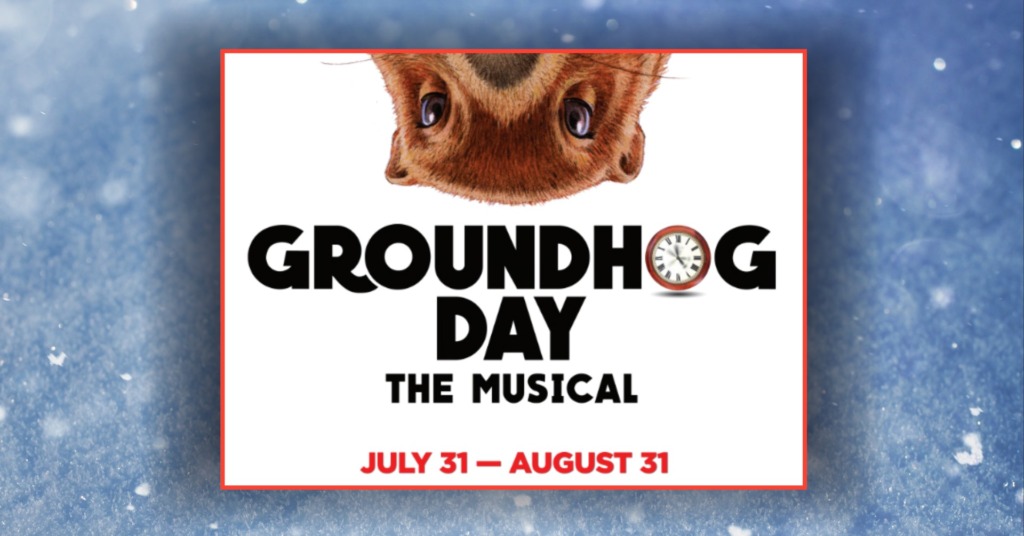
Witty and thoughtful, Groundhog Day: The Musical at Annapolis Summer Garden Theatre runs from July 31st to August 31st, and is an experience audiences will want to experience over and over (and over and over and over and over and over and over and over) again. Groundhog Day features adult language, sexuality, and themes of suicide, and is recommended for mature audiences.
Running Time: 2 hours and 15 minutes with one intermission
Groundhog Day plays through August 31st 2025 2025 at Annapolis Summer Garden Theatre— 143 Compromise Street in Historic Annapolis, MD. Tickets are available for purchase by calling the box office at 410-268-9212 or in advance online.