
Everyone must write what they feel as best they know how. Chekhov said it. Maybe. Probably. Hard to tell what’s direct source material versus creative licensing with this rather impressive new production of The Seagull being produced by The Rude Mechanicals at The Greenbelt Arts Center. Directed by Melissa Schick, this imaginative reinterpretation and musical adaptation of one of Chekhov’s more depressing works is surprisingly charming, well-parsed and paced, and delivers a refreshing new spin on an old war-horse-staple of the theatrical canon. Nobody comes to The Seagull expecting to be entertained or enjoy themselves, at least not anyone who has seen it or read it in its originating formats, but this production catches the eye and the ear and renders it beautifully into a two-hour digestible rock-adjacent concert that pulls the message forward with a late 90’s/early 00’s flavor directly accessible to the theatrical palette.
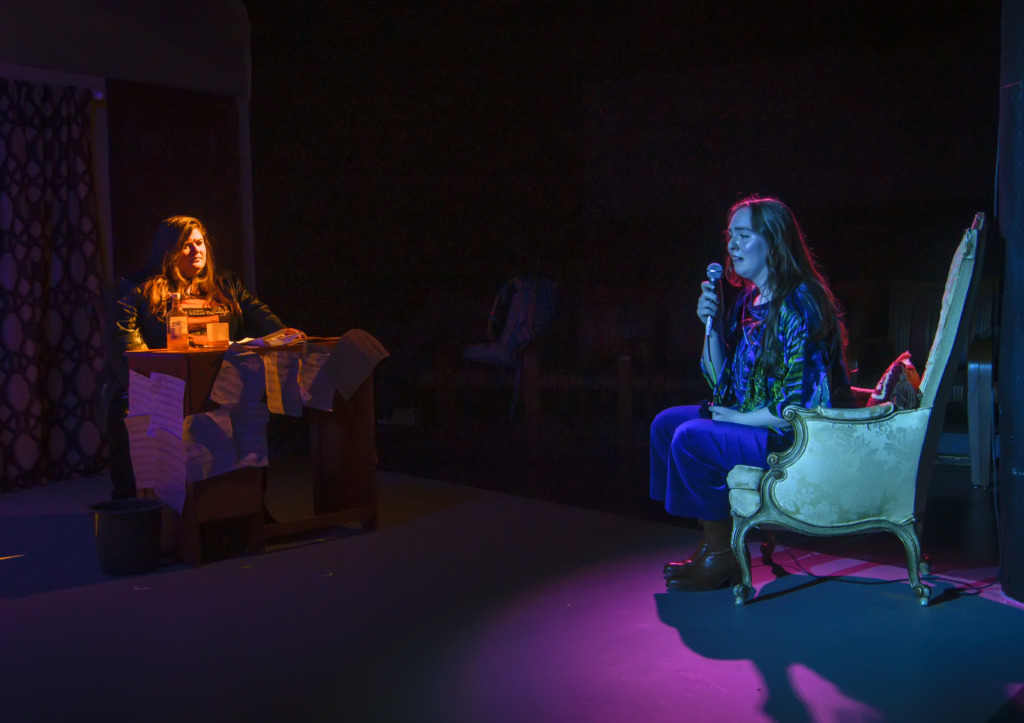
Aesthetically the setwork is simple but deceptively so. Very mindful, very demure. Which is so not a 90’s/00’s saying but when the shoe fits…I digress. It’s a wall with a window and some basic furnishings. Nothing complex. Except for the black velvet curtains rigged across the center to hide the live musicians— Chekhov’s Gun (featuring Eric Honour on electric guitar, Diana Dzikiewicz on drums, keys, violin, and Leah DeLano on bass with Matt Etner on interstitial vocals & guitar) –when they aren’t being featured. What makes the stage pop is the impressive Lighting Design of Jeff Poretsky and Liana Olear. They use a lot of ‘moody blues’ and cool lower lights to affect the feeling and overall verve of these dysthymic characters right into the visual canvas of the theatrical experience. And liberal splashes of red pop up when needed. One of the coolest lighting effects is the personalized gobo with the ‘Chekhov’s Gun’ logo, projected right above where the band is stationed.
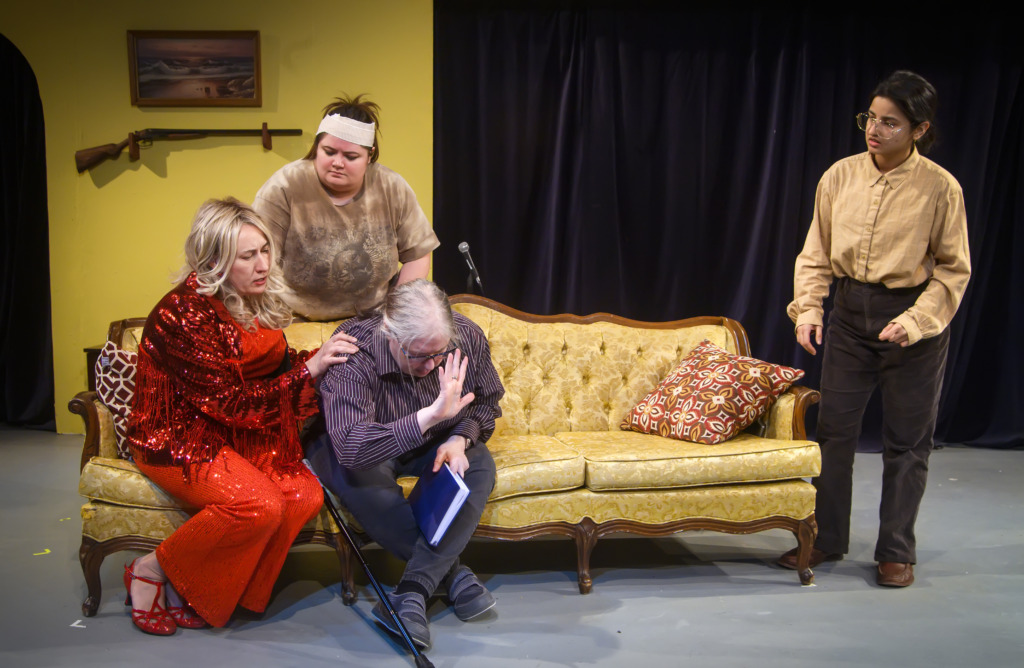
The show’s costumes are a curious blend of iconic musical styles through the years. While Constantine is clearly channeling Eddie from Rocky Horror Show and the band themselves have lots of gold lamé with black leather and metal, there are other hints of musical eras from decades gone by. Doc Dorn is an excellent example of that groovy 70’s vibe. But the pièce de résistance (or pieces since she’s got so many of them) are the stunning, sparkly, sequin-laden ‘jumpsuit style’ couture featured on Irina Arkadina. It’s giving ABBA vibes and ‘jaded pop-rocker’ verve; it’s stellar. Costume and Props Designer Spencer Dye has made brilliant choices as far as the show’s sartorial selection goes but really brings the notion of ‘impressive work’ home with the show’s properties’ design work— in particular the titular object in all its shot-dead glory.
Taking the show by the proverbial wings, as it were, and simultaneously stretching and truncating it so that it fits her vision, Director Melissa Schick manages to strike a resounding balance between her interpretation of Chekhov’s The Seagull and his original work. Instead of poetry and the fecklessness of ennui that accompanies the ‘the lifestyles of the rich and famous’, Schick shifts the show’s focus to music— a universally relatable topic. They’re all musicians rather than poets. Which is a bit like setting Romeo & Juliet in German-occupied France circa World War II, but Schick takes her thematic concept one step further, taking it from idea to fruition, and a grand one at that. She sets the show to music. More specifically, the characters— in a subtly self-acknowledged fashion— actualize their emotions through carefully selected, though somewhat obscure, pop songs of their time. Schick’s musical selection is perfect for the way these characters express themselves, particularly Masha’s opening bid of “Happy House” (Siouxsie and The Banshees) and the delightfully awkward, blossoming chemistry between Trigorin and Nina, which gets expressed in “Fame” (David Bowie.) Schick finds a way to make the songs drop naturally into the narrative, not too many musical moments and they don’t feel as if they’re coming out of nowhere. And her handling of Nina’s finale number— “Edge of Seventeen” (Stevie Nicks) is sublime. Given Nina’s trajectory, when she first picks up the mic and you hear that song coming, you get this sense of— for lack of better wording, ‘incompletion.’ Because it feels like the Nina character is about to end her stage time with a concert version of this number. But Schick breaks the song up, accurately reflecting the character’s madness. You don’t get Nina at a mic doing the number. You get Nina at one mic doing a part of the number, snapping back to reality (which perfectly mirrors the “I am a Seagull; no I am a singer” line from the text,) before dashing madcap like Ophelia undone to another section of the stage with a different mic and the lighting popping back on to sing the next segment of the number. The jarring juxtaposing of interlacing reality into the madness that becomes her song is brilliant and executed flawlessly.
Musically the show is impressive. Sound Mixer Matt Etner (and Board Op Tabi Dickson) need major shoutouts because of the balance on the band. It’s superb. They aren’t masked— they’re dead-center once those curtains get drawn back— but they’re at the perfect level of balanced volume and the mics of the singers pick up over them, just enough, every single time. It’s very impressive, especially considering the spatial challenges of GAC’s black-box stage. Eric Honour, in addition to being the electric guitar of Chekhov’s Gun, serves as the show’s musical director, and gets a great deal of passionate pathos out of each of the characters during their moments in song. This is particularly true for the Irina Arkadina character when she’s singing her “Living in a House Divided” (Sonny & Cher.) You get the emotional resonance of “Jolene” only sung in reverse as Arkadina is pleading with ‘her man’ to stay rather than be stolen away by the younger, sprightlier version of herself. Honour works with Schick to create this exceptionally well-set experience. It becomes a classic, modernized with music. Not a musical, per say, but exquisite and thoroughly enjoyable, regardless of the moody depressive overtones. And again, a full round of kudos to the live, on-stage musicians— Honour, Dzikiewicz, and DeLano (who doubles up as an in-show character) and to Matt Etner giving subtle and delicate interstitial music with his vocals during those smooth scene changes.
Kashaf Jabbar pops into the role of Medviedenko unobtrusively and easily. There’s a simplicity to this character, almost as if Chekhov (and by proxy, Schick’s interpretation) didn’t really know what to do with the character but needed a plot-assist and poof Medviedenko. Jabbar doesn’t let that stop her from being present, even having a hint of petulant humor when whining at Masha. There’s a levelheadedness to Jabbar’s portrayal as well. Everyone else’s characters are reading like personifications of various mental illnesses, not the least of which are bipolar 1 & 2 and depression, whilst Jabbar’s Medviedenko is like the base-line of ‘normal.’ It’s a great foil for everyone else in the show, even if the character only appears from time to time.
So too is Mikki Berry’s Peter Sorin. A true representation of age and fatigue, the Peter Sorin character looms like a shadow over everyone, reminding them of mortality and how time is the true thief of joy if you let it be. Berry’s portrayal of this aging old man is wild because Berry still possesses quite a burst of spirit and imbues appropriate moments accordingly. And when Berry takes to nodding off and snoring a mighty, prodigious and yet still adorable snore, you get a much-needed dose of humor. Berry is lively, attentive, and uses Peter’s book as a lifeline, keeping her character tangentially engaged with the nonsense of the others around her whilst disappearing into the character’s only personal reality; it’s a unique hybrid performance.
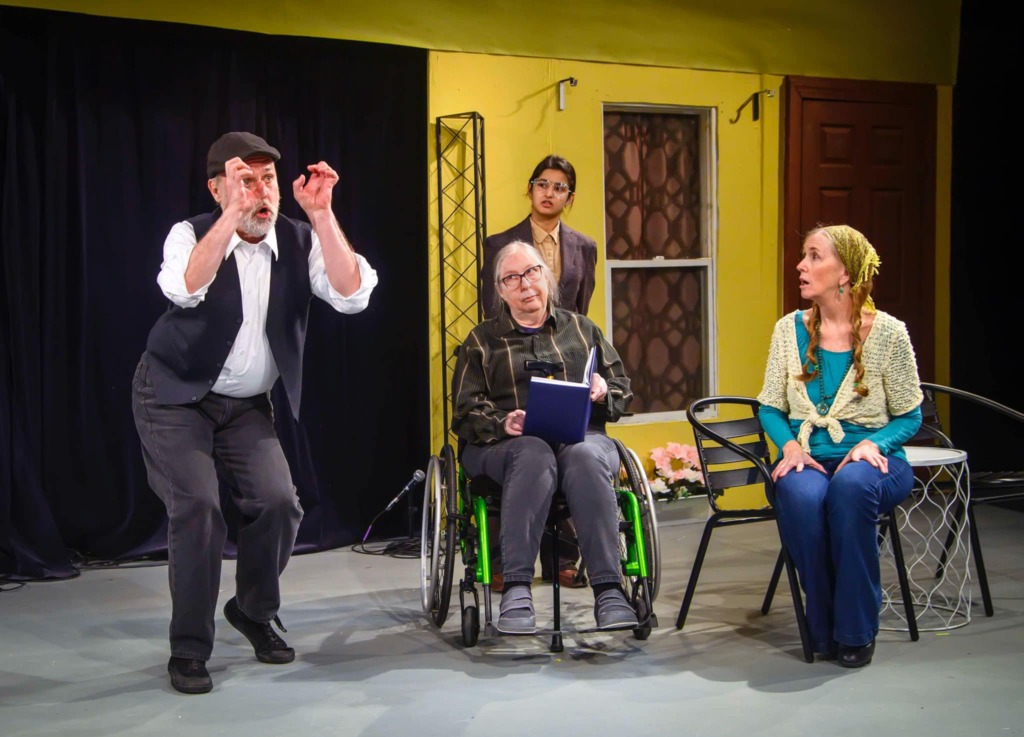
Couldn’t tell you the purpose of the Shamraeff character, don’t even think he’s ever actually addressed by name in the show, but with Bill Bodie manning him, you’ll remember every instance he’s on stage. Bodie can chew scenery simply by stalking into a scene. And the few throw-away lines of dialogue that his character has should be unmemorable at best but Bodie is so damn animated it’s impossible to forget him, particularly when he’s fussing, which is basically every time his character is on stage. Lively, engaging, and creating this noticeable supportive character from virtually nothing, Bodie catches everyone’s eye even if his character feels like something Chekhov forgot about before adding him back in.
You get a curious dynamic from Paulina (Leah DeLano), who you learn much, much later in the show is Masha’s mother, and her interactions with Eugene Dorn (Joshua Engel.) There’s a groovy elegance between the pair, particularly with Engel’s character as he just floats in and out of the scenes on a cloud of psychedelic decadence. The runaround scene between the pair is quite cute, especially when the stationary furniture somehow jumps into the path of their chase and both of their characterizations give you the hint of a mellow musical pastime.
Nina (Aisling Mockler) is an odd duck. Or better, an odd seagull. Naïve and full of curiosity, Mockler approaches the character with a certain trepidation, as if music is both her muse and her captor, her tutor and her lover. It’s a fascinating relationship dynamic, particularly as she interacts with both Constantine (Marianne Virnelson) and Trigorin (Steven Howell Wilson.) There is a tragically beautiful moment near the end of the production, when Mockler climbs in through Constantine’s window, before she launches herself into this Ophelia-esque plummet into insanity. Mockler is teetering on the brink of bleak reality and fantastical lunacy and plunges headlong into both simultaneously when she picks up the microphone for her final number “Edge of Seventeen.” And while no one is going to be or even come close to sounding like Stevie Nicks, Mockler delivers this number with the reverence and intensity that would make Nicks proud. Her backing pips during Trigorin’s “Fame” are equal parts nervous and splendid, which plays into the whole of their interconnective dynamic brilliantly.
Worry not, Trigorin, you won’t be out of sorts for a week as this critic has no pans for you. Quite the opposite. The aloof yet desperate existence of Steven Howell Wilson’s Trigorin is a conundrum that is both captivating and intriguing. You want to dislike the character but Wilson finds this oddly disjointed humanity to make him not only palatable but pitiable. He’s not the raging ego Constantine makes him out to be, but rather a fellow traveler, lost like the rest of us, cursed with a gift, and gifted with a curse, struggling to find meaning in it all; it’s as tragically beautiful as Nina’s breakdown. Vocally, Wilson leans into the abyss of “Fame” giving you this nervous uncertainty of trying to express the character’s soul while paying respectful tribute to Bowie; it’s a wonderful dynamic to experience.
Ever a sparkling gem, Jaki Demarest delivers a blasé diva-popstar who is both jaded and over it all. And yet does so with such radiance and sparkle (only half of which is coming from those gloriously outrageous sequin-costumes) that you find yourself thoroughly enjoying her characterization of Irina Arkadina, even though the character herself is most unlikeable. She’s rude and harsh to her daughter Constantine, she’s glib and full of herself…and yet, Demarest finds that human moment, when her character is on the brink of losing her own heart’s muse. She sees Trigorin’s head turned by the younger, fascinating creature of Nina, and you get this heart-stopping moment where she pours an honest soul of fear and uncertainty and passion into “Living in a House Divided.” (Demarest seems to have missed her calling a musical theatre star because her vocals are astonishingly well-toned, her tonality is clear, and her emotional connection to the song would do any leading lady of the musical theatre a solid justice. And the fact that she’s decked out in Mamma Mia garb just gives us all the yen to want to see her tackle Donna Sheridan someday!)
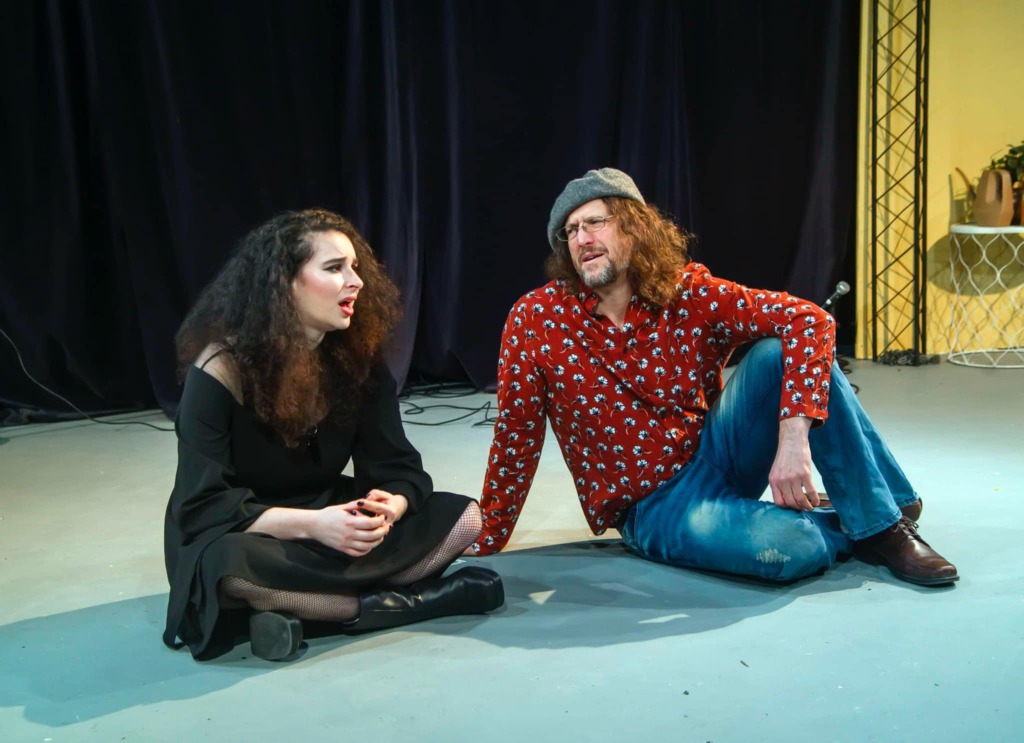
Unrequited love populates this production like nobody’s business. It’s like a modern soap quadrangle of tangled and messy heart-based affairs. Masha loves Constantine. Constantine loves Nina. Nina’s too young to know what love is but wants to be in the limelight so she loves Trigorin. Who is with but not necessarily in love with Irina, who loves him but loves herself more. And somewhere in there some other characters are having heartfelt feels— like Paulina lusting after the Doctor despite being married to Shamraeff and Medviedenko pining away for Masha like poor Helena of Midsummer. It’s one big sticky love-lust-based mess. And you see it and feel it most with Masha (Lily Tender) and Constantine (Marianne Virnelson) respectively, though not necessarily reciprocally of one another.
Virnelson’s Constantine is complex. Edgy and moody but desperate. And you get this astonishing sense of “tough exterior raw and tortured interior.” It’s exquisite. So when…things happen (because let’s not spoil events even though they are already known by a great many)… you really feel Constantine’s pain. The tears Virnelson sheds are visceral and you can feel them on a spiritual-emotional level. There’s also something catastrophically unhinged about the way Virnelson approaches Constantine. And although that character isn’t the character doing the drugs, you get the sense of a chemical imbalance in her portrayal and it really elevates the character’s experience as a whole. And her singing is pretty damn impressive too.
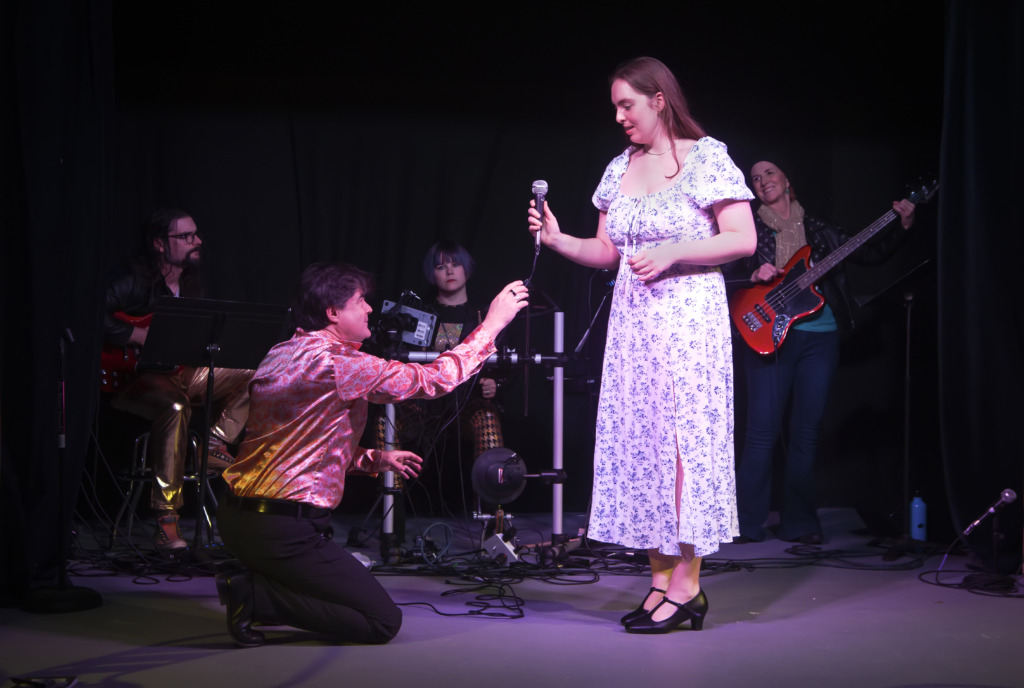
Lily Tender’s Masha is something visually and emotionally straight out of Cruel Intentions if that movie had a live-stage baby with Lydia Deetz from Beetlejuice and Wednesday Addams from The Addams Family. You get this emo-goth look— which is so much more than just the costume, hair, and makeup, it’s a whole attitude— like what ‘basic-bitch’ was in the 90’s before it got co-opted by the pumpkin spice latte generation. For this production, Tender’s Masha is not only an active character but somehow a narrative conduit for the audience. Never breeching that fourth wall, but directing us, guiding us like Chekhov’s beacon, if you will. Her vocals are glorious and perfectly suited for the melancholy music she expresses throughout the show and that moment at the very end when she delivers her final line— it’s harrowing in a glorious-trainwreck fashion. You know what’s coming, it’s haunting, disturbing, and sad, and yet Tender makes it oh so beautiful.
It’s a truly impressive approach to The Seagull. It’s both innovative and introspective. Melissa Schick’s approach to this piece feels complete; the idea fully expressed, the execution flawlessly set. Arguably one of the most polished classical-adjacent productions The Rudes have created on this side of the pandemic.
Running Time: 2 hours with one intermission
The Seagull plays through February 2nd 2025 with The Rude Mechanicals, in residence at The Greenbelt Arts Center— 123 Centerway in downtown Greenbelt, MD. For tickets call the box office at 301-441-8770 or purchase them online.