
Do you want to look into the bottom of your soul? How many of you would be okay with such a notion? What if you had no choice because you were a— Bad Seed? In a gripping drama, Cockpit in Court kicks off their 2025 summer season in the upstairs cabaret space with Bad Seed by Maxwell Anderson (based on the novel by William March.) Directed by Todd Pearthree, this spooky little tale may not be an Agatha Christie mystery, but it will certainly keep you on the edge of your seat.

If there’s a minor complaint to be had it’s with the play itself. The male characters are essentially throw-aways, with the exception of Leroy— and we’ll get to him— but because of that, some of the performances from the male actors aren’t entirely on the same level as those of the actresses, though that isn’t wholly the performers’ fault. And the fact that the play takes quite a while to really get going, gain momentum, and get interesting. Once it does, it’s quite the little thriller, but you’ll have to slog through some heavy expository setup for the reward, which ultimately is worth the wait, but bare that in mind and get yourself some snacks (possibly some wine) from the concession stand before heading in.
Stage Manager, doubling up as the show’s scenic & properties designer, Dan Morelli, does a decent job of keeping Todd Pearthree’s show on track; pacing is critical in a show like this; too rushed and you lose important details, too slow and you lose audience interest. Morelli strikes a balance, and while the expository introductions are somewhat of a slog, that’s just the way of plays written in and of that time period. Morelli’s scenic and property-designs are in-line with the times, and are kept simple but elegant. Heather Kohlbus further grounds the time stamp of the production into the show’s aesthetic with terrifically traditional 50’s garb, particularly for little miss Rhoda, and her mother Christine, and the nosy-neighbor Monica. All of the period pieces featured in this production are exceptionally well suited to the actors and really drive home the ‘bygone era’ notion that accompanies these types of dramas. Aaron S. Adams also deserves a nod of praise for simple but effective lighting, particularly those freeze-cues that highlight Rhoda’s face at the end of the first and second act; they’re quite frightening!
As mentioned, the menfolk aren’t given much to go on when it comes to having rigorously fleshed out dynamic existences within the context of that play but it doesn’t mean they don’t get an A-for-effort, particularly were Jeff Burch as Richard Bravo and Tom Burns as Reginald Tasker are concerned. (The other gents in the play— Brian Boys as Kenneth Penmark/Mr. Daigle, Joey Hellman as Emery— are just fine for their cameo-style character tracks.) Burch, who doesn’t arrive until the second act, has that avuncular-paternal joviality about his portrayal, right up until he doesn’t, when things are suddenly quite serious. And Burns’ Reginald Tasker has all the charm of a 1950’s gentleman, with all of the curious enthusiasm over someone who is just a little too interested in ghoulish things like murders and the nurture-vs-nature debate when it comes to despicable and deplorable behavior. Both deliver their characters with noticeable enthusiasm, though it presents itself in very different veins.
Leroy (Matthew Sean Mitchell) is the outlier amongst the male characters, the exception to the rule when it comes to Maxwell Anderson’s script. There are layers upon layers about this particular character, all squirreled away beneath the brutish and boorish exterior of ‘the help’ and hidden within the gruff accent, and smart-mouthed comments directed at Rhoda. The interactions that Mitchell exchanges with Rhoda (played by Mckenzie Nace) are unsettling, if for no other reason because of how calm and frighteningly mild mannered Nace remains, even when Mitchell is trying to rile her up; it elevates the heart rate and sets the hairs on the back of your neck standing straight up. Mitchell does an excellent job at flipping between the brash and mouthy interactions with Nace to the subservient ‘knows-his-place’ attitude that he’s forced to present when confronted by both Monica and Christine.
The textbook epitome of 1950’s logic is in play when it comes to Miss Fern (Holly Pasciullo.) In the scene where she’s attempting to explain to Christine why they in fact will not be having Rhoda back to her school next year, Pasciullo dances nervously all around the mulberry bush, saying everything and anything polite to keep the truth from surfacing. While the character may be written as a milquetoast plot-agenda, Pasciullo makes her almost fidgety, as if she’s the one with something to hide. It’s a unique approach to the character that makes Miss Fern more than static.
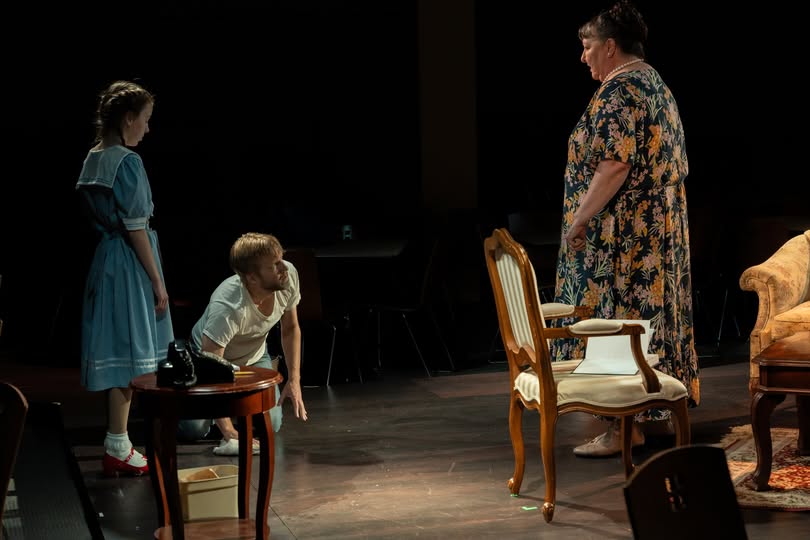
Life is a grim business and Monica Breedlove (Liz Boyer Hunnicutt) seems to have no issues being grim about it, ghoulish as her brother Emory calls it. Hunnicutt is a radiant gem in the ‘comic-relief’ role of the show, as some of the more humorous lines are laid upon her shoulders and delivered with great success. Hunnicutt has a strong, versatile stage presence, sliding easily into those more serious moments when the script calls for and she finds a way to humorously soften the hard-blown edges of the character’s self-deprecating nature. The character of Monica flits in and out of the scenes but every time she does, Hunnicutt ensures that you’re focusing on her, especially in those more maternal exchanges between her and Rhoda, despite not being the girl’s mother.
If you want the scene-stealer of the show, it’s Tammy Oppel, no question. Though she’s only really in two scenes, her spatial exuberance and bombastic tenacity permeates the whole show. Oppel delivers the epitome of a drunken, distraught 1950’s housewife, suffering an inconceivable loss and failing spectacularly at overcoming insurmountable grief. The drunken sway is perfected in her body language, her speech never slurring too far as to make her unintelligible. And she gets right up in Miss Fern’s face, Christine’s as well in a way that punches you hard in the gut and knocks the wind completely out of your sails. The time period would write her off as a housewife having a hysterics episode. But it’s beyond clear that Oppel is channeling the woman dangling by the very last frayed thread of her sanity and when she sobs, shrieking and collapsing to the floor your heart just bleeds for her. (This whole scene is completely offset by the burst of summer-wind that is Hunnicutt’s Monica who literally busts in thereafter with some silly line or other.) Tammy Oppel takes those two well-earned moments in the spotlight, delivering harrowing and unforgettably dramatic performances in each.
Christine (Lauren Hampton) is deceptively mild. When you first get a taste for the character, you sense that Hampton is channeling every 1950’s dark-drama/thriller screen actress ever seen in a film and balling it all up into one ‘every-woman’ of the time. The hesitancy to express emotion other than simple, happy feelings; the reservations at trying to be seen as calm and collected; the piqued curiosity that is dangerous but necessary; Hampton masters all of that, mostly in the first act. The dynamism of her portrayal really blows in full swing at the very end of Act I, when she’s confronting Rhoda about ‘the truth’ and then again when she has her full-blown meltdown in Act II. It’s compelling and really gripping. And the interplay between Hampton and Nace’s Rhoda puts the shivers up and down your spine most assuredly.
Mckenzie Nace will be sending the audience home with unsettling nightmares for ages. Think Linda Blair circa 1973. She’s sweet, earnest, and a little too-perfect when she’s trying to put her best smile and cheery disposition forward. Nace embraces the duality of the character with gusto and is not afraid to let that eerie, controlled fury slither into her speech patterns and body language. Watching her slow-stalk to the door and lock it, all while stoically but calmly saying “give me my shoes” to Emory is one of the most disturbing moments in the whole show. And when she has her little shrieking tantrum it’s equally upsetting. Nace has an exquisite stage presence and understands the nuances of the character, which makes the show that much more gripping to watch.
Malignant roots my be what survives on this earth in this day and age— but Cockpit in Court has this quaint little production of Bad Seed on its cabaret stage. And just like a wax rosebud or a plastic peach, it looks really pretty, imitating life, until you bite into it and uncover the true horrors that lie hidden beneath. Catch it before the month runs out if you’d like a good thrill this summer.
Running Time: Approximately 2 hours and 20 minutes with one intermission
Bad Seed plays through June 29th 2025 with Cockpit in Court in the upstairs Cabaret Space of The Robert and Eleanor Romadka College Center at the Community College of Baltimore County Essex Campus— 7201 Rossville Boulevard, Essex MD. For tickets call the box office at (443) 840-2787 or purchase them online.